












Front cover
文献情報
出版日
DOI
10.1039/C4CP90175D
インパクトファクター
3.676
著者
原文を見る
要旨
A graphical abstract is available for this content
関連文献
A DFT-design of single component bifunctional organocatalysts for the carbon dioxide/propylene oxide coupling reaction
Morad M. El-Hendawy, Ibtesam M. Desoky, Mahmoud M. A. Mohamed
2021-11-08
Paper
DOI: 10.1039/D1CP04091J
The ferromagnetic and anti-ferromagnetic phases (cubic, tetragonal, orthorhombic) of KMnF3. A quantum mechanical investigation
Fabien Pascale, Philippe D’Arco, Roberto Dovesi
2021-11-06
Paper
DOI: 10.1039/D1CP03816H
Clustering of metal dopants in defect sites of graphene-based materials
Krista G. Steenbergen, Nicola Gaston, Beate Paulus
2021-12-10
Paper
DOI: 10.1039/D1CP05008G
Appraising the potency of small molecule inhibitors and their graphene surface-mediated organizational attributes on uric acid–melamine clusters
Krishna Gopal Chattaraj, Sandip Paul
2021-11-29
Paper
DOI: 10.1039/D1CP03695E
Comment on “High-temperature superconductivity in transition metallic hydrides MH11 (M = Mo, W, Nb, and Ta) under high pressure” by M. Du, Z. Zhang, H. Song, H. Yu, T. Cui, V. Z. Kresinc and D. Duan, Phys. Chem. Chem. Phys., 2021, 23, 6717
X. H. Zheng, J. X. Zheng
2022-01-10
Comment
DOI: 10.1039/D1CP01474A
Analytically and empirically consistent characterization of the resistive switching mechanism in a Ag conducting-bridge random-access memory device through a pseudo-liquid interpretation approach
Yeon-Joon Choi, Suhyun Bang, Tae-Hyeon Kim, Kyungho Hong, Sungjoon Kim, Sungjun Kim, Seongjae Cho, Byung-Gook Park
2021-11-09
Paper
DOI: 10.1039/D1CP04637C
Outer-sphere electron transfer does not underpin B12-dependent olefinic reductive dehalogenation in anaerobes
2021-12-01
Paper
DOI: 10.1039/D1CP04632B
The determination of the HOR/HER reaction mechanism from experimental kinetic data
Karen Chan
2021-11-25
Perspective
DOI: 10.1039/D1CP04134G
Assessing doping strategies for monolayer MoS2 towards non-enzymatic detection of cortisol: a first-principles study
Gabriele Boschetto, Aida Todri-Sanial
2021-12-14
Paper
DOI: 10.1039/D1CP04116A
In silico investigation of DNA minor groove binding bibenzimidazoles in the context of UVA phototherapy
Andrew Hung
2021-12-06
Paper
DOI: 10.1039/D1CP04841D
こちらもおすすめ
化合物よくある質問
2-ヒドロキシ-5-ニトロベンジンブロモイドの代替品はありますか?
2-ヒドロキシ-5-ニトロベンジンブロモイドは特定の化学反応に適しているため、代替品は限られています。しかし、同様の構造を持つ2-ヒドロキシ-4-ニトロベンジン...
772-33-82-(Bromomethyl)-4-ni...
化合物よくある質問
N-(2-ブロモフェニル)-1-チロール-3-オキソ-3-(ピペリジニル)プロペン-2-イル)ベンゼンアミドを取り扱う際の実験室安全事項は何ですか?
N-(2-ブロモフェニル)-1-チロール-3-オキソ-3-(ピペリジニル)プロペン-2-イル)ベンゼンアミドは有毒で、皮膚や粘膜に刺激を与える可能性があります。...
1800044-77-2N-[(1Z)-1-(2-Bromoph...
化合物よくある質問
1,3プロパンジオール,2-[2-(2アミノ-6クロロ-9Hピリミジン-9-イル)エチル-1,1,2,2-D4]-2,3-ジアセタートの市場動向や研究トレンドはどうですか?
この化合物は、新規治療薬の開発に注目されています。市場では、その有効性と安全性が評価され、研究分野では、分子生物学と医薬化学の新たな発見が期待されています。
1020718-81-31,3-Propanediol, 2-[...
579-44-2Ethanone, 2-hydroxy-...
化合物よくある質問
Succinimidyl-alanyl-phenylalanyl-prolyl-phenylalanine 4-nitroanilide はどの業界で使用されていますか?
Succinimidyl-alanyl-phenylalanyl-prolyl-phenylalanine 4-nitroanilide は主に医薬品開発やポ...
128802-73-3succinimidyl-alanyl-...
化合物よくある質問
メチル6-アミノ-5-クロロピリジン-2-カーボイル酸について、適用される法規ガイドラインは何ですか?
メチル6-アミノ-5-クロロピリジン-2-カーボイル酸(CAS番号: 1256794-05-4)の使用には、GHS( Globally Harmonized S...
1256794-05-4Methyl 6-amino-5-chl...
化合物よくある質問
エチル4-(シクロ Pentagonyl)アミノ-2-メチル硫化基ピリミジン-5-カルボキシレートを取り扱う際の実験室安全事項は何ですか?
取り扱いには、耐薬品性の容器を使用し、通気性の良い場所で操作することを推奨します。漏れ時は、SDS(安全データシート)を参照して適切な措置を取ること。手洗いと洗...
211245-62-4ethyl 4-(cyclopentyl...
化合物よくある質問
(S)-3-ベンZYルピペリジン塩酸塩とは何ですか?
(S)-3-ベンZYルピペリジン塩酸塩は、CAS番号1258940-00-9で表される化合物です。これは、(S)-3-苯基哌啶的盐酸盐であり、主に医薬品の原料と...
1258940-00-9(S)-3-Phenylpiperidi...
化合物よくある質問
3,5-二甲基金剛胺の主な用途は何ですか?
3,5-二甲基金剛胺は、主に医薬品の原料として使用され、また抗うつ薬や抗アルツハイマー薬の開発に利用されます。さらに、化粧品や食品添加物の製造でも重要な役割を果...
19988-45-52-(2,3-Dihydroxyphen...
化合物よくある質問
ビス(4-メチル-2-ペンチル)フェニルカルボン酸エステルの代替品はありますか?
ビス(4-メチル-2-ペンチル)フェニルカルボン酸エステル (CAS番号: 1398066-13-1) の代替品には、ビス(2-エチルヘキシル)フェノールカルボ...
1398066-13-1Bis(4-methyl-2-penty...
掲載誌
Physical Chemistry Chemical Physics

CiteScore:
5.5
自己引用率:
10.3%
年間論文数:
3036
Physical Chemistry Chemical Physics (PCCP) is an international journal co-owned by 19 physical chemistry and physics societies from around the world. This journal publishes original, cutting-edge research in physical chemistry, chemical physics and biophysical chemistry. To be suitable for publication in PCCP, articles must include significant innovation and/or insight into physical chemistry; this is the most important criterion that reviewers and Editors will judge against when evaluating submissions. The journal has a broad scope and welcomes contributions spanning experiment, theory, computation and data science. Topical coverage includes spectroscopy, dynamics, kinetics, statistical mechanics, thermodynamics, electrochemistry, catalysis, surface science, quantum mechanics, quantum computing and machine learning. Interdisciplinary research areas such as polymers and soft matter, materials, nanoscience, energy, surfaces/interfaces, and biophysical chemistry are welcomed if they demonstrate significant innovation and/or insight into physical chemistry. Joined experimental/theoretical studies are particularly appreciated when complementary and based on up-to-date approaches.
おすすめ化合物
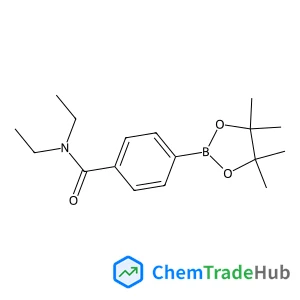
N,N-Diethyl-4-(4,4,5,5-tetramethyl-1,3,2-dioxaborolan-2-yl)benzamide
CAS番号:
325142-99-2
分子式:
C17H26BNO3
おすすめサプライヤー





免責事項
このページに表示される学術雑誌情報は、参考および研究目的のみを目的としています。当社は雑誌出版社とは提携しておらず、投稿の取り扱いも行っておりません。出版に関するお問い合わせは、各雑誌出版社に直接ご連絡ください。
表示されている情報に誤りがある場合は、support@chemtradehub.com までご連絡ください。迅速に確認し、対応いたします。