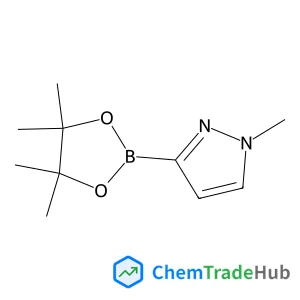
1-Methyl-3-(4,4,5,5-tetramethyl-1,3,2-dioxaborolan-2-yl)-1H-pyrazole
CAS番号:
1020174-04-2
分子式:
C10H17BN2O2
Kurt Kugler, Mareike Luhn, Jean André Schramm, Khosrow Rahimi
Nowadays NH3 is exclusively synthesized by the Haber process. Unfortunately, the energy demand and the CO2 emissions due to H2 production are high. Hydrogen production utilizes precious carbon sources such as coal and natural gas. In the past we proposed an alternative process concept using a membrane electrode assembly in an electrochemical membrane reactor (ecMR). At the anode H2O is oxidized at an IrMMO catalyst to form protons. By applying an external potential to the ecMR N2 is reduced to NH3 at the cathode. Just recently Rh and Ru were identified as possible cathodic electrocatalysts by DFT calculations. We present an easy and highly efficient method for galvanic coatings of Rh and Ru on randomly structured Ti felts to be used in a membrane electrode assembly. Linear sweep voltammetry measurements give a slightly higher activity of Ru for the liquid phase electrochemical NH3 synthesis. The NH4+ concentration reached is 8 times higher for Ru than for Rh. From an economical point of view, Ru is also more feasible for an electrochemical NH3 synthesis process. Such electrodes can now be evaluated in an ecMR in comparison to recently demonstrated Ti-based electrodes.
Vladimir I. Novoderezhkin, Elisabet Romero, Javier Prior, Rienk van Grondelle
DOI: 10.1039/C6CP07308E
Natasha W. Pettinger, Robert E. A. Williams, Jinquan Chen
DOI: 10.1039/C6CP08227K
Mandeep K. Chahal, Muniappan Sankar, Ray J. Butcher
DOI: 10.1039/C6CP08396J
P. Gast, D. Mance, E. Zurlo, M. Baldus, M. Huber
DOI: 10.1039/C6CP05864G
Denis S. Grebenkov, Gleb Oshanin
DOI: 10.1039/C6CP06102H
Yue Tong, Xiaowen Yu, Gaoquan Shi
DOI: 10.1039/C6CP08176B
Eesh Vaghela, M. J. Keshvani, Keval Gadani, Zalak Joshi, Hetal Boricha, K. Asokan, D. Venkateshwarlu, V. Ganesan, N. A. Shah, P. S. Solanki
DOI: 10.1039/C6CP07730G
Hao Jin, Jianwei Li, Ying Dai, Yadong Wei
DOI: 10.1039/C6CP08158D
Chao Wu, Qingxun Guo, Wujun Ma, Xiaoping Li, Panlong Qiu, Jianyong Hu, Qiang Wang
DOI: 10.1039/C6CP08334J
DOI: 10.1039/C6CP07271B
2-溴-9,9-二苯基芴は、医薬品、工業材料、有機合成の研究分野で応用されます。特に、レーザー材料や機能性ポリマーの合成に使用されることがあります。また、蛍光色...
四氯化铱の市場は研究開発分野で注目されており、特にナノ技術や金属有機框架(MOFs)の分野での需要が増加傾向にあります。価格は安定しており、中国や韓国での生産が...
1-(4-溴-3-氟苯基)-2-氯乙酮 (CAS番号: 1260857-14-4) の廃棄物は専門的な廃棄処理が必要です。まず、廃棄物は密閉された容器に収集し、...
苦参酚Kは、CAS番号101236-49-1を持つ化合物で、主に天然由来の生薬から抽出されます。この化合物は、抗炎症作用や抗癌作用を持つことが報告されています。
POTASSIUM (1-(TERTBUTOXYCARBONYL)AZETIDIN-3-YL)TRIFLUOROBORATE を含む廃棄物は、まず安全なエント...
4-庚基-4’-聯苯羧酸は、特殊化学品や合成化学の分野で用いられる化学物質ですが、市場動向としては、研究開発の進展とともに需要が増加しています。また、環境配慮型...
6-ブロモ-3-メトキシ-1-フェニル-1H-インドゾールを含む廃棄物は、適切な化学廃棄処理が必要です。通常、廃棄物は密閉容器に収集され、専門の廃棄処理業者に引...
4,4-二甲基-2-吡咯烷酮は医薬、ポリマー、センサー、半導体などの業界で広く使用されています。特に溶媒としての性能が高く評価されています。

Physical Chemistry Chemical Physics (PCCP) is an international journal co-owned by 19 physical chemistry and physics societies from around the world. This journal publishes original, cutting-edge research in physical chemistry, chemical physics and biophysical chemistry. To be suitable for publication in PCCP, articles must include significant innovation and/or insight into physical chemistry; this is the most important criterion that reviewers and Editors will judge against when evaluating submissions. The journal has a broad scope and welcomes contributions spanning experiment, theory, computation and data science. Topical coverage includes spectroscopy, dynamics, kinetics, statistical mechanics, thermodynamics, electrochemistry, catalysis, surface science, quantum mechanics, quantum computing and machine learning. Interdisciplinary research areas such as polymers and soft matter, materials, nanoscience, energy, surfaces/interfaces, and biophysical chemistry are welcomed if they demonstrate significant innovation and/or insight into physical chemistry. Joined experimental/theoretical studies are particularly appreciated when complementary and based on up-to-date approaches.

![4-{2-[4-(2-Methyl-2-propanyl)phenyl]ethoxy}quinazoline structure](https://static.chemtradehub.com/structs/120/120928-09-8-d3db.webp "4-{2-[4-(2-Methyl-2-propanyl)phenyl]ethoxy}quinazoline structure")