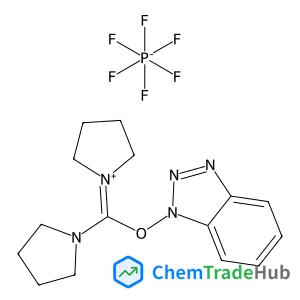
(1H-Benzotriazol-1-yloxy)(di-1-pyrrolidinyl)methylium hexafluorophosphate
CAS番号:
105379-24-6
分子式:
C15H21F6N5OP
Mengshuai Liu, Kunqi Gao, Lin Liang, Fangxiao Wang, Lei Shi, Li Sheng
Catalytic coupling of carbon dioxide with epoxides to obtain cyclic carbonates is an important reaction that has been receiving renewed interest. In this contribution, the cycloaddition reaction in the presence of various hydrogen bond donors (HBDs) catalyzed by hydroxyl/carboxyl task-specific ionic liquids (ILs) is studied in detail. It was found that the activity of ILs could be significantly enhanced in the presence of ethylene glycol (EG), and EG/HEBimBr were the most efficient catalysts for the CO2 cycloaddition to propylene oxide. Moreover, the binary catalysts were also efficiently versatile for the CO2 cycloaddition to less active epoxides such as styrene oxide and cyclohexene oxide. Besides, the minimum energy paths for this hydrogen bond-promoted catalytic reaction were calculated using the density functional theory (DFT) method. The DFT results suggested that the ring-closing reaction was the rate-determining step in the HEBimBr-catalyzed cycloaddition reaction but the EG addition could remarkably reduce its energy barrier as the formation of a hydrogen bond between EG and the oxygen atom of epoxides led this process along the standard SN2 mechanism. As a result, the ring-opening reaction became the rate-determining step in the EG/HEBimBr-catalyzed cycloaddition reaction. The work reported herein helped the understanding and design of catalysts for efficient fixation of CO2 to epoxides via hydrogen bond activation.
M. Rhia L. Stone, Urszula Łapińska, Stefano Pagliara, Muriel Masi, Joanne T. Blanchfield, Matthew A. Cooper, Mark A. T. Blaskovich
DOI: 10.1039/D0CB00118J
Jonathan Cramer, Xiaohua Jiang, Wojciech Schönemann, Marleen Silbermann, Pascal Zihlmann, Stefan Siegrist, Brigitte Fiege, Roman Peter Jakob, Said Rabbani, Timm Maier, Beat Ernst
DOI: 10.1039/D0CB00108B
Han Yao, Chushu Li, Fang He, Teng Song, Jean-Philippe Brosseau, Huanbin Wang, Haojie Lu, Caiyun Fang, Hubing Shi, Jiang Lan, Jing-Yuan Fang, Jie Xu
DOI: 10.1039/D0CB00157K
Tyrza van Leeuwen, Can Araman, Linda Pieper Pournara, Arieke S. B. Kampstra, Thomas Bakkum, Mikkel H. S. Marqvorsen, Clarissa R. Nascimento, G. J. Mirjam Groenewold, Willemijn van der Wulp, Marcel G. M. Camps, George M. C. Janssen, Peter A. van Veelen, Gerard J. P. van Westen, Antonius P. A. Janssen, Bogdan I. Florea, Herman S. Overkleeft, Ferry A. Ossendorp, René E. M. Toes, Sander I. van Kasteren
DOI: 10.1039/D1CB00009H
Haydn A. Little, Jake G. Carter, Craig Douglas, Matthew R. Hicks, David M. Kenyon, Christophe Lacomme, Richard T. Logan, Timothy R. Dafforn, James H. R. Tucker
DOI: 10.1039/D0CB00135J
Mikhail A. Kabeshov, Biagia Musio, Steven V. Ley
DOI: 10.1039/C7RE00164A
Qiang Xiao, Dallin S. Ashton, Zachary B. Jones, Katherine P. Thompson, Joshua L. Price
DOI: 10.1039/D0CB00075B
2-メトキシ-4-(メチルスルフィニル)アミンは、主に医薬品および農薬の製造に使用されます。また、合成化学の一部として研究用材料としても利用されます。
代替品としては、4,6-二クロロピラミジンアミンや他のピラミジン系化合物が考えられます。ただし、目的と用途によって最適な代替品は異なります。
6-氯-4-甲基-1H-吲哚の廃棄物は、適切な容器に収集し、密閉して保管します。温度は常温、湿度は低く、直射日光を避けて保管することを推奨します。廃棄処理は専門...
2-フローユロ-4-(トリフルオロメチル)ベンゾイドのCAS番号は207974-08-1です。この化合物はGHS分類で毒性物質と有害な反応物質として分類されます...
4-ニトロフェニルN-[(ベンゼルオキシルカーボンイル]グリシングリシングリシン酸は、室温で暗所に保管し、乾燥した環境で保存することを推奨します。容器は密閉性の...
イソデスロラタドリンの代替品としては、デスロラタドリンや他の抗ヒスタミン薬が挙げられます。具体的には、デスロラタドリン、ラセカミド、フェルタドリンなどが、症状や...
5-甲氧基-1,2,3,4-四氢异喹啉盐酸盐の一般的な合成方法は、メタノール中で5-メトキシ-1,2,3,4-四ヒュドロイソキシンを塩酸で塩化します。この反応で...
CAS番号6471-78-9の4-アミノ-5-メトキシ-2-トルエンサルホニック酸は、GHS分類では corrosive(腐食性)と識別されます。EUのREAC...
甲基孕酮の取り扱いは、PPE(個人保護具)の使用が必要な重要な安全事項を伴います。防塵マスク、ゴーグル、手袋を着用することが推奨されます。ドラフトチャンバーを使...

Physical Chemistry Chemical Physics (PCCP) is an international journal co-owned by 19 physical chemistry and physics societies from around the world. This journal publishes original, cutting-edge research in physical chemistry, chemical physics and biophysical chemistry. To be suitable for publication in PCCP, articles must include significant innovation and/or insight into physical chemistry; this is the most important criterion that reviewers and Editors will judge against when evaluating submissions. The journal has a broad scope and welcomes contributions spanning experiment, theory, computation and data science. Topical coverage includes spectroscopy, dynamics, kinetics, statistical mechanics, thermodynamics, electrochemistry, catalysis, surface science, quantum mechanics, quantum computing and machine learning. Interdisciplinary research areas such as polymers and soft matter, materials, nanoscience, energy, surfaces/interfaces, and biophysical chemistry are welcomed if they demonstrate significant innovation and/or insight into physical chemistry. Joined experimental/theoretical studies are particularly appreciated when complementary and based on up-to-date approaches.
![[4-(Heptyloxy)phenyl]boronic acid structure](https://static.chemtradehub.com/structs/136/136370-19-9-ad33.webp "[4-(Heptyloxy)phenyl]boronic acid structure")