












Knitting up 2,7-disubstituted carbazole based oligomers through supramolecular interactions for their application in organic thin film transistors
文献情報
出版日
2015-01-13
DOI
10.1039/C4CP05241B
インパクトファクター
3.676
著者
Ranjodh Singh, Chung-Shu Wu, Fu-Hsiang Ko
原文を見る
要旨
For the design and development of organic electronic devices, the main focus is particularly on the synthesis of new organic semiconductors and dielectric materials. Molecular engineering is another effective strategy, in this direction which has been explored successfully in this study through synthesis of a π-conjugated oligomer CbzTPAU2, with Mw = 2169. This bow shaped oligomer has its core unit made of 2,7-disubstituted carbazole which further has been connected to its end-terminal unit TPAU2 by 1,4-bis(decyloxy)-2,5-diethynylbenzene. The presence of a uracil moiety on end terminals of CbzTPAU2 has triggered the self-assembly of CbzTPAU2 molecules through knitting up of each of these single units through four Uracil–Uracil intermolecular hydrogen bonds (U⋯U) per CbzTPAU2 unit. An Atomic Force Microscope (AFM) study was employed to explore the directionality of hydrogen bonding. Further, the effect of solvent polarity on the stability of U⋯U bonding in CbzTPAU2 oligomers has also been reported here in this study. The potential of these self-assembled CbzTPAU2 oligomers when explored as charge transporting layers in OTFTs has shown p-type behaviour. The OTFT device bottom-gate, top-contact when fabricated on the heavily doped n-type Si wafer with SiO2 as a gate dielectric (200 nm) has shown a good on/off ratio 3.43 × 10³ and with an average hole mobility of 0.167 cm2 V−1 s−1.
関連文献
Light-induced modulation of DNA recognition by the Rad4/XPC damage sensor protein
Amirrasoul Tavakoli, Debamita Paul, Hong Mu, Jagannath Kuchlyan, Saroj Baral, Anjum Ansari, Suse Broyde, Jung-Hyun Min
2021-01-06
Paper
DOI: 10.1039/D0CB00192A
Stapling proteins in the RELA complex inhibits TNFα-induced nuclear translocation of RELA
Smit Kour, Sandeep Rana, Smitha Kizhake, David Klinkebiel, Jayapal Reddy Mallareddy, Tom Huxford
2021-10-28
Communication
DOI: 10.1039/D1CB00183C
The chemical biology of coronavirus host–cell interactions
Suprama Datta, Erik C. Hett, Kalpit A. Vora, Rob C. Oslund, Olugbeminiyi O. Fadeyi, Andrew Emili
2020-12-23
Review Article
DOI: 10.1039/D0CB00197J
Measuring ROS and redox markers in plant cells
Edward N. Smith, Emily Flashman
2021-06-29
Review Article
DOI: 10.1039/D1CB00071C
A two-step resin based approach to reveal survivin-selective fluorescent probes
Andrew J. Ambrose, Nhan T. Pham, Jared Sivinski, Niloufar Mollasalehi, Paula Jimenez, Maria A. Abad, A. Arockia Jeyaprakash, Steven Shave, Letícia V. Costa-Lotufo, James J. La Clair, Manfred Auer, Eli Chapman
2020-11-27
Communication
DOI: 10.1039/D0CB00122H
Elongation rate and average length of amyloid fibrils in solution using isotope-labelled small-angle neutron scattering
Ben J. Eves, James J. Doutch, Ann E. Terry, Han Yin, Martine Moulin, Michael Haertlein, David M. Dias, Gudrun Lotze, Annela M. Seddon, Adam M. Squires
2021-04-14
Paper
DOI: 10.1039/D1CB00001B
Combining bacteriophage engineering and linear dichroism spectroscopy to produce a DNA hybridisation assay
Haydn A. Little, Jake G. Carter, Craig Douglas, Matthew R. Hicks, David M. Kenyon, Christophe Lacomme, Richard T. Logan, Timothy R. Dafforn, James H. R. Tucker
2020-10-23
Paper
DOI: 10.1039/D0CB00135J
A STING-based fluorescent polarization assay for monitoring activities of cyclic dinucleotide metabolizing enzymes
Caroline W. Karanja, Kofi S. Yeboah, Wilson W. S. Ong
2020-12-17
Paper
DOI: 10.1039/D0CB00187B
Medicinal chemistry of the myeloid C-type lectin receptors Mincle, Langerin, and DC-SIGN
Jonathan Cramer
2021-09-16
Review Article
DOI: 10.1039/D1MD00238D
Membrane composition and lipid to protein ratio modulate amyloid kinetics of yeast prion protein
Arnab Bandyopadhyay, Achinta Sannigrahi, Krishnananda Chattopadhyay
2021-02-05
Paper
DOI: 10.1039/D0CB00203H
こちらもおすすめ
化合物よくある質問
2-メトキシ-4-(メチルスルフィニル)アミンの主な用途は何ですか?
2-メトキシ-4-(メチルスルフィニル)アミンは、主に医薬品および農薬の製造に使用されます。また、合成化学の一部として研究用材料としても利用されます。
41608-73-52-Methoxy-4-(methyls...
118684-13-24-(Bromomethyl)-3-me...
化合物よくある質問
4,6-二氯-N-甲基ピラミジンアミンの代替品はありますか?
代替品としては、4,6-二クロロピラミジンアミンや他のピラミジン系化合物が考えられます。ただし、目的と用途によって最適な代替品は異なります。
10397-15-64,6-Dichloro-N-methy...
化合物よくある質問
6-氯-4-甲基-1H-吲哚を含む廃棄物はどのように処理すべきですか?
6-氯-4-甲基-1H-吲哚の廃棄物は、適切な容器に収集し、密閉して保管します。温度は常温、湿度は低く、直射日光を避けて保管することを推奨します。廃棄処理は専門...
885520-84-36-chloro-4-methyl-1H...
化合物よくある質問
2-フローユロ-4-(トリフルオロメチル)ベンゾイドについて「に適用される法規ガイドラインは何ですか」
2-フローユロ-4-(トリフルオロメチル)ベンゾイドのCAS番号は207974-08-1です。この化合物はGHS分類で毒性物質と有害な反応物質として分類されます...
207974-08-1[2-Fluoro-4-(trifluo...
化合物よくある質問
4-ニトロフェニルN-[(ベンゼルオキシルカーボンイル]グリシングリシングリシン酸はどのように保存すればよいですか?
4-ニトロフェニルN-[(ベンゼルオキシルカーボンイル]グリシングリシングリシン酸は、室温で暗所に保管し、乾燥した環境で保存することを推奨します。容器は密閉性の...
19811-64-44-Nitrophenyl N-[(be...
化合物よくある質問
イソデスロラタドリンの代替品はありますか?
イソデスロラタドリンの代替品としては、デスロラタドリンや他の抗ヒスタミン薬が挙げられます。具体的には、デスロラタドリン、ラセカミド、フェルタドリンなどが、症状や...
183198-49-4Iso Desloratadine
化合物よくある質問
5-甲氧基-1,2,3,4-四氢异喹啉盐酸盐はどのように合成されますか?
5-甲氧基-1,2,3,4-四氢异喹啉盐酸盐の一般的な合成方法は、メタノール中で5-メトキシ-1,2,3,4-四ヒュドロイソキシンを塩酸で塩化します。この反応で...
103030-69-95-Methoxy-1,2,3,4-te...
化合物よくある質問
4-アミノ-5-メトキシ-2-トルエンサルホニック酸についての法規ガイドラインは何ですか?
CAS番号6471-78-9の4-アミノ-5-メトキシ-2-トルエンサルホニック酸は、GHS分類では corrosive(腐食性)と識別されます。EUのREAC...
6471-78-94-Amino-5-Methoxy-2-...
化合物よくある質問
甲基孕酮を取り扱う際の実験室安全事項は何ですか?
甲基孕酮の取り扱いは、PPE(個人保護具)の使用が必要な重要な安全事項を伴います。防塵マスク、ゴーグル、手袋を着用することが推奨されます。ドラフトチャンバーを使...
204063-33-22-[(Diphenylmethyl)a...
掲載誌
Physical Chemistry Chemical Physics

CiteScore:
5.5
自己引用率:
10.3%
年間論文数:
3036
Physical Chemistry Chemical Physics (PCCP) is an international journal co-owned by 19 physical chemistry and physics societies from around the world. This journal publishes original, cutting-edge research in physical chemistry, chemical physics and biophysical chemistry. To be suitable for publication in PCCP, articles must include significant innovation and/or insight into physical chemistry; this is the most important criterion that reviewers and Editors will judge against when evaluating submissions. The journal has a broad scope and welcomes contributions spanning experiment, theory, computation and data science. Topical coverage includes spectroscopy, dynamics, kinetics, statistical mechanics, thermodynamics, electrochemistry, catalysis, surface science, quantum mechanics, quantum computing and machine learning. Interdisciplinary research areas such as polymers and soft matter, materials, nanoscience, energy, surfaces/interfaces, and biophysical chemistry are welcomed if they demonstrate significant innovation and/or insight into physical chemistry. Joined experimental/theoretical studies are particularly appreciated when complementary and based on up-to-date approaches.
おすすめ化合物
![4-{2-[4-(2-Methyl-2-propanyl)phenyl]ethoxy}quinazoline structure](https://static.chemtradehub.com/structs/120/120928-09-8-d3db.webp "4-{2-[4-(2-Methyl-2-propanyl)phenyl]ethoxy}quinazoline structure")

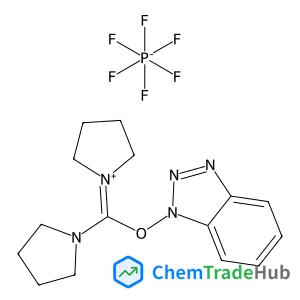
(1H-Benzotriazol-1-yloxy)(di-1-pyrrolidinyl)methylium hexafluorophosphate
CAS番号:
105379-24-6
分子式:
C15H21F6N5OP
おすすめサプライヤー






免責事項
このページに表示される学術雑誌情報は、参考および研究目的のみを目的としています。当社は雑誌出版社とは提携しておらず、投稿の取り扱いも行っておりません。出版に関するお問い合わせは、各雑誌出版社に直接ご連絡ください。
表示されている情報に誤りがある場合は、support@chemtradehub.com までご連絡ください。迅速に確認し、対応いたします。