












Characterization and preparation of bio-tubular scaffolds for fabricating artificial vascular grafts by combining electrospinning and a 3D printing system
文献情報
出版日
2014-12-18
DOI
10.1039/C4CP04801F
インパクトファクター
3.676
著者
Dong Nyoung Heo, Ji Sun Park, Jin Ho Lee, Jun Hee Lee, Wan Doo Kim, Il Keun Kwon, Su A. Park
原文を見る
要旨
The last decade has seen artificial blood vessels composed of natural polymer nanofibers grafted into human bodies to facilitate the recovery of damaged blood vessels. However, electrospun nanofibers (ENs) of biocompatible materials such as chitosan (CTS) suffer from poor mechanical properties. This study describes the design and fabrication of artificial blood vessels composed of a blend of CTS and PCL ENs and coated with PCL strands using rapid prototyping technology. The resulting tubular vessels exhibited excellent mechanical properties and showed that this process may be useful for vascular reconstruction.
関連文献
Adsorbing the 3d-transition metal atoms to effectively modulate the electronic and magnetic behaviors of zigzag SiC nanoribbons
Hui Li, Wei Chen, Xiaopeng Shen, Jingwei Liu, Xuri Huang, Guangtao Yu
2017-01-03
Paper
DOI: 10.1039/C6CP06717D
Nanoparticle–nanoparticle vs. nanoparticle–substrate hot spot contributions to the SERS signal: studying Raman labelled monomers, dimers and trimers
Kamila Moor, Kristina Gudun, Zarina Yelemessova, Rostislav Bukasov
2016-12-15
Paper
DOI: 10.1039/C6CP08254H
Ionic liquids and deep eutectic solvents for lignocellulosic biomass fractionation
Dannie J. G. P. van Osch, Laura J. B. M. Kollau, Sari Asikainen, Marisa A. A. Rocha
2016-12-02
Perspective
DOI: 10.1039/C6CP07499E
The decomposition of benzenesulfonyl azide: a matrix isolation and computational study
Guohai Deng, Xuelin Dong, Qifan Liu, Dingqing Li, Hongmin Li, Qiao Sun, Xiaoqing Zeng
2017-01-11
Paper
DOI: 10.1039/C6CP08125H
Room-temperature ferromagnetism in the two-dimensional layered Cu2MoS4 nanosheets
Ke Zhang, Rashid Khan, Hongyan Guo, Irfan Ali, Xiuling Li, Yunxiang Lin, Haiping Chen, Wensheng Yan, Xiaojun Wu, Li Song
2016-12-12
Communication
DOI: 10.1039/C6CP07270D
Novel high-temperature ferroelectric domain morphology in PbTiO3 ultrathin films
Dorothy M. Duffy
2017-01-13
Paper
DOI: 10.1039/C6CP08157F
Fast and accurate MAS–DNP simulations of large spin ensembles
Shimon Vega
2017-01-05
Paper
DOI: 10.1039/C6CP07881H
Intracellular water – an overlooked drug target? Cisplatin impact in cancer cells probed by neutrons
A. L. M. Batista de Carvalho, V. Garcia Sakai, L. Hatter, L. A. E. Batista de Carvalho
2016-11-24
Paper
DOI: 10.1039/C6CP05198G
Cobalt disulfide/graphite foam composite films as self-standing electrocatalytic electrodes for overall water splitting
Yue Tong, Xiaowen Yu, Gaoquan Shi
2017-01-16
Paper
DOI: 10.1039/C6CP08176B
こちらもおすすめ
化合物よくある質問
2-ブロモ-9,9-ジフェニル-9H-フルオレンの主な用途は何ですか?
2-溴-9,9-二苯基芴は、医薬品、工業材料、有機合成の研究分野で応用されます。特に、レーザー材料や機能性ポリマーの合成に使用されることがあります。また、蛍光色...
474918-32-62-Bromo-9,9-diphenyl...
化合物よくある質問
四氯化铱の市場動向や研究トレンドはどうですか?
四氯化铱の市場は研究開発分野で注目されており、特にナノ技術や金属有機框架(MOFs)の分野での需要が増加傾向にあります。価格は安定しており、中国や韓国での生産が...
207399-11-9Tetrachloroiridium h...
882-06-44-Nitrocinnamic acid
化合物よくある質問
1-(4-溴-3-氟苯基)-2-氯乙酮を含む廃棄物はどのように処理すべきですか?
1-(4-溴-3-氟苯基)-2-氯乙酮 (CAS番号: 1260857-14-4) の廃棄物は専門的な廃棄処理が必要です。まず、廃棄物は密閉された容器に収集し、...
1260857-14-41-(4-Bromo-3-fluorop...
化合物よくある質問
苦参酚Kとは何ですか?
苦参酚Kは、CAS番号101236-49-1を持つ化合物で、主に天然由来の生薬から抽出されます。この化合物は、抗炎症作用や抗癌作用を持つことが報告されています。
101236-49-1Kushenol K
化合物よくある質問
POTASSIUM (1-(TERTBUTOXYCARBONYL)AZETIDIN-3-YL)TRIFLUOROBORATE を含む廃棄物はどのように処理すべきですか?
POTASSIUM (1-(TERTBUTOXYCARBONYL)AZETIDIN-3-YL)TRIFLUOROBORATE を含む廃棄物は、まず安全なエント...
1430219-73-0Potassium (1-(tert-b...
化合物よくある質問
4-庚基-4’-联苯羧酸の市場動向や研究トレンドはどうですか?
4-庚基-4’-聯苯羧酸は、特殊化学品や合成化学の分野で用いられる化学物質ですが、市場動向としては、研究開発の進展とともに需要が増加しています。また、環境配慮型...
58573-94-74'-Heptyl-4-biphenyl...
化合物よくある質問
6-ブロモ-3-メトキシ-1-フェニル-1H-インドゾールを含む廃棄物はどのように処理すべきですか?
6-ブロモ-3-メトキシ-1-フェニル-1H-インドゾールを含む廃棄物は、適切な化学廃棄処理が必要です。通常、廃棄物は密閉容器に収集され、専門の廃棄処理業者に引...
1332527-03-36-Bromo-3-methoxy-1-...
化合物よくある質問
4,4-二甲基-2-吡咯烷酮はどの業界で使用されていますか?
4,4-二甲基-2-吡咯烷酮は医薬、ポリマー、センサー、半導体などの業界で広く使用されています。特に溶媒としての性能が高く評価されています。
66899-02-34,4-dimethylpyrrolid...
51312-42-6Sodium Phosphotungst...
掲載誌
Physical Chemistry Chemical Physics

CiteScore:
5.5
自己引用率:
10.3%
年間論文数:
3036
Physical Chemistry Chemical Physics (PCCP) is an international journal co-owned by 19 physical chemistry and physics societies from around the world. This journal publishes original, cutting-edge research in physical chemistry, chemical physics and biophysical chemistry. To be suitable for publication in PCCP, articles must include significant innovation and/or insight into physical chemistry; this is the most important criterion that reviewers and Editors will judge against when evaluating submissions. The journal has a broad scope and welcomes contributions spanning experiment, theory, computation and data science. Topical coverage includes spectroscopy, dynamics, kinetics, statistical mechanics, thermodynamics, electrochemistry, catalysis, surface science, quantum mechanics, quantum computing and machine learning. Interdisciplinary research areas such as polymers and soft matter, materials, nanoscience, energy, surfaces/interfaces, and biophysical chemistry are welcomed if they demonstrate significant innovation and/or insight into physical chemistry. Joined experimental/theoretical studies are particularly appreciated when complementary and based on up-to-date approaches.
おすすめ化合物

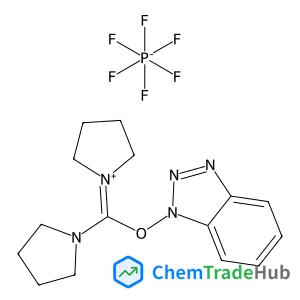
(1H-Benzotriazol-1-yloxy)(di-1-pyrrolidinyl)methylium hexafluorophosphate
CAS番号:
105379-24-6
分子式:
C15H21F6N5OP
おすすめサプライヤー




免責事項
このページに表示される学術雑誌情報は、参考および研究目的のみを目的としています。当社は雑誌出版社とは提携しておらず、投稿の取り扱いも行っておりません。出版に関するお問い合わせは、各雑誌出版社に直接ご連絡ください。
表示されている情報に誤りがある場合は、support@chemtradehub.com までご連絡ください。迅速に確認し、対応いたします。