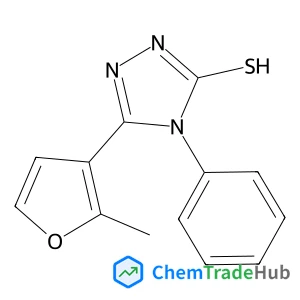
5-(2-Methyl-3-furyl)-4-phenyl-2,4-dihydro-3H-1,2,4-triazole-3-thione
CAS番号:
346464-59-3
分子式:
C13H11N3OS
Shintaro Takata, Yoshihiro Miura
Using an ultra-high vacuum (UHV) electrochemistry approach with pulsed laser deposition (PLD), we investigated the band-gap state for TiO2(110). In the PLD chamber, a TiO2(110) surface was cleaned by annealing in O2 enough for it to exhibit a sharp (1 × 1) reflection high energy electron diffraction (RHEED) pattern. The cleaned TiO2(110)-(1 × 1) sample then underwent electrochemical measurements without exposure to air, showing the band-gap state at −0.14 V vs. Ag by Mott–Schottky plot analysis. The band-gap state gradually disappeared under UV illumination at +0.6 V vs. Ag due to photoetching, and reappeared on reduction in a vacuum and/or deposition of a fresh TiO2 film. These results indicated that the electrochemically observed band-gap state for TiO2(110) was a defect state due to oxygen deficiency, most probably identical to that observed under UHV, which does not necessarily exist on the surface. A quantitative analysis of the defect density suggests that the origin of this defect state is not the surface bridging hydroxyls or oxygen vacancies, but rather the interstitial Ti3+ ions in the subsurface region.
Hong Xie, Kaiyue Duan, Muyin Xue, Yongling Du, Chunming Wang
DOI: 10.1039/C6AN00545D
Jingni Fu, Changqin Ding, Anwei Zhu
DOI: 10.1039/C6AN00981F
Amber S. Moody, Taylor D. Payne, Brian A. Barth, Bhavya Sharma
DOI: 10.1039/C9AN01708A
Wushuang Bai, Qinglin Sheng, Jianbin Zheng
DOI: 10.1039/C6AN00632A
Jorge M. G. Sarraguça, Catarina Lima, Filipe Machado, João A. Lopes, Agostinho Almeida, Luís Fernandes
DOI: 10.1039/C6AN00247A
Xiaoya Ma
DOI: 10.1039/C9AN02271F
Linfeng Chen, Xike Tian, Yuan Zhao, Yong Li, Chao Yang, Zhaoxin Zhou
DOI: 10.1039/C6AN00740F
Hyewon Seo
DOI: 10.1039/C9AN02213A
Ji Eun Song, Ji Hoon Park, Ju A. La, Seyeon Park, Min Kuk Jeong, Eun Chul Cho
DOI: 10.1039/C6AN00399K
取り扱いにはPPE(プロテクティブ・パーソナル・エイド)が必要で、防ぐ手袋と保護眼鏡を着用してください。ドラフトチャンバーの使用を推奨します。漏洩した場合は、適...
この化合物の代替品としては、BOC保護基を有さないアミノ酸やその他の保護基化合物が考えられます。また、メチオキシ基を有しない他の芳香族アミノ酸も代替品として挙げ...
Methyl 2-(chloromethyl)-3-nitrobenzoate(1218910-61-2)の代替品としては、化学組成を変えることで効果を達成する...
(2R)-2-アミノ-N-ベンジル-3-ヒドロキシプロパナミドを含む廃棄物は、適切な廃棄物管理ガイドラインに基づき処理する必要があります。まず、廃棄物を適切に収...
6,7-二氢-咪唑並[1,2-a]ピリドイン-8(5h)-酮は、2-ブロモフェニルアセトインとリン酸ハロゲン化物を反応させることで合成できます。この反応は高温で...
エチル(3R)-3-ピロリジニル酢酸水和塩は、CAS番号1332459-32-1の化合物で、(R)-乙基2-(ピロリジン-3-基)酢酸塩水和塩と呼ばれます。この...
(2S)-{[(2-メチルエチルオキシ]カルボニル}アミノ)[2-(トリアフルオロメチルフェニル]エチカシック酸のCAS番号は1203454-45-8です。この...
2-ブロモ-1-(2-メチル-2-プロパニル)-4-ニトロベンゼンは、直射日光を避けて暗所で、室温(約15℃〜25℃)、乾燥した場所に保存する必要があります。ま...
市場動向としては、1-[(4-硝基フェニル)スルホニル]-1H-1,2,4-三唑は主に農業用除草剤や合成化学製品の原料として利用されています。研究トレンドとして...

Physical Chemistry Chemical Physics (PCCP) is an international journal co-owned by 19 physical chemistry and physics societies from around the world. This journal publishes original, cutting-edge research in physical chemistry, chemical physics and biophysical chemistry. To be suitable for publication in PCCP, articles must include significant innovation and/or insight into physical chemistry; this is the most important criterion that reviewers and Editors will judge against when evaluating submissions. The journal has a broad scope and welcomes contributions spanning experiment, theory, computation and data science. Topical coverage includes spectroscopy, dynamics, kinetics, statistical mechanics, thermodynamics, electrochemistry, catalysis, surface science, quantum mechanics, quantum computing and machine learning. Interdisciplinary research areas such as polymers and soft matter, materials, nanoscience, energy, surfaces/interfaces, and biophysical chemistry are welcomed if they demonstrate significant innovation and/or insight into physical chemistry. Joined experimental/theoretical studies are particularly appreciated when complementary and based on up-to-date approaches.
![Benzeneacetic acid, 2-bromo-α-[[(1,1-dimethylethoxy)carbonyl]amino]-, (αS)- structure](https://static.chemtradehub.com/structs/122/1228547-87-2-f296.webp "Benzeneacetic acid, 2-bromo-α-[[(1,1-dimethylethoxy)carbonyl]amino]-, (αS)- structure")