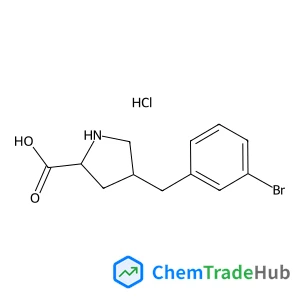
(2S,4R)-4-(3-Bromobenzyl)pyrrolidine-2-carboxylic acid hydrochloride
CAS番号:
1049734-10-2
分子式:
C12H15BrClNO2
Pilar Redondo, Antonio Largo, Víctor Manuel Rayón, Germán Molpeceres, José Ángel Sordo, Carmen Barrientos
The reactions, in the gas phase, between alkali-earth monocations (Mg+, Ca+, Sr+, Ba+) and CH3X (X = Cl, Br) have been theoretically studied. The stationary points on the potential energy surfaces were characterized at the Density Functional Theory level on the framework of the mPW1K functional with the QZVPP Ahlrichs's basis sets. A complementary kinetics study has also been performed using conventional/variational microcanonical transition state theory. In the reactions of Mg+ with either chloro- or bromomethane the transition structure lies in energy clearly above the reactants rendering thermal activation of CH3Cl or CH3Br extremely improbable. The remaining reactions are exothermic and barrierless processes; thus carbon–halogen bonds in chloro- or bromomethane can be activated by calcium, strontium or barium monocations to obtain the metal halogen cation and the methyl radical. The Mulliken population analysis for the stationary points of the potential energy surfaces supports a “harpoon”-like mechanism for the halogen-atom abstraction processes. An analysis of the bonding situation for the stationary points on the potential energy surface has also been performed in the framework of the quantum theory of atoms in molecules.
Gustavo A. Garcia, Bérenger Gans, Julia Krüger, Anja Röder, Allan Lopes, Christa Fittschen, Christian Alcaraz, Jean-Christophe Loison
DOI: 10.1039/C8CP00510A
Ernst R. H. van Eck, Arno P. M. Kentgens
DOI: 10.1039/C8CP00603B
Jingwen Zhu, Emilie-Laure Zins, Mohammad Esmail Alikhani
DOI: 10.1039/C8CP01970C
Eric Michoulier, Aude Simon, Joëlle Mascetti, Céline Toubin
DOI: 10.1039/C8CP00593A
Chao Xu, Le Yu, Feng Long Gu
DOI: 10.1039/C8CP02767F
J. Laisney, H. J. Shepherd, L. Rechignat, G. Molnár, E. Rivière, M.-L. Boillot
DOI: 10.1039/C8CP02376J
Ryuhei Harada, Yasuteru Shigeta
DOI: 10.1039/C8CP02246A
Xinju Pan, Gang Zhou
DOI: 10.1039/C7CP08112J
Qiang Shao, Weiliang Zhu
DOI: 10.1039/C8CP03156H
4'-ブロモビフェニル-3-メトークシーディ.ActionBarは、冷暗所で、直射日光を避け、密栓の容器に保存し、遠隔場所に保管してください。温度は常温(0〜2...
2-異丙基フェニルヒドラジン塩酸塩は、CAS番号58928-82-8を有する化合物で、構造式はC11H14N2HClです。これは塩基性化合物であり、水に溶けやす...
5-(4-クロロフェニル)-4H-1,2,4-三氮唑-3-アミンは取り扱いに注意が必要です。PPEとして防塵マスク、ゴーグル、手袋を使用し、ドラフトチャンバーを...
去甲基雷贝拉唑硫醚は、ベンジミダゾール硫化物と3-メチル-4-ピリジノールの反応によって合成されます。具体的には、2-チオキシドベンジミダゾールと3-メチル-4...
2-ブロモ-5-フロロ-N-(2-フェノールメチル)ベンゼンウレアは、毒性や刺激性の実験データに基づき、適切な取扱いと防護措置を講じることで安全に使用できます。...
対甲苯磺酸酯-四聚乙二醇-四氢吡喃醚のCAS番号は86259-89-4です。この化合物は無色の液体で、分子量は約724.8です。高濃度では溶血性が報告されており...
2-(3-(二氟甲基)-4-氟苯基)-4,4,5,5-四甲基-1,3,2-二噁硼戊環は、室温で暗い場所に保管し、直射日光から遠ざけ、容器は密閉状態で保存してくだ...
この化合物の代替品には、ピロリミジン酸やその類似物、またピロリミジンカルボン酸の他の異性体があります。これらの代替品は、特定の化学反応や目的に応じて選択すること...
5-クロロベンゾ[1,3]二オキセイン-4-アミンはCAS番号379228-45-2に該当します。この化合物はGHS分類でH314(接触により急性毒性がある)と...

Physical Chemistry Chemical Physics (PCCP) is an international journal co-owned by 19 physical chemistry and physics societies from around the world. This journal publishes original, cutting-edge research in physical chemistry, chemical physics and biophysical chemistry. To be suitable for publication in PCCP, articles must include significant innovation and/or insight into physical chemistry; this is the most important criterion that reviewers and Editors will judge against when evaluating submissions. The journal has a broad scope and welcomes contributions spanning experiment, theory, computation and data science. Topical coverage includes spectroscopy, dynamics, kinetics, statistical mechanics, thermodynamics, electrochemistry, catalysis, surface science, quantum mechanics, quantum computing and machine learning. Interdisciplinary research areas such as polymers and soft matter, materials, nanoscience, energy, surfaces/interfaces, and biophysical chemistry are welcomed if they demonstrate significant innovation and/or insight into physical chemistry. Joined experimental/theoretical studies are particularly appreciated when complementary and based on up-to-date approaches.