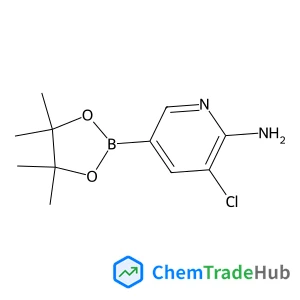
3-Chloro-5-(4,4,5,5-tetramethyl-1,3,2-dioxaborolan-2-yl)-2-pyridinamine
CAS番号:
1032758-99-8
分子式:
C11H16BClN2O2
Jaroslaw Kalinowski, Markku Räsänen
High-level quantum chemical calculations reported here predict the existence and remarkable stability, of chemically-bound xenon atoms in fibrous silica. The results may support the suggestion of Sanloup and coworkers that chemically-bound xenon and silica account for the problem of “missing xenon” (by a factor of 20!) from the atmospheres of Earth and Mars. So far, the host silica was assumed to be quartz, which is in contradiction with theory. The xenon-fibrous silica molecule is computed to be stable well beyond room temperature. The calculated Raman spectra of the species agree well with the main features of the experiments by Sanloup et al. The results predict computationally the existence of a new family of noble-gas containing materials. The fibrous silica species are finite molecules, their laboratory preparation should be feasible, and potential applications are possible.
DOI: 10.1039/C7CP07701G
A. J. Ocaña, S. Blázquez, A. Canosa, M. Antiñolo
DOI: 10.1039/C7CP07868D
Xiaolu Xiong, Guangshi Li, Hongwei Cheng, Qian Xu
DOI: 10.1039/C8CP00873F
Marcileia Zanatta, Jairton Dupont, Gabriela Negruni Wentz, Francisco P. dos Santos
DOI: 10.1039/C8CP00066B
Sjoerd A. Veldhuis, Xin Yu Chin, Natalia Yantara, Xiaodong Chen
DOI: 10.1039/C7CP07827G
Hao Wu, David Reens, Tim Langen, Yuval Shagam, Daniela Fontecha, Jun Ye
DOI: 10.1039/C8CP00962G
Ericmoore Jossou, Ubong Eduok, Nelson Y. Dzade, Barbara Szpunar, Jerzy A. Szpunar
DOI: 10.1039/C7CP07154J
Diego Coglitore, Andrea Merenda, Nicoletta Giamblanco, Ludovic F. Dumée, Jean-Marc Janot, Sébastien Balme
DOI: 10.1039/C8CP01787E
Andrés Arango-Restrepo, Daniel Barragán, J. Miguel Rubi
DOI: 10.1039/C7CP08469B
2-ヒドロキシ-5-ニトロベンジンブロモイドは特定の化学反応に適しているため、代替品は限られています。しかし、同様の構造を持つ2-ヒドロキシ-4-ニトロベンジン...
N-(2-ブロモフェニル)-1-チロール-3-オキソ-3-(ピペリジニル)プロペン-2-イル)ベンゼンアミドは有毒で、皮膚や粘膜に刺激を与える可能性があります。...
この化合物は、新規治療薬の開発に注目されています。市場では、その有効性と安全性が評価され、研究分野では、分子生物学と医薬化学の新たな発見が期待されています。
Succinimidyl-alanyl-phenylalanyl-prolyl-phenylalanine 4-nitroanilide は主に医薬品開発やポ...
メチル6-アミノ-5-クロロピリジン-2-カーボイル酸(CAS番号: 1256794-05-4)の使用には、GHS( Globally Harmonized S...
取り扱いには、耐薬品性の容器を使用し、通気性の良い場所で操作することを推奨します。漏れ時は、SDS(安全データシート)を参照して適切な措置を取ること。手洗いと洗...
(S)-3-ベンZYルピペリジン塩酸塩は、CAS番号1258940-00-9で表される化合物です。これは、(S)-3-苯基哌啶的盐酸盐であり、主に医薬品の原料と...
3,5-二甲基金剛胺は、主に医薬品の原料として使用され、また抗うつ薬や抗アルツハイマー薬の開発に利用されます。さらに、化粧品や食品添加物の製造でも重要な役割を果...
ビス(4-メチル-2-ペンチル)フェニルカルボン酸エステル (CAS番号: 1398066-13-1) の代替品には、ビス(2-エチルヘキシル)フェノールカルボ...

Physical Chemistry Chemical Physics (PCCP) is an international journal co-owned by 19 physical chemistry and physics societies from around the world. This journal publishes original, cutting-edge research in physical chemistry, chemical physics and biophysical chemistry. To be suitable for publication in PCCP, articles must include significant innovation and/or insight into physical chemistry; this is the most important criterion that reviewers and Editors will judge against when evaluating submissions. The journal has a broad scope and welcomes contributions spanning experiment, theory, computation and data science. Topical coverage includes spectroscopy, dynamics, kinetics, statistical mechanics, thermodynamics, electrochemistry, catalysis, surface science, quantum mechanics, quantum computing and machine learning. Interdisciplinary research areas such as polymers and soft matter, materials, nanoscience, energy, surfaces/interfaces, and biophysical chemistry are welcomed if they demonstrate significant innovation and/or insight into physical chemistry. Joined experimental/theoretical studies are particularly appreciated when complementary and based on up-to-date approaches.