












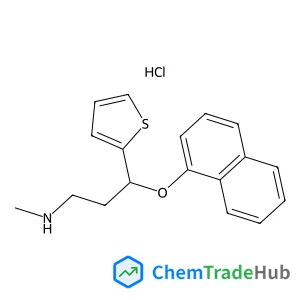
N-Methyl-3-(1-naphthyloxy)-3-(2-thienyl)-1-propanamine hydrochloride (1:1)
CAS番号:
1188266-11-6
分子式:
C18H20ClNOS
Yuriy Uvaydov, Nicholas E. Geacintov, Vladimir Shafirovich
A direct method has been developed for the in vitro synthesis of stable DNA–protein cross-links (DPC's) between guanine and amino acids (lysine and arginine). This method employs the combination of guanine neutral radicals, G(–H)˙, and side-chain C-centered amino acid radicals. The latter were generated indirectly after first causing the selective photoionization of 2-aminopurine (2AP) embedded in the oligonucleotide, 5′-d(CC[2AP]TCGCTACC), by intense nanosecond 308 nm excimer laser pulses. The 2AP radical cation deprotonates rapidly to form the 2AP(–H)˙ neutral radical which, in turn, oxidizes the nearby guanine to form the neutral guanine G(–H)˙ radical, as described previously (Shafirovich et al., J. Phys. Chem. B, 2001, 105, 8431). In parallel, the hydrated electrons, generated by the photoionization of 2AP, are scavenged by nitrous oxide to generate hydroxyl radicals. In the presence of a large excess of the amino acids, the hydroxyl radicals oxidize the latter to produce C-centered amino acid radicals that combine with the G(–H)˙ radicals to form the guanine–amino acid cross-linked oligonucleotide product. Analogous products were generated by photoionizing the free nucleoside, 2′,3′,5′-tri-O-acetylguanosine, (tri-O-Ac-Guo), using intense nanosecond 266 nm Nd:YAG laser pulse irradiation. The guanine–amino acid cross-links thus produced site-specifically positioned either in oligonucleotides, or in the free nucleoside tri-O-Ac-Guo were isolated by HPLC methods and identified by high resolution LC-TOF/MS and LC-MS/MS methods. The possibility that analogous guanine–amino acid cross-linked products could be formed in vivo using single hit radical generation mechanisms during oxidative stress is discussed.
Till Uhlemann, Jens Wallauer, Karl-Michael Weitzel
DOI: 10.1039/C5CP02266E
Gregory J. Dutton, Steven W. Robey
DOI: 10.1039/C5CP02800K
Zhen Liu, Frank Endres
DOI: 10.1039/C5CP01472G
Romain Gautier, Luc Bousset, Ronald Melki, Stefano Vanni
DOI: 10.1039/C5CP00244C
Yu-Tsung Lin, Hsien-Ching Chung, Po-Hua Yang, Shih-Yang Lin, Ming-Fa Lin
DOI: 10.1039/C5CP02226F
Kai Zhang, Chunyan Li, Yang Zhao, Xianbo Yu, Yujin Chen
DOI: 10.1039/C5CP02028J
V. D. Gordon, T. J. O'Halloran, O. Shindell
DOI: 10.1039/C4CP05876C
Yan Qian, Shaohua Lu, Erjun Kan, Ruifeng Lu, Kaiming Deng, Hui Wang, Yanming Ma
DOI: 10.1039/C5CP01601K
Veronika Horká-Zelenková, Jozef Rakovský, Petr Pracna, Ondrej Votava
DOI: 10.1039/C5CP00425J
カルボニル基が付いた5-氰基-1-{[(2-メチル-2-プロpanyl)オキシ]カーボンイル}1H-吲哚-2-イリド-2-ボリン酸は、直射日光を避けて室温(15...
この化合物は合成化学分野において、特にピリジン化合物の合成や改良に用いられます。最近の研究では、ピリジン化合物の新規合成法や特性の改良が注目されています。市場動...
聚二季戊四醇六丙烯酸酯は、医薬品、ポリマー、センサー、半導体などの業界で広く使用されています。特にポリマー業界では硬化剤として、医薬分野では医療機器の製造に使用...
1-氯-5-硝基异喹啉は、薬理学や合成化学の研究分野で注目されています。市場動向としては、その生物学的な活性や合成可能性を評価する研究が増えています。また、代替...
2-チロール-5-メチルスルフェニル-3-trifルオルメチルベンゼンは、トリフルオロメチル化反応と硫化反応を経て合成されます。通常、トリフルオロメチル化剤と硫...
p-トールイルマグネシウムブロミドのCAS番号は4294-57-9です。この化合物は白色の結晶性粉末で、分子量は204.32です。溶剤中で良好に溶解しますが、水...
1-(5-甲基-2-硫化素基)プロパン-1-酮の市場動向は、化学産業全体の需要に影響を受けますが、最近では pharmaceutical 分野での応用が注目され...
十一碳烯酰甘氨酸は吸入や皮膚から吸収されることがあり、取り扱う際には防塵マスクと手袋を使用してください。ドラフトチャンバーを用いて漏洩を処理し、適切なSDS(S...
この化合物は吸入や皮膚吸収による毒性があるため、防塵マスク、ゴーグル、防護手袋を使用する必要があります。ドラフトチャンバーでの操作が必要です。漏洩時には即座に換...
安全性は化合物の使用方法によります。直接的な毒性は報告されていませんが、吸入や皮膚接触には注意が必要です。適切な防護服を着用し、換気を図ることを推奨します。

Physical Chemistry Chemical Physics (PCCP) is an international journal co-owned by 19 physical chemistry and physics societies from around the world. This journal publishes original, cutting-edge research in physical chemistry, chemical physics and biophysical chemistry. To be suitable for publication in PCCP, articles must include significant innovation and/or insight into physical chemistry; this is the most important criterion that reviewers and Editors will judge against when evaluating submissions. The journal has a broad scope and welcomes contributions spanning experiment, theory, computation and data science. Topical coverage includes spectroscopy, dynamics, kinetics, statistical mechanics, thermodynamics, electrochemistry, catalysis, surface science, quantum mechanics, quantum computing and machine learning. Interdisciplinary research areas such as polymers and soft matter, materials, nanoscience, energy, surfaces/interfaces, and biophysical chemistry are welcomed if they demonstrate significant innovation and/or insight into physical chemistry. Joined experimental/theoretical studies are particularly appreciated when complementary and based on up-to-date approaches.
![(2R,6S)-6-[(Benzyloxy)methyl]-4-{[(2-methyl-2-propanyl)oxy]carbonyl}-2-morpholinecarboxylic acid structure](https://static.chemtradehub.com/structs/109/1093085-91-6-3382.webp "(2R,6S)-6-[(Benzyloxy)methyl]-4-{[(2-methyl-2-propanyl)oxy]carbonyl}-2-morpholinecarboxylic acid structure")
![1-{3-[4-Amino-3-(4-phenoxyphenyl)-1H-pyrazolo[3,4-d]pyrimidin-1-yl]-1-piperidinyl}-2,3-dihydroxy-1-propanone structure](https://static.chemtradehub.com/structs/122/1226872-27-0-e037.webp "1-{3-[4-Amino-3-(4-phenoxyphenyl)-1H-pyrazolo[3,4-d]pyrimidin-1-yl]-1-piperidinyl}-2,3-dihydroxy-1-propanone structure")






