












Dissecting the steps of CO2 reduction: 1. The interaction of CO and CO2 with γ-Al2O3: an in situ FTIR study
文献情報
出版日
2014-05-29
DOI
10.1039/C4CP00616J
インパクトファクター
3.676
著者
János Szanyi, Ja Hun Kwak
原文を見る
要旨
The adsorption of CO2 and CO was investigated on a pure γ-Al2O3 support material that has been used in Pd and Ru catalysts for the reduction of CO2. The adsorption of CO2 resulted in the formation of carbonates, bicarbonates and linearly adsorbed CO2 species. The amount and the nature of the adsorbed species were dependent on the annealing temperature of the alumina support. On γ-Al2O3 annealed at 473 K mostly bicarbonates formed, while no adsorbed CO2 was seen on this highly hydroxylated surface. With increasing calcination temperature the amount of both surface carbonates and linearly adsorbed CO2 increased, but still the most abundant surface species were bicarbonates. Surface carbonates and adsorbed CO2 can readily be removed from the alumina surface, while bicarbonates are stable to elevated temperatures. The interaction of CO with γ-Al2O3 is much weaker than that of CO2. At room temperature CO adsorbs only on Lewis acid sites, and can be readily removed by evacuation. At 100 K CO can probe different defect sites on the alumina surface. Under no conditions we have observed the formation of any carbonates or bicarbonates upon the interaction of CO with the pure alumina support. In co-adsorption experiments CO competes for adsorption sites with the linearly adsorbed CO2 on the 773 K-annealed γ-Al2O3 surface, but it does not result in the desorption of CO2, rather in the increased production of weakly held carbonates. After the removal of adsorbed CO, CO2 moves back to its original adsorption sites, i.e., Lewis acidic Al3+ centers. The exposure of a CO2-saturated γ-Al2O3 to H2O did not affect any of the adsorbed surface species. The findings of this study will be used to rationalize the results of our ongoing in situ and in operando studies on the reduction of CO2 on supported Pd and Ru catalysts.
関連文献
Effect of a single methyl substituent on the electronic structure of cobaltocene studied by computationally assisted MATI spectroscopy
Sergey Yu. Ketkov, Sheng-Yuan Tzeng, Elena A. Rychagova, Anton N. Lukoyanov, Wen-Bih Tzeng
2023-12-05
Paper
DOI: 10.1039/D3CP05120J
Non-equilibrium magnetic properties of a mixed spin (1/2, 1) Ising graphene nanoisland
Bayram Deviren, Seyma Akkaya Deviren, Tevfik Fikret Yagmuroglu
2023-11-24
Paper
DOI: 10.1039/D3CP04785G
Coexistence of topological node surface and Dirac fermions in phonon-mediated superconductor YB2C2
Siqi Wang, Mingmin Zhong, Haibo Liu, Meng Ju
2023-11-14
Paper
DOI: 10.1039/D3CP03678B
Utilization of the through-space effect to design donor–acceptor systems of pyrrole, indole, isoindole, azulene and aniline
2023-12-18
Paper
DOI: 10.1039/D3CP03393G
Refining protein amide I spectrum simulations with simple yet effective electrostatic models for local wavenumbers and dipole derivative magnitudes
Cesare M. Baronio, Andreas Barth
2023-12-15
Paper
DOI: 10.1039/D3CP02018E
Peroxidase activity of a Cu–Fe bimetallic hydrogel and applications for colorimetric detection of ascorbic acid
Xiao-Juan Wang, Yan Long, Chuan-Wan Wei, Shu-Qin Gao
2023-12-05
Paper
DOI: 10.1039/D3CP05403A
Exploiting the photophysical features of DMAN template in ITQ-51 zeotype in the search for FRET energy transfer
Ainhoa Oliden-Sánchez, Rebeca Sola-Llano, Joaquín Pérez-Pariente, Luis Gómez-Hortigüela, Virginia Martínez-Martínez
2023-12-07
Paper
DOI: 10.1039/D3CP02625F
こちらもおすすめ
化合物よくある質問
2-メトキシ-4-(メチルスルフィニル)アミンの主な用途は何ですか?
2-メトキシ-4-(メチルスルフィニル)アミンは、主に医薬品および農薬の製造に使用されます。また、合成化学の一部として研究用材料としても利用されます。
41608-73-52-Methoxy-4-(methyls...
118684-13-24-(Bromomethyl)-3-me...
化合物よくある質問
4,6-二氯-N-甲基ピラミジンアミンの代替品はありますか?
代替品としては、4,6-二クロロピラミジンアミンや他のピラミジン系化合物が考えられます。ただし、目的と用途によって最適な代替品は異なります。
10397-15-64,6-Dichloro-N-methy...
化合物よくある質問
6-氯-4-甲基-1H-吲哚を含む廃棄物はどのように処理すべきですか?
6-氯-4-甲基-1H-吲哚の廃棄物は、適切な容器に収集し、密閉して保管します。温度は常温、湿度は低く、直射日光を避けて保管することを推奨します。廃棄処理は専門...
885520-84-36-chloro-4-methyl-1H...
化合物よくある質問
2-フローユロ-4-(トリフルオロメチル)ベンゾイドについて「に適用される法規ガイドラインは何ですか」
2-フローユロ-4-(トリフルオロメチル)ベンゾイドのCAS番号は207974-08-1です。この化合物はGHS分類で毒性物質と有害な反応物質として分類されます...
207974-08-1[2-Fluoro-4-(trifluo...
化合物よくある質問
4-ニトロフェニルN-[(ベンゼルオキシルカーボンイル]グリシングリシングリシン酸はどのように保存すればよいですか?
4-ニトロフェニルN-[(ベンゼルオキシルカーボンイル]グリシングリシングリシン酸は、室温で暗所に保管し、乾燥した環境で保存することを推奨します。容器は密閉性の...
19811-64-44-Nitrophenyl N-[(be...
化合物よくある質問
イソデスロラタドリンの代替品はありますか?
イソデスロラタドリンの代替品としては、デスロラタドリンや他の抗ヒスタミン薬が挙げられます。具体的には、デスロラタドリン、ラセカミド、フェルタドリンなどが、症状や...
183198-49-4Iso Desloratadine
化合物よくある質問
5-甲氧基-1,2,3,4-四氢异喹啉盐酸盐はどのように合成されますか?
5-甲氧基-1,2,3,4-四氢异喹啉盐酸盐の一般的な合成方法は、メタノール中で5-メトキシ-1,2,3,4-四ヒュドロイソキシンを塩酸で塩化します。この反応で...
103030-69-95-Methoxy-1,2,3,4-te...
化合物よくある質問
4-アミノ-5-メトキシ-2-トルエンサルホニック酸についての法規ガイドラインは何ですか?
CAS番号6471-78-9の4-アミノ-5-メトキシ-2-トルエンサルホニック酸は、GHS分類では corrosive(腐食性)と識別されます。EUのREAC...
6471-78-94-Amino-5-Methoxy-2-...
化合物よくある質問
甲基孕酮を取り扱う際の実験室安全事項は何ですか?
甲基孕酮の取り扱いは、PPE(個人保護具)の使用が必要な重要な安全事項を伴います。防塵マスク、ゴーグル、手袋を着用することが推奨されます。ドラフトチャンバーを使...
204063-33-22-[(Diphenylmethyl)a...
掲載誌
Physical Chemistry Chemical Physics

CiteScore:
5.5
自己引用率:
10.3%
年間論文数:
3036
Physical Chemistry Chemical Physics (PCCP) is an international journal co-owned by 19 physical chemistry and physics societies from around the world. This journal publishes original, cutting-edge research in physical chemistry, chemical physics and biophysical chemistry. To be suitable for publication in PCCP, articles must include significant innovation and/or insight into physical chemistry; this is the most important criterion that reviewers and Editors will judge against when evaluating submissions. The journal has a broad scope and welcomes contributions spanning experiment, theory, computation and data science. Topical coverage includes spectroscopy, dynamics, kinetics, statistical mechanics, thermodynamics, electrochemistry, catalysis, surface science, quantum mechanics, quantum computing and machine learning. Interdisciplinary research areas such as polymers and soft matter, materials, nanoscience, energy, surfaces/interfaces, and biophysical chemistry are welcomed if they demonstrate significant innovation and/or insight into physical chemistry. Joined experimental/theoretical studies are particularly appreciated when complementary and based on up-to-date approaches.
おすすめ化合物
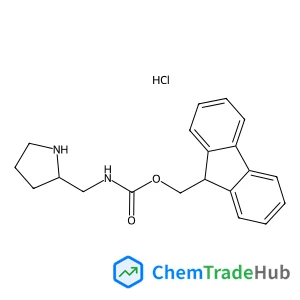
(S)-(9H-Fluoren-9-yl)methyl (pyrrolidin-2-ylmethyl)carbamate hydrochloride
CAS番号:
1217813-15-4
分子式:
C20H23ClN2O2
おすすめサプライヤー






免責事項
このページに表示される学術雑誌情報は、参考および研究目的のみを目的としています。当社は雑誌出版社とは提携しておらず、投稿の取り扱いも行っておりません。出版に関するお問い合わせは、各雑誌出版社に直接ご連絡ください。
表示されている情報に誤りがある場合は、support@chemtradehub.com までご連絡ください。迅速に確認し、対応いたします。