












Comparison of transflection and transmission FTIR imaging measurements performed on differentially fixed tissue sections
文献情報
出版日
2015-02-03
DOI
10.1039/C4AN02034K
インパクトファクター
4.616
著者
Miguel de la Guardia, Matti Kiupel, Bayden R. Wood
原文を見る
要旨
The widespread and cost-effective use of transflection substrates in Fourier transform infrared (FTIR) imaging of clinical samples is affected by the presence of artefacts including the electric field standing wave (EFSW) and contributions from light dispersion. For IR-based diagnostics, the manifestation of undesirable artifacts can distort the spectra and lead to erroneous diagnosis. Nevertheless, there is no clear consensus in the literature about the degree of influence of these effects. The aim of this work is to contribute to this discussion by comparing transflection and transmission images of the same tissue. For this purpose two adjacent sections of the same tissue (lymphoma sample) were fixed onto a CaF2 window and a transflective slide for FTIR imaging. The samples in this case had a central area where based on morphology it was presumed the fixative did not penetrate to the same extent hence providing a comparable region for the two different substrates with a distinct physical/chemical difference. Transmission and transflection spectra from adjacent hyperspectral tissue images were combined in an extended dataset. Surprisingly, unsupervised hierarchical cluster analysis clustered together transflection and transmission spectra, being classified according to differences in tissue fixation instead of the geometry employed for the image acquisition. A more detailed examination of spectra from the peripheral zone of the tissue indicated that the main differences between the transflection and transmission spectra were: (1) a small shift of the amide I, (2) a larger “noise” component in the transflection spectra requiring more averaging to obtain representative spectra of tissue types, and (3) the phosphate bands were generally higher in absorbance in the transflection measurements compared to the transmission ones. The amide I shift and the larger spectral variance was consistent with results obtained in previous studies where the EFWS was present. The findings indicate that artifacts resulting from transflection measurements were small but consistent across the tissue, and therefore the use of transflection measurements could be employed for disease diagnosis. Accordingly, we recommend a straightforward multivariate comparison of images from transmission and transflection measurements in a combined data matrix obtained from adjacent sections of the tissue as a useful preliminary study for establishing the impact of the EFWS on the samples, before considering the routine use of transflection substrates for any new tissue studied.
関連文献
t-Bu-Amphos–RhCl3·3H2O: a highly recyclable catalyst system for the cross-coupling of aldehydes and aryl- and alkenylboronic acids in aqueous solvents
Rongcai Huang, Kevin H. Shaughnessy
2005-08-03
Communication
DOI: 10.1039/B509406B
First snapshot of a nonpolymeric hydrogelator interacting with its gelling solvents
D. Krishna Kumar, D. Amilan Jose, Amitava Das, Parthasarathi Dastidar
2005-07-13
Communication
DOI: 10.1039/B506941F
Organogel of an 8-quinolinol platinum(ii) chelate derivative and its efficient phosphorescence emission effected by inhibition of dioxygen quenching
Michihiro Shirakawa, Norifumi Fujita, Takahiro Tani, Kenji Kaneko, Seiji Shinkai
2005-07-04
Communication
DOI: 10.1039/B506148B
Self-repairing polymers: poly(dioxaborolane)s containing trigonal planar boron
Weijun Niu, Caroline O'Sullivan, Brett M. Rambo, Mark D. Smith, John J. Lavigne
2005-07-28
Communication
DOI: 10.1039/B504634C
Enantiomerically pure P-chiral phosphinoselenoic chlorides: inversion of configuration at the P-chirogenic center in the synthesis and reaction of these substances
Tsutomu Kimura, Toshiaki Murai
2005-07-13
Communication
DOI: 10.1039/B507755A
MCuB7O12·nH2O (M = Na, K ): A new copper borate with 14-ring channels
Tao Yang, Guobao Li, Liping You, Jing Ju, Fuhui Liao, Jianhua Lin
2005-07-26
Communication
DOI: 10.1039/B506901G
Virus–glycopolymer conjugates by copper(i) catalysis of atom transfer radical polymerization and azide–alkyne cycloaddition
Sayam Sen Gupta, Krishnaswami S. Raja, Eiton Kaltgrad, Erica Strable, M. G. Finn
2005-07-19
Communication
DOI: 10.1039/B502444G
Electrochemical detection of Arachis hypogaea (peanut) agglutinin binding to monovalent and clustered lactosyl motifs immobilized on a polypyrrole film
Chantal Gondran, Olivier Renaudet, Pascal Dumy, Hugues Driguez, Sébastien Fort, Serge Cosnier
2005-07-14
Communication
DOI: 10.1039/B506699A
Injectable biodegradable hydrogels composed of hyaluronic acid–tyramine conjugates for drug delivery and tissue engineering
Motoichi Kurisawa, Joo Eun Chung, Yi Yan Yang, Shu Jun Gao, Hiroshi Uyama
2005-07-28
Communication
DOI: 10.1039/B506989K
2-Phenallyl as a versatile protecting group for the asymmetric one-pot three-component synthesis of propargylamines
Nina Gommermann, Paul Knochel
2005-07-26
Communication
DOI: 10.1039/B507810E
こちらもおすすめ
化合物よくある質問
2-メトキシ-4-(メチルスルフィニル)アミンの主な用途は何ですか?
2-メトキシ-4-(メチルスルフィニル)アミンは、主に医薬品および農薬の製造に使用されます。また、合成化学の一部として研究用材料としても利用されます。
41608-73-52-Methoxy-4-(methyls...
118684-13-24-(Bromomethyl)-3-me...
化合物よくある質問
4,6-二氯-N-甲基ピラミジンアミンの代替品はありますか?
代替品としては、4,6-二クロロピラミジンアミンや他のピラミジン系化合物が考えられます。ただし、目的と用途によって最適な代替品は異なります。
10397-15-64,6-Dichloro-N-methy...
化合物よくある質問
6-氯-4-甲基-1H-吲哚を含む廃棄物はどのように処理すべきですか?
6-氯-4-甲基-1H-吲哚の廃棄物は、適切な容器に収集し、密閉して保管します。温度は常温、湿度は低く、直射日光を避けて保管することを推奨します。廃棄処理は専門...
885520-84-36-chloro-4-methyl-1H...
化合物よくある質問
2-フローユロ-4-(トリフルオロメチル)ベンゾイドについて「に適用される法規ガイドラインは何ですか」
2-フローユロ-4-(トリフルオロメチル)ベンゾイドのCAS番号は207974-08-1です。この化合物はGHS分類で毒性物質と有害な反応物質として分類されます...
207974-08-1[2-Fluoro-4-(trifluo...
化合物よくある質問
4-ニトロフェニルN-[(ベンゼルオキシルカーボンイル]グリシングリシングリシン酸はどのように保存すればよいですか?
4-ニトロフェニルN-[(ベンゼルオキシルカーボンイル]グリシングリシングリシン酸は、室温で暗所に保管し、乾燥した環境で保存することを推奨します。容器は密閉性の...
19811-64-44-Nitrophenyl N-[(be...
化合物よくある質問
イソデスロラタドリンの代替品はありますか?
イソデスロラタドリンの代替品としては、デスロラタドリンや他の抗ヒスタミン薬が挙げられます。具体的には、デスロラタドリン、ラセカミド、フェルタドリンなどが、症状や...
183198-49-4Iso Desloratadine
化合物よくある質問
5-甲氧基-1,2,3,4-四氢异喹啉盐酸盐はどのように合成されますか?
5-甲氧基-1,2,3,4-四氢异喹啉盐酸盐の一般的な合成方法は、メタノール中で5-メトキシ-1,2,3,4-四ヒュドロイソキシンを塩酸で塩化します。この反応で...
103030-69-95-Methoxy-1,2,3,4-te...
化合物よくある質問
4-アミノ-5-メトキシ-2-トルエンサルホニック酸についての法規ガイドラインは何ですか?
CAS番号6471-78-9の4-アミノ-5-メトキシ-2-トルエンサルホニック酸は、GHS分類では corrosive(腐食性)と識別されます。EUのREAC...
6471-78-94-Amino-5-Methoxy-2-...
化合物よくある質問
甲基孕酮を取り扱う際の実験室安全事項は何ですか?
甲基孕酮の取り扱いは、PPE(個人保護具)の使用が必要な重要な安全事項を伴います。防塵マスク、ゴーグル、手袋を着用することが推奨されます。ドラフトチャンバーを使...
204063-33-22-[(Diphenylmethyl)a...
掲載誌
Analyst

CiteScore:
7.8
自己引用率:
5.6%
年間論文数:
653
Analyst publishes analytical and bioanalytical research that reports premier fundamental discoveries and inventions, and the applications of those discoveries, unconfined by traditional discipline barriers.
おすすめ化合物
![4-[(2-{2-[2-(2-Aminoethoxy)ethoxy]ethoxy}ethyl)amino]-2-(2,6-dioxo-3-piperidinyl)-1H-isoindole-1,3(2H)-dione structure](https://static.chemtradehub.com/structs/209/2093416-31-8-3162.webp "4-[(2-{2-[2-(2-Aminoethoxy)ethoxy]ethoxy}ethyl)amino]-2-(2,6-dioxo-3-piperidinyl)-1H-isoindole-1,3(2H)-dione structure")
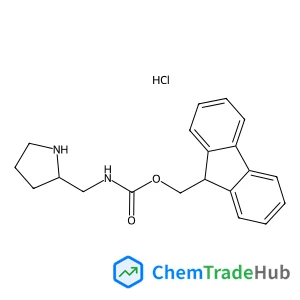
(S)-(9H-Fluoren-9-yl)methyl (pyrrolidin-2-ylmethyl)carbamate hydrochloride
CAS番号:
1217813-15-4
分子式:
C20H23ClN2O2

おすすめサプライヤー





免責事項
このページに表示される学術雑誌情報は、参考および研究目的のみを目的としています。当社は雑誌出版社とは提携しておらず、投稿の取り扱いも行っておりません。出版に関するお問い合わせは、各雑誌出版社に直接ご連絡ください。
表示されている情報に誤りがある場合は、support@chemtradehub.com までご連絡ください。迅速に確認し、対応いたします。