












Universal electronics for miniature and automated chemical assays
文献情報
出版日
2014-12-09
DOI
10.1039/C4AN02013H
インパクトファクター
4.616
著者
原文を見る
要旨
This minireview discusses universal electronic modules (generic programmable units) and their use by analytical chemists to construct inexpensive, miniature or automated devices. Recently, open-source platforms have gained considerable popularity among tech-savvy chemists because their implementation often does not require expert knowledge and investment of funds. Thus, chemistry students and researchers can easily start implementing them after a few hours of reading tutorials and trial-and-error. Single-board microcontrollers and micro-computers such as Arduino, Teensy, Raspberry Pi or BeagleBone enable collecting experimental data with high precision as well as efficient control of electric potentials and actuation of mechanical systems. They are readily programmed using high-level languages, such as C, C++, JavaScript or Python. They can also be coupled with mobile consumer electronics, including smartphones as well as teleinformatic networks. More demanding analytical tasks require fast signal processing. Field-programmable gate arrays enable efficient and inexpensive prototyping of high-performance analytical platforms, thus becoming increasingly popular among analytical chemists. This minireview discusses the advantages and drawbacks of universal electronic modules, considering their application in prototyping and manufacture of intelligent analytical instrumentation.
関連文献
Photosensitizing properties of 2,4-dichlorobenzoic acid and chlorinated biphenyl carboxylic acids, potentially key components of chromophoric dissolved organic matter
Anne L. Boreen, Kristopher McNeill
2005-07-14
Communication
DOI: 10.1039/B506971H
Highly luminescent water-soluble CdTe nanowires as fluorescent probe to detect copper(ii)
Bo Tang, Jinye Niu, Chengguang Yu, Linhai Zhuo, Jiechao Ge
2005-07-19
Communication
DOI: 10.1039/B502978C
Porous polystyrene microspheres having dimpled surface structures prepared within micellar assemblies of amphiphilic silica particles in water
Yoshiko K. Takahara, Koji Tachi, Takao Sakata, Toshiaki Hasegawa, Hirotaro Mori, Michio Matsumura, Bunsho Ohtani
2005-07-21
Communication
DOI: 10.1039/B507123B
Dynamic helicity inversion in an octahedral cobalt(ii) complex system via solvato-diastereomerism
Hiroyuki Miyake, Hideki Sugimoto, Hitoshi Tamiaki, Hiroshi Tsukube
2005-08-02
Communication
DOI: 10.1039/B506130J
Thio[2-(benzoylamino)ethylamino]-β-CD fragment modified gold nanoparticles as recycling extractors for [60]fullerene
Yu Liu, Ying-Wei Yang, Yong Chen
2005-07-21
Communication
DOI: 10.1039/B507650A
Photostability of a highly luminescent europium β-diketonate complex in imidazolium ionic liquids
Peter Nockemann, Eva Beurer, Kris Driesen, Rik Van Deun, Kristof Van Hecke, Luc Van Meervelt, Koen Binnemans
2005-08-03
Communication
DOI: 10.1039/B506915G
Targeting of mixed sequence double-stranded DNA using pyrene-functionalized 2′-amino-α-l-LNA
Patrick J. Hrdlicka, T. Santhosh Kumar, Jesper Wengel
2005-07-21
Communication
DOI: 10.1039/B506986F
Ru(iv)-catalyzed isomerization of allylamines in water: A highly efficient procedure for the deprotection of N-allylic amines
Victorio Cadierno, Sergio E. García-Garrido, José Gimeno, Noel Nebra
2005-07-13
Communication
DOI: 10.1039/B506788J
Virus–glycopolymer conjugates by copper(i) catalysis of atom transfer radical polymerization and azide–alkyne cycloaddition
Sayam Sen Gupta, Krishnaswami S. Raja, Eiton Kaltgrad, Erica Strable, M. G. Finn
2005-07-19
Communication
DOI: 10.1039/B502444G
こちらもおすすめ
化合物よくある質問
2-メトキシ-4-(メチルスルフィニル)アミンの主な用途は何ですか?
2-メトキシ-4-(メチルスルフィニル)アミンは、主に医薬品および農薬の製造に使用されます。また、合成化学の一部として研究用材料としても利用されます。
41608-73-52-Methoxy-4-(methyls...
118684-13-24-(Bromomethyl)-3-me...
化合物よくある質問
4,6-二氯-N-甲基ピラミジンアミンの代替品はありますか?
代替品としては、4,6-二クロロピラミジンアミンや他のピラミジン系化合物が考えられます。ただし、目的と用途によって最適な代替品は異なります。
10397-15-64,6-Dichloro-N-methy...
化合物よくある質問
6-氯-4-甲基-1H-吲哚を含む廃棄物はどのように処理すべきですか?
6-氯-4-甲基-1H-吲哚の廃棄物は、適切な容器に収集し、密閉して保管します。温度は常温、湿度は低く、直射日光を避けて保管することを推奨します。廃棄処理は専門...
885520-84-36-chloro-4-methyl-1H...
化合物よくある質問
2-フローユロ-4-(トリフルオロメチル)ベンゾイドについて「に適用される法規ガイドラインは何ですか」
2-フローユロ-4-(トリフルオロメチル)ベンゾイドのCAS番号は207974-08-1です。この化合物はGHS分類で毒性物質と有害な反応物質として分類されます...
207974-08-1[2-Fluoro-4-(trifluo...
化合物よくある質問
4-ニトロフェニルN-[(ベンゼルオキシルカーボンイル]グリシングリシングリシン酸はどのように保存すればよいですか?
4-ニトロフェニルN-[(ベンゼルオキシルカーボンイル]グリシングリシングリシン酸は、室温で暗所に保管し、乾燥した環境で保存することを推奨します。容器は密閉性の...
19811-64-44-Nitrophenyl N-[(be...
化合物よくある質問
イソデスロラタドリンの代替品はありますか?
イソデスロラタドリンの代替品としては、デスロラタドリンや他の抗ヒスタミン薬が挙げられます。具体的には、デスロラタドリン、ラセカミド、フェルタドリンなどが、症状や...
183198-49-4Iso Desloratadine
化合物よくある質問
5-甲氧基-1,2,3,4-四氢异喹啉盐酸盐はどのように合成されますか?
5-甲氧基-1,2,3,4-四氢异喹啉盐酸盐の一般的な合成方法は、メタノール中で5-メトキシ-1,2,3,4-四ヒュドロイソキシンを塩酸で塩化します。この反応で...
103030-69-95-Methoxy-1,2,3,4-te...
化合物よくある質問
4-アミノ-5-メトキシ-2-トルエンサルホニック酸についての法規ガイドラインは何ですか?
CAS番号6471-78-9の4-アミノ-5-メトキシ-2-トルエンサルホニック酸は、GHS分類では corrosive(腐食性)と識別されます。EUのREAC...
6471-78-94-Amino-5-Methoxy-2-...
化合物よくある質問
甲基孕酮を取り扱う際の実験室安全事項は何ですか?
甲基孕酮の取り扱いは、PPE(個人保護具)の使用が必要な重要な安全事項を伴います。防塵マスク、ゴーグル、手袋を着用することが推奨されます。ドラフトチャンバーを使...
204063-33-22-[(Diphenylmethyl)a...
掲載誌
Analyst

CiteScore:
7.8
自己引用率:
5.6%
年間論文数:
653
Analyst publishes analytical and bioanalytical research that reports premier fundamental discoveries and inventions, and the applications of those discoveries, unconfined by traditional discipline barriers.
おすすめ化合物
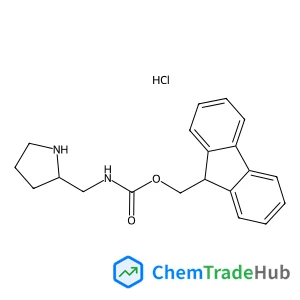
(S)-(9H-Fluoren-9-yl)methyl (pyrrolidin-2-ylmethyl)carbamate hydrochloride
CAS番号:
1217813-15-4
分子式:
C20H23ClN2O2


おすすめサプライヤー





免責事項
このページに表示される学術雑誌情報は、参考および研究目的のみを目的としています。当社は雑誌出版社とは提携しておらず、投稿の取り扱いも行っておりません。出版に関するお問い合わせは、各雑誌出版社に直接ご連絡ください。
表示されている情報に誤りがある場合は、support@chemtradehub.com までご連絡ください。迅速に確認し、対応いたします。