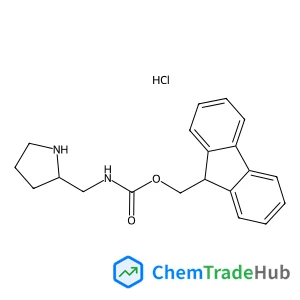
(S)-(9H-Fluoren-9-yl)methyl (pyrrolidin-2-ylmethyl)carbamate hydrochloride
CAS番号:
1217813-15-4
分子式:
C20H23ClN2O2
D. J. Lewis
Hydrodynamic chromatography – inductively coupled plasma mass spectrometry (HDC-ICP-MS) is a technique that is widely used in the size-characterisation of nanoparticles. In this work, a system was modified to facilitate the injection of NIST-traceable standards into the post-column effluent, which then allowed the response from an eluting nanoparticle to be quantified against the response from the post-column standards. Combining the simultaneously acquired particle sizing data and mass concentration data allowed accurate quantification of the particle number concentration to be made in a single analytical run. This unique single-method approach was successfully validated against a nanoparticle system which had previously been characterised in a number of recent peer-reviewed publications. In addition to this, its robustness was assessed using extracts from a study investigating the fate of nanoparticles in sewage sludge, and found to provide much improved data compared to what might have been achieved using an external calibration approach. With in-vial limits of detection of 2 and 10 ng ml−1 for titanium and silver respectively, it is insufficient for use with environmental waters, but is foreseen as being useful in screening nanoparticle production processes, or in the characterisation of higher concentration materials. As this instrumental configuration is likely to be of use to researchers involved in the general area of quantitative trace element speciation, detailed description of construction of the interface is given as ESI.
Weijun Niu, Caroline O'Sullivan, Brett M. Rambo, Mark D. Smith, John J. Lavigne
DOI: 10.1039/B504634C
Michihiro Shirakawa, Norifumi Fujita, Takahiro Tani, Kenji Kaneko, Seiji Shinkai
DOI: 10.1039/B506148B
Elizabeth Glogowski, Jinbo He, Thomas P. Russell, Todd Emrick
DOI: 10.1039/B503670D
Gareth O. Lloyd, Martin W. Bredenkamp, Leonard J. Barbour
DOI: 10.1039/B507726E
Victorio Cadierno, Sergio E. García-Garrido, José Gimeno, Noel Nebra
DOI: 10.1039/B506788J
Olalla Nieto Faza, Carlos Silva López, Rosana Álvarez, Ángel R. de Lera
DOI: 10.1039/B506601H
Makeba B. Murphy-Jolly, Lesley C. Lewis, Andrew J. M. Caffyn
DOI: 10.1039/B507752D
Chunling Fu, Jing Li
DOI: 10.1039/B508069J
Mei-Ling Hong, Shun-Jun Ji, Yong-Chua Teo
DOI: 10.1039/B507768K
Jeane Bordini, Peter C. Ford, Elia Tfouni
DOI: 10.1039/B507407J
2-メトキシ-4-(メチルスルフィニル)アミンは、主に医薬品および農薬の製造に使用されます。また、合成化学の一部として研究用材料としても利用されます。
代替品としては、4,6-二クロロピラミジンアミンや他のピラミジン系化合物が考えられます。ただし、目的と用途によって最適な代替品は異なります。
6-氯-4-甲基-1H-吲哚の廃棄物は、適切な容器に収集し、密閉して保管します。温度は常温、湿度は低く、直射日光を避けて保管することを推奨します。廃棄処理は専門...
2-フローユロ-4-(トリフルオロメチル)ベンゾイドのCAS番号は207974-08-1です。この化合物はGHS分類で毒性物質と有害な反応物質として分類されます...
4-ニトロフェニルN-[(ベンゼルオキシルカーボンイル]グリシングリシングリシン酸は、室温で暗所に保管し、乾燥した環境で保存することを推奨します。容器は密閉性の...
イソデスロラタドリンの代替品としては、デスロラタドリンや他の抗ヒスタミン薬が挙げられます。具体的には、デスロラタドリン、ラセカミド、フェルタドリンなどが、症状や...
5-甲氧基-1,2,3,4-四氢异喹啉盐酸盐の一般的な合成方法は、メタノール中で5-メトキシ-1,2,3,4-四ヒュドロイソキシンを塩酸で塩化します。この反応で...
CAS番号6471-78-9の4-アミノ-5-メトキシ-2-トルエンサルホニック酸は、GHS分類では corrosive(腐食性)と識別されます。EUのREAC...
甲基孕酮の取り扱いは、PPE(個人保護具)の使用が必要な重要な安全事項を伴います。防塵マスク、ゴーグル、手袋を着用することが推奨されます。ドラフトチャンバーを使...

Analyst publishes analytical and bioanalytical research that reports premier fundamental discoveries and inventions, and the applications of those discoveries, unconfined by traditional discipline barriers.