



Amperometric hydrogen peroxide and glucose biosensor based on NiFe2/ordered mesoporous carbon nanocomposites
文献情報
出版日
2014-11-27
DOI
10.1039/C4AN01549E
インパクトファクター
4.616
著者
Longwei Yin, Jingyun Ma, Enyan Guo, Qun Li, Zhaoqiang Li, Kegao Liu
原文を見る
要旨
Nanocomposites of NiFex embedded in ordered mesoporous carbon (OMC) (x = 0, 1, 2) were prepared by a wet impregnation and hydrogen reduction process and were used to construct electrochemical biosensors for the amperometric detection of hydrogen peroxide (H2O2) or glucose. The NiFe2/OMC nanocomposites were demonstrated to have a large surface area, suitable mesoporous channels, many edge-plane-like defective sites, and a good distribution of alloyed nanoparticles. The NiFe2/OMC and Nafion modified glass carbon electrode (GCE) exhibited excellent electrocatalytic activities toward the reduction of H2O2 as well. By utilizing it as a bioplatform, GOx (glucose oxidase) cross-linked with Nafion was immobilized on the surface of the electrode for the construction of an amperometric glucose biosensor. Our results indicated that the amperometric hydrogen peroxide biosensor (NiFe2/OMC + Nafion + GCE) showed good analytical performances in term of a high sensitivity of 4.29 μA mM−1 cm−2, wide linearity from 6.2 to 42 710 μM and a low detection limit of 0.24 μM at a signal-to-noise ratio of 3 (S/N = 3). This biosensor exhibited excellent selectivity, high stability and negligible interference for the detection of H2O2. In addition, the immobilized enzyme on NiFe2/OMC + Nafion + GCE, retaining its bioactivity, exhibited a reversible two-proton and two-electron transfer reaction, a fast heterogeneous electron transfer rate and an effective Michaelis–Menten constant (K′M) (3.18 mM). The GOx + NiFe2/OMC + Nafion + GCE could be used to detect glucose based on the oxidation of glucose catalyzed by GOx and exhibited a wide detection range of 48.6–12 500 μM with a high sensitivity of 6.9 μA mM−1 cm−2 and a low detection limit of 2.7 μM (S/N = 3). The enzymic biosensor maintained a high selectivity and stability features, and shows great promise for application in the detection of glucose.
おすすめジャーナル

Organic Preparations and Procedures International

Science

Journal of Organometallic Chemistry

Russian Chemical Reviews

Planta Medica

Nature

Journal of Heterocyclic Chemistry

Proceedings of the National Academy of Sciences of the United States of America

Pharmacological Reviews

Journal of Physics and Chemistry of Solids
関連文献
Investigation of proton dynamics and the proton transport pathway in choline dihydrogen phosphate using solid-state NMR
Lindsay S. Cahill, Usman Ali Rana, Maria Forsyth, Mark E. Smith
2010-04-08
Paper
DOI: 10.1039/B916422G
Dimerisation of nitrile oxides: a quantum-chemical study
Tibor Pasinszki, Balázs Havasi, Nicholas P. C. Westwood
2009-04-17
Paper
DOI: 10.1039/B823406J
The gas-phase reaction between silylene and 2-butyne: kinetics, isotope studies, pressure dependence studies and quantum chemical calculations
Rosa Becerra, J. Pat Cannady, Guy Dormer, Robin Walsh
2009-04-17
Paper
DOI: 10.1039/B823109E
Non-perturbative magnetic phenomena in closed-shell paramagnetic molecules
Erik I. Tellgren, Trygve Helgaker, Alessandro Soncini
2009-04-16
Paper
DOI: 10.1039/B822262B
A vibrational circular dichroism approach to the determination of the absolute configuration of flexible and transparent molecules: fluorenoneketals of 1,n-diols
Patrizia Scafato, Carlo Rosini
2010-03-17
Paper
DOI: 10.1039/B913213A
Thermodynamic investigation of the binding of dissymmetric pyrenyl-gemini surfactants to DNA
Shawn D. Wettig, Rubena Deubry, Javed Akbar, Tranum Kaur, Haitang Wang, Tatiana Sheinin, Jamie W. Joseph, Roderick A. Slavcev
2010-03-25
Paper
DOI: 10.1039/B923817D
Thermodynamic theory of two-dimensional to three-dimensional growth transition in quantum dotsself-assembly
Xinlei Li, Yuanyuan Cao, Guowei Yang
2010-03-16
Paper
DOI: 10.1039/B927189A
Effective temperature representation of quantum delocalization effects on the dynamics of NO(A2Σ+←X2Π+) photoexcitation in Ne matrices
L. García-Reyes, J. Rubayo-Soneira
2009-04-28
Paper
DOI: 10.1039/B819355J
Thermal reversion of spirooxazine in ionic liquids containing the [NTf2]− anion
Simon Coleman, Robert Byrne, Stela Minkovska
2009-05-08
Paper
DOI: 10.1039/B901417A
Studying long-time dynamics of imidazolium-based ionic liquids with a systematically coarse-grained model
Hossein Ali Karimi-Varzaneh, Florian Müller-Plathe, Sundaram Balasubramanian, Paola Carbone
2010-03-25
Paper
DOI: 10.1039/B925780B
こちらもおすすめ
化合物よくある質問
2-氟-4-イオドベンzo酸エチルエステルを取り扱う際の実験室安全事項は何ですか?
2-氟-4-イオドベンzo酸エチルエステルは有機溶媒を用いた反応であり、ドラフトチャンバーでの操作が必要です。漏洩時にはSDS参照の安全措置を講じ、PPE(防護...
205750-82-9Benzoic acid, 2-fluo...
化合物よくある質問
血根碱の主な用途は何ですか?
血根碱は主に医薬分野で利用され、抗炎症や抗がん剤としての潜在的な効果が研究されています。また、化学研究や薬物開発において、新しい薬剤設計の参考となる化合物として...
2447-54-313-Methyl[1,3]benzod...
化合物よくある質問
Methyl 3-methoxythiophene-2-carboxylateの主な用途は何ですか?
Methyl 3-メトキシスチフェン-2-カルボン酸メチルエステルは、薬品合成、染料製造、以及合成中間体としての用途が広がっています。
62353-75-7Methyl 3-methoxythio...
化合物よくある質問
丹磺酰-L-亮氨酸はどのように保存すればよいですか?
丹磺酰-L-亮氨酸は乾燥した場所で、直射日光から保護し、低温(室温以下)で保存してください。密閉容器に入れて保管することをおすすめします。
1100-22-7N-{[5-(Dimethylamino...
化合物よくある質問
5-(苄氧基)ピラミジン-4-アミンの代替品はありますか?
5-(苄氧基)ピラミジン-4-アミンの代替品として、6-メトキシピラミジンや5-フェニルピラミジンなどが挙げられます。これらの化合物は、5-(苄氧基)ピラミジン...
92289-50-45-benzyloxypyrimidin...
化合物よくある質問
8-ヒドロキシノルデコペントアセートの物理化学的性質は何ですか?
8-ヒドロキシノルデコペントアセートはCAS番号84807-87-4の化合物で、分子量は750.02 uです。これは油溶性で、水に溶けにくい特徴があります。反応...
84807-87-4(5Z,8Z,11Z,13E,15S)-...
化合物よくある質問
tert-ブチル(エス)-1-ヒドロキシペンタ-4-エン-2-イルカルバamateの主な用途は何ですか?
tert-ブチル(エス)-1-ヒドロキシペンタ-4-エン-2-イルカルバamateは主に医薬品の合成材料や分析化学の試薬として使用されます。
116613-81-12-Methyl-2-propanyl ...
化合物よくある質問
ブコール-L-2-フローヨルブリンについて適切な法規ガイドラインは何ですか?
ブコール-L-2-フローヨルブリン(CAS番号: 1196107-73-9)は、GHS(グローバルハザードアサessmentシステム)に基づく危害分類と表示が求...
1196107-73-92-Bromo-13,13-dimeth...
化合物よくある質問
6-ブロモ-N-環丙基-2-ピリジニニメタンの市場動向や研究トレンドはどうですか
6-ブロモ-N-環丙基-2-ピリジニニメタンは、薬理学研究や合成化学に使用される化合物であり、特に抗ウイルス薬や抗がん薬の開発に注目されています。市場では、薬物...
959237-20-86-Bromo-N-cyclopropy...
化合物よくある質問
RS-AMPÀはどのように保存すればよいですか?
RS-AMPÀは、遮光容器に保存し、室温(15〜25℃)で保管することが推奨されます。高湿や熱は物質を劣化させるため、湿度は50%以下に保つことが重要です。また...
74341-63-2(RS)-AMPA
掲載誌
Analyst

CiteScore:
7.8
自己引用率:
5.6%
年間論文数:
653
Analyst publishes analytical and bioanalytical research that reports premier fundamental discoveries and inventions, and the applications of those discoveries, unconfined by traditional discipline barriers.
おすすめ化合物


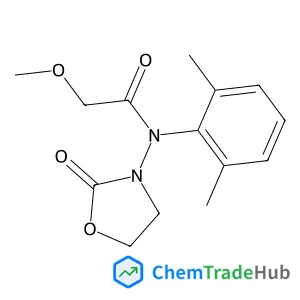
N-(2,6-Dimethylphenyl)-2-methoxy-N-(2-oxo-1,3-oxazolidin-3-yl)acetamide
CAS番号:
77732-09-3
分子式:
C14H18N2O4
おすすめサプライヤー





免責事項
このページに表示される学術雑誌情報は、参考および研究目的のみを目的としています。当社は雑誌出版社とは提携しておらず、投稿の取り扱いも行っておりません。出版に関するお問い合わせは、各雑誌出版社に直接ご連絡ください。
表示されている情報に誤りがある場合は、support@chemtradehub.com までご連絡ください。迅速に確認し、対応いたします。