












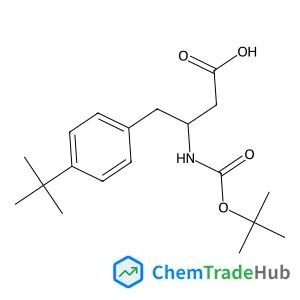
(S)-3-((tert-Butoxycarbonyl)amino)-4-(4-(tert-butyl)phenyl)butanoic acid
CAS番号:
403661-85-8
分子式:
C19H29NO4
Qinzheng Yang, Hua Yue, Bin Wang, Zhiguo Su, Wei Wei, Guanghui Ma
Various carriers are being advanced for anti-cancer therapy, which can protect drugs and ferry them to the target site. However, little understanding exists regarding the effect of molecular structure on anti-cancer drug delivery efficiency. To fill this knowledge gap, we take poly(lactic acid) (PLA), poly(lactide-co-glycolide) (PLGA), and poly-ethylene glycol-co-poly-lactide (PEG-b-PLA) polymers as prototype materials and comparatively explore the inherent relationship between the molecular structure and the delivery ability. Compared with PLA and PLGA NPs, PEG-b-PLA ones possess the advantages of longer blood circulation time, more tumor accumulation, and better intratumoral delivery ability. Subsequent mechanism investigations reveal that the molecular structure will regulate the polymer arrangement and render NPs different hydrophilicity/deformability, which dictate the distinct delivery performances. Finally, the superior PEG-b-PLA NPs are further loaded with the anti-cancer drug paclitaxel (PTX) and functionalized with magnetic (M) Fe3O4 nanocrystals. As-designed PTX/M PEG-b-PLA NPs show much better tumor inhibition efficacy and fewer side effects than the commercialized Taxol® formulation, strongly supporting their use as high-performance carriers for anti-cancer therapy.
Masumeh Foroutan, Vahid Fadaei Naeini, Mina Ebrahimi
DOI: 10.1039/C9CP04977K
Lihui Ou, Junxiang Chen
DOI: 10.1039/C9CP05043D
Yeqian Hu, Xiantong Tang, Ruiheng Pan, Jinqiu Deng, Hongqiang Zhu, Zuhong Xiong
DOI: 10.1039/C9CP01201J
Peter Lackner, Zhiyu Zou, Sabrina Mayr, Ulrike Diebold, Michael Schmid
DOI: 10.1039/C9CP03322J
Yusuke Nanba, Masashi Okubo, Hisao Kiuchi
DOI: 10.1039/C9CP02604E
Monique Comte, Lionel Montagne, Bertrand Doumert, Laurent Cormier
DOI: 10.1039/C9CP03181B
Rayssa Jossanea Brasileiro Motta, Ana Zélia Falcão Almeida, Bruna Luiza Batista de Lima, Ricardo Schneider, Rosangela de Carvalho Balaban, Jeroen Sebastiaan van Duijneveldt, Rodrigo José de Oliveira
DOI: 10.1039/C9CP05225A
Zongbao Li, Xinsheng Liu, Xia Wang, Yusi Yang, Wei Shi, Yong Li, Xiaobo Xing
DOI: 10.1039/C9CP05058B
4-アミノフェノール酸ナトリウム水和物は、CAS番号206557-08-6の化合物で、4-アミノフェノールとナトリウムが結合した塩と水和物です。この化合物は、白...
この化合物は特定の合成プロセスに使用される可能性がありますが、代替品として、他の类似的な化合物、例えばMethyl 3-methyl-N-{[(2-methyl...
4-Boc-2-哌嗪甲酸は、薬品開発や合成化学分野で広く使用されており、その需要は継続的に推移しています。特に、新薬開発における合成化学分野での需要が高まってい...
4,4'-二羟甲基联苯のCAS番号は1667-12-5です。この化合物は白色の結晶粉末で、分子量は154.20です。水にわずかに溶けますが、アルコールや有機溶媒...
5-甲硫基戊腈は医薬品産業で使用される可能性があります。また、ポリマー合成の触媒として、センサー製造の一部として、半導体製造のプロセス改善に使用される可能性があ...
この化合物は、1-abieta-8,11,13-trien-19-イルと6'-メトキシシンコナナン-9-基を含有する窒素含有化合物から合成されます。一般的な合成...
6-ブロモベンジジミダゾール-2-カルビルデオキシドは、避光・乾燥した容器(密閉容器)で-20℃~4℃の低温で保存してください。高温や直射日光、湿気は避けてくだ...
621-65-8のCAS番号を持つBoc-N-甲基氨甲环酸は、化学式C7H13NO5を有する化合物です。この化合物は白色の結晶性粉末で、吸湿性があります。
乙基三氟硼酸钾は、トリフLUオール酸カリウムとエチルブロミドを反応させて合成されます。この反応は高い選択性と収率を持ち、触媒を用いることで効率的に進行します。
2-フロウロ-5-クロロ-4-アミノフェノールは、直射日光を避けて冷却された暗所で保存し、密閉容器に保管してください。温度は常温か低温が適しています。
Journal of Materials Chemistry A, B & C cover high quality studies across all fields of materials chemistry. The journals focus on those theoretical or experimental studies that report new understanding, applications, properties and synthesis of materials. The journals have a strong history of publishing quality reports of interest to interdisciplinary communities and providing an efficient and rigorous service through peer review and publication. The journals are led by an international team of Editors-in-Chief and Associate Editors who are all active researchers in their fields. Journal of Materials Chemistry A, B & C are separated by the intended application of the material studied. Broadly, applications in energy and sustainability are of interest to Journal of Materials Chemistry A, applications in biology and medicine are of interest to Journal of Materials Chemistry B, and applications in optical, magnetic and electronic devices are of interest to Journal of Materials Chemistry C. More than one Journal of Materials Chemistry journal may be suitable for certain fields and researchers are encouraged to submit their paper to the journal that they feel best fits for their particular article. Example topic areas within the scope of Journal of Materials Chemistry B are listed below. This list is neither exhaustive nor exclusive. Antifouling coatings Biocompatible materials Bioelectronics Bioimaging Biomimetics Biomineralisation Bionics Biosensors Diagnostics Drug delivery Gene delivery Immunobiology Nanomedicine Regenerative medicine & Tissue engineering Scaffolds Soft robotics Stem cells Therapeutic devices image block All articles published in Journal of Materials Chemistry B from 2019 onwards will be indexed in MEDLINE®. Articles that primarily focus on providing insight into the underlying science and performance of biomaterials within a biological environment are more suited to our companion journal, Biomaterials Science.
![[3-(2,6-Dichlorophenyl)-5-isopropyl-1,2-oxazol-4-yl]methanol structure](https://static.chemtradehub.com/structs/278/278597-30-1-5c79.webp "[3-(2,6-Dichlorophenyl)-5-isopropyl-1,2-oxazol-4-yl]methanol structure")
![(4aR,5S,6R,8aS)-5-[2-(3-Furyl)ethyl]-8a-(hydroxymethyl)-5,6-dimethyl-3,4,4a,5,6,7,8,8a-octahydro-1-naphthalenecarboxylic acid structure](https://static.chemtradehub.com/structs/184/18411-75-1-d4cd.webp "(4aR,5S,6R,8aS)-5-[2-(3-Furyl)ethyl]-8a-(hydroxymethyl)-5,6-dimethyl-3,4,4a,5,6,7,8,8a-octahydro-1-naphthalenecarboxylic acid structure")



