


Dynamic and thermodynamic characteristics associated with the glass transition of amorphous trehalose–water mixtures
文献情報
出版日
2014-04-25
DOI
10.1039/C3CP55418J
インパクトファクター
3.676
著者
Lindong Weng, Gloria D. Elliott
原文を見る
要旨
The glass transition temperature Tg of biopreservative formulations is important for predicting the long-term storage of biological specimens. As a complementary tool to thermal analysis techniques, which are the mainstay for determining Tg, molecular dynamics simulations have been successfully applied to predict the Tg of several protectants and their mixtures with water. These molecular analyses, however, rarely focused on the glass transition behavior of aqueous trehalose solutions, a subject that has attracted wide scientific attention via experimental approaches. Important behavior, such as hydrogen-bonding dynamics and self-aggregation has yet to be explored in detail, particularly below, or in the vicinity of, Tg. Using molecular dynamics simulations of several dynamic and thermodynamic properties, this study reproduced the supplemented phase diagram of trehalose–water mixtures (i.e., Tg as a function of the solution composition) based on experimental data. The structure and dynamics of the hydrogen-bonding network in the trehalose–water systems were also analyzed. The hydrogen-bonding lifetime was determined to be an order of magnitude higher in the glassy state than in the liquid state, while the constitution of the hydrogen-bonding network exhibited no noticeable change through the glass transition. It was also found that trehalose molecules preferred to form small, scattered clusters above Tg, but self-aggregation was substantially increased below Tg. The average cluster size in the glassy state was observed to be dependent on the trehalose concentration. Our findings provided insights into the glass transition characteristics of aqueous trehalose solutions as they relate to biopreservation.
おすすめジャーナル

Pharmacological Reviews

Nature

Pure and Applied Chemistry

Journal of Medicinal Chemistry

Journal of Physics and Chemistry of Solids

Israel Journal of Chemistry

Journal of Heterocyclic Chemistry

Proceedings of the National Academy of Sciences of the United States of America

Kinetics and Catalysis

Organic Preparations and Procedures International
関連文献
Electrodeposition of monodispersed Fe nanocrystals from an ionic liquid
C. L. Aravinda, W. Freyland
2004-10-19
Communication
DOI: 10.1039/B409861G
Practical asymmetric synthesis of β-hydroxy-β-trifluoromethylated ketonesvia the first example of the in situ generation of trifluoro-acetaldehyde and its successive asymmetric carbon–carbon bond formation reaction with chiral imines
Kazumasa Funabiki, Wataru Hashimoto, Masaki Matsui
2004-08-13
Communication
DOI: 10.1039/B408226E
A metallo-capped polyrotaxane containing calix[4]arenes and cyclodextrins and its highly selective binding for Ca2+
Yu Liu, Hao Wang, Heng-Yi Zhang, Peng Liang
2004-09-06
Communication
DOI: 10.1039/B409356A
Polysulfones: solid organic catalysts for the chemoselective cleavage of methyl-substituted allyl ethers under neutral conditions
Dean Marković, Peter Steunenberg, Martin Ekstrand, Pierre Vogel
2004-09-21
Communication
DOI: 10.1039/B410965A
Synthesis of Ag2S quantum dots in water-in-CO2 microemulsions
2004-09-30
Communication
DOI: 10.1039/B410700D
Electronic and vibrational properties of a MOF-5 metal–organic framework: ZnO quantum dot behaviour
S. Bordiga, C. Lamberti, G. Ricchiardi, L. Regli, F. Bonino, A. Damin, K.-P. Lillerud, M. Bjorgen, A. Zecchina
2004-09-01
Communication
DOI: 10.1039/B407246D
Self-assembled zinc(ii) Schiff basepolymers for applications in polymer light-emitting devices
Chi-Chung Kwok, Sze-Chit Yu, Iona H. T. Sham, Chi-Ming Che
2004-10-20
Communication
DOI: 10.1039/B412762E
Advanced selective optical sensors based on periodically organized mesoporous hybrid silica thin films
Lionel Nicole, Cédric Boissière, David Grosso, Peter Hesemann, Joël Moreau, Clément Sanchez
2004-09-06
Communication
DOI: 10.1039/B408869G
Supramolecular isomerism in spin crossover networks with aurophilic interactions
Ana Galet, M. Carmen Muñoz, Víctor Martínez, José Antonio Real
2004-09-07
Communication
DOI: 10.1039/B409974E
Synthesis and electropolymerization of novel oligothiophene-functionalized perylene bisimides
Chang-Cheng You, Chantu R. Saha-Möller, Frank Würthner
2004-08-06
Communication
DOI: 10.1039/B407551J
こちらもおすすめ
化合物よくある質問
カルボニル基が付いた5-氰基-1-{[(2-メチル-2-プロpanyl)オキシ]カーボンイル}1H-吲哚-2-イリド-2-ボリン酸はどのように保存すればよいですか?
カルボニル基が付いた5-氰基-1-{[(2-メチル-2-プロpanyl)オキシ]カーボンイル}1H-吲哚-2-イリド-2-ボリン酸は、直射日光を避けて室温(15...
475102-15-9(5-Cyano-1-{[(2-meth...
化合物よくある質問
tert-ブチル2-クロロメチルピリジン-3-基炭酸エステルの市場動向や研究トレンドはどうですか?
この化合物は合成化学分野において、特にピリジン化合物の合成や改良に用いられます。最近の研究では、ピリジン化合物の新規合成法や特性の改良が注目されています。市場動...
1203498-98-9tert-Butyl 2-chloro-...
化合物よくある質問
聚二季戊四醇六丙烯酸酯はどの業界で使用されていますか?
聚二季戊四醇六丙烯酸酯は、医薬品、ポリマー、センサー、半導体などの業界で広く使用されています。特にポリマー業界では硬化剤として、医薬分野では医療機器の製造に使用...
29570-58-93-(Acryloyloxy)-2-({...
化合物よくある質問
1-氯-5-硝基异喹啉の市場動向や研究トレンドはどうですか?
1-氯-5-硝基异喹啉は、薬理学や合成化学の研究分野で注目されています。市場動向としては、その生物学的な活性や合成可能性を評価する研究が増えています。また、代替...
58142-97-51-Chloro-5-nitroisoq...
化合物よくある質問
2-チロール-5-メチルスルフェニル-3-trifルオルメチルベンゼンはどのように合成されますか?
2-チロール-5-メチルスルフェニル-3-trifルオルメチルベンゼンは、トリフルオロメチル化反応と硫化反応を経て合成されます。通常、トリフルオロメチル化剤と硫...
957066-04-51-Chloro-4-(methylsu...
化合物よくある質問
p-トールイルマグネシウムブロミドの物理化学的性質は何ですか?
p-トールイルマグネシウムブロミドのCAS番号は4294-57-9です。この化合物は白色の結晶性粉末で、分子量は204.32です。溶剤中で良好に溶解しますが、水...
4294-57-9p-Tolylmagnesium bro...
化合物よくある質問
1-(5-甲基-2-硫化素基)プロパン-1-酮の市場動向や研究トレンドはどうですか?
1-(5-甲基-2-硫化素基)プロパン-1-酮の市場動向は、化学産業全体の需要に影響を受けますが、最近では pharmaceutical 分野での応用が注目され...
59303-13-81-(5-Methyl-2-thieny...
化合物よくある質問
十一碳烯酰甘氨酸を取り扱う際の実験室安全事項は何ですか?
十一碳烯酰甘氨酸は吸入や皮膚から吸収されることがあり、取り扱う際には防塵マスクと手袋を使用してください。ドラフトチャンバーを用いて漏洩を処理し、適切なSDS(S...
54301-26-7N-10-Undecenoylglyci...
化合物よくある質問
1H,1H-全氟-3,6-二氧杂葵-1-醇を取り扱う際の実験室安全事項は何ですか?
この化合物は吸入や皮膚吸収による毒性があるため、防塵マスク、ゴーグル、防護手袋を使用する必要があります。ドラフトチャンバーでの操作が必要です。漏洩時には即座に換...
152914-73-32,2-Difluoro-2-[1,1,...
化合物よくある質問
3-(4-(フルオロメチルオキシ)フェニル)-1,2,4-オキサジアゾール-5-カルボハイドライドは安全ですか?
安全性は化合物の使用方法によります。直接的な毒性は報告されていませんが、吸入や皮膚接触には注意が必要です。適切な防護服を着用し、換気を図ることを推奨します。
883028-82-83-(4-(Trifluorometho...
掲載誌
Physical Chemistry Chemical Physics

CiteScore:
5.5
自己引用率:
10.3%
年間論文数:
3036
Physical Chemistry Chemical Physics (PCCP) is an international journal co-owned by 19 physical chemistry and physics societies from around the world. This journal publishes original, cutting-edge research in physical chemistry, chemical physics and biophysical chemistry. To be suitable for publication in PCCP, articles must include significant innovation and/or insight into physical chemistry; this is the most important criterion that reviewers and Editors will judge against when evaluating submissions. The journal has a broad scope and welcomes contributions spanning experiment, theory, computation and data science. Topical coverage includes spectroscopy, dynamics, kinetics, statistical mechanics, thermodynamics, electrochemistry, catalysis, surface science, quantum mechanics, quantum computing and machine learning. Interdisciplinary research areas such as polymers and soft matter, materials, nanoscience, energy, surfaces/interfaces, and biophysical chemistry are welcomed if they demonstrate significant innovation and/or insight into physical chemistry. Joined experimental/theoretical studies are particularly appreciated when complementary and based on up-to-date approaches.
おすすめ化合物
![(2R,6S)-6-[(Benzyloxy)methyl]-4-{[(2-methyl-2-propanyl)oxy]carbonyl}-2-morpholinecarboxylic acid structure](https://static.chemtradehub.com/structs/109/1093085-91-6-3382.webp "(2R,6S)-6-[(Benzyloxy)methyl]-4-{[(2-methyl-2-propanyl)oxy]carbonyl}-2-morpholinecarboxylic acid structure")
![1-oxaspiro[4.4]nonan-6-one structure](https://static.chemtradehub.com/structs/134/134179-01-4-e051.webp "1-oxaspiro[4.4]nonan-6-one structure")
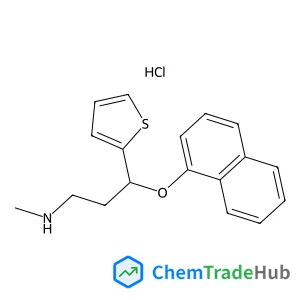
N-Methyl-3-(1-naphthyloxy)-3-(2-thienyl)-1-propanamine hydrochloride (1:1)
CAS番号:
1188266-11-6
分子式:
C18H20ClNOS
おすすめサプライヤー





免責事項
このページに表示される学術雑誌情報は、参考および研究目的のみを目的としています。当社は雑誌出版社とは提携しておらず、投稿の取り扱いも行っておりません。出版に関するお問い合わせは、各雑誌出版社に直接ご連絡ください。
表示されている情報に誤りがある場合は、support@chemtradehub.com までご連絡ください。迅速に確認し、対応いたします。