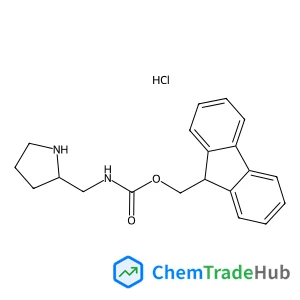
(S)-(9H-Fluoren-9-yl)methyl (pyrrolidin-2-ylmethyl)carbamate hydrochloride
CAS番号:
1217813-15-4
分子式:
C20H23ClN2O2
Jenel Vatamanu, Dmitry Bedrov
In this work using molecular dynamics simulations we examine the temperature dependence of the differential capacitance of room temperature ionic liquid electrolytes near electrified surfaces. For electrodes with atomically flat surfaces our simulations show very weak temperature dependence of the differential capacitance (DC) with a slight decrease of DC with increasing temperature. For atomically corrugated surfaces where the ion dimensions are comparable to the size of the surface corrugation patterns, the influence of temperature on DC is much more pronounced. At low temperatures the DC dependence on electrode potential shows large variations with well-defined maxima and minima. However, with increasing temperature these features are significantly flattened. Also for these corrugated surfaces an abnormal positive slope of DC vs. temperature is observed in the narrow range of relatively low voltages. Analysis of changes in the electric double layer structure as a function of temperature allowed us to propose a new mechanism explaining the observed trends in capacitance as a function of temperature and surface topography. The obtained simulation results are discussed in light of available experimental data and help to discriminate between contradictory experimentally observed trends in DC temperature dependence reported for ionic liquid based electrolytes in the literature.
Tsutomu Kimura, Toshiaki Murai
DOI: 10.1039/B507755A
Naoto Hashimoto, Keiko Ninomiya, Takamasa Endo, Masahiko Sisido
DOI: 10.1039/B508194G
Jing Yang, Daniel Lévy, Wei Deng, Patrick Keller, Min-Hui Li
DOI: 10.1039/B508034G
Makeba B. Murphy-Jolly, Lesley C. Lewis, Andrew J. M. Caffyn
DOI: 10.1039/B507752D
Anne L. Boreen, Kristopher McNeill
DOI: 10.1039/B506971H
Dolos Foguet-Albiol, Khalil A. Abboud, George Christou
DOI: 10.1039/B507748F
A. J. (Ton) Dirks, Sander S. van Berkel, Nikos S. Hatzakis, Joost A. Opsteen, Floris L. van Delft, Jeroen J. L. M. Cornelissen, Alan E. Rowan, Jan C. M. van Hest, Floris P. J. T. Rutjes, Roeland J. M. Nolte
DOI: 10.1039/B508428H
Ramsey Ida, Gang Wu
DOI: 10.1039/B505674H
Herbert W. Roesky, S. Shravan Kumar
DOI: 10.1039/B505307B
Robin B. Bedford, Duncan W. Bruce, Robert M. Frost, Michael Hird
DOI: 10.1039/B507133J
2-メトキシ-4-(メチルスルフィニル)アミンは、主に医薬品および農薬の製造に使用されます。また、合成化学の一部として研究用材料としても利用されます。
代替品としては、4,6-二クロロピラミジンアミンや他のピラミジン系化合物が考えられます。ただし、目的と用途によって最適な代替品は異なります。
6-氯-4-甲基-1H-吲哚の廃棄物は、適切な容器に収集し、密閉して保管します。温度は常温、湿度は低く、直射日光を避けて保管することを推奨します。廃棄処理は専門...
2-フローユロ-4-(トリフルオロメチル)ベンゾイドのCAS番号は207974-08-1です。この化合物はGHS分類で毒性物質と有害な反応物質として分類されます...
4-ニトロフェニルN-[(ベンゼルオキシルカーボンイル]グリシングリシングリシン酸は、室温で暗所に保管し、乾燥した環境で保存することを推奨します。容器は密閉性の...
イソデスロラタドリンの代替品としては、デスロラタドリンや他の抗ヒスタミン薬が挙げられます。具体的には、デスロラタドリン、ラセカミド、フェルタドリンなどが、症状や...
5-甲氧基-1,2,3,4-四氢异喹啉盐酸盐の一般的な合成方法は、メタノール中で5-メトキシ-1,2,3,4-四ヒュドロイソキシンを塩酸で塩化します。この反応で...
CAS番号6471-78-9の4-アミノ-5-メトキシ-2-トルエンサルホニック酸は、GHS分類では corrosive(腐食性)と識別されます。EUのREAC...
甲基孕酮の取り扱いは、PPE(個人保護具)の使用が必要な重要な安全事項を伴います。防塵マスク、ゴーグル、手袋を着用することが推奨されます。ドラフトチャンバーを使...

Physical Chemistry Chemical Physics (PCCP) is an international journal co-owned by 19 physical chemistry and physics societies from around the world. This journal publishes original, cutting-edge research in physical chemistry, chemical physics and biophysical chemistry. To be suitable for publication in PCCP, articles must include significant innovation and/or insight into physical chemistry; this is the most important criterion that reviewers and Editors will judge against when evaluating submissions. The journal has a broad scope and welcomes contributions spanning experiment, theory, computation and data science. Topical coverage includes spectroscopy, dynamics, kinetics, statistical mechanics, thermodynamics, electrochemistry, catalysis, surface science, quantum mechanics, quantum computing and machine learning. Interdisciplinary research areas such as polymers and soft matter, materials, nanoscience, energy, surfaces/interfaces, and biophysical chemistry are welcomed if they demonstrate significant innovation and/or insight into physical chemistry. Joined experimental/theoretical studies are particularly appreciated when complementary and based on up-to-date approaches.