












Destabilization of Mg–H bonding through nano-interfacial confinement by unsaturated carbon for hydrogen desorption from MgH2
文献情報
出版日
2013-02-11
DOI
10.1039/C3CP50515D
インパクトファクター
3.676
著者
Md Abdul Wahab, Jie Cui, Min Zhu
原文を見る
要旨
We propose a new mechanism for destabilizing Mg–H bonding by means of a combination of the size effect and MgH2–carbon scaffold interfacial bonding, and experimentally realize low temperature hydrogen release starting from 50 °C using an MgH2@CMK-3 nanoconfinement system (37.5 wt% MgH2 loading amount). Based on computational calculations, it is found that the charge transfer from MgH2 to the carbon scaffold plays a critical role in the significant reduction of thermodynamics of MgH2 dehydrogenation. Our results suggest how to explore an alternative route for the enhancement of nano-interfacial confinement to destabilize the Mg–H hydrogen storage system.
関連文献
Polyolefin plastic waste hydroconversion to fuels, lubricants, and waxes: a comparative study
Pavel A. Kots
2021-12-01
Perspective
DOI: 10.1039/D1RE00447F
Towards controlled bubble nucleation in microreactors for enhanced mass transport
Jeffery A. Wood, Stefan Schlautmann, Han J. G. E. Gardeniers, Séverine Le Gac
2021-07-16
Paper
DOI: 10.1039/D1RE00092F
MFI zeolite-supported Ru nanoparticles for efficient conversion of pyroglutamic acid to 2-pyrrolidone
Akihiro Otani, Masaya Kuroda, Satoshi Suganuma, Etsushi Tsuji, Naonobu Katada
2021-07-30
Paper
DOI: 10.1039/D1RE00186H
Ionic liquid-derived polyelectrolyte promoting the biphasic condensation of immiscible reactants at moderate temperature
Yuki Kohno, Takashi Makino
2021-08-27
Communication
DOI: 10.1039/D1RE00304F
Determination of the propagation rate coefficient of acrylonitrile
Tanja Junkers, Sandy P. S. Koo, Christopher Barner-Kowollik
2010-03-04
Communication
DOI: 10.1039/C0PY00019A
Enhanced methane conversion using Ni-doped calcium ferrite oxygen carriers in chemical looping partial oxidation systems with CO2 utilization
Vedant Shah, Zhuo Cheng, Pinak Mohapatra, Liang-Shih Fan
2021-07-14
Paper
DOI: 10.1039/D1RE00150G
Regeneration of pristine HZSM-5 extrudates during the production of deeply deoxygenated bio-oil from ex situ catalytic fast pyrolysis of biomass in a bench-scale fluidised-bed reactor
Nuttapan Promsampao, Nuwong Chollacoop, Adisak Pattiya
2021-11-24
Paper
DOI: 10.1039/D1RE00347J
Generating molecules with optimized aqueous solubility using iterative graph translation
Camille Bilodeau, Wengong Jin, Hongyun Xu, Jillian A. Emerson, Sukrit Mukhopadhyay, Thomas H. Kalantar, Tommi Jaakkola, Regina Barzilay, Klavs F. Jensen
2021-11-15
Paper
DOI: 10.1039/D1RE00315A
Copper-catalyzed redox-neutral regioselective chlorosulfonylation of vinylarenes
Lixia Liu, Chengming Wang
2021-06-16
Communication
DOI: 10.1039/D1RE00188D
こちらもおすすめ
化合物よくある質問
2-ブロモ-9,9-ジフェニル-9H-フルオレンの主な用途は何ですか?
2-溴-9,9-二苯基芴は、医薬品、工業材料、有機合成の研究分野で応用されます。特に、レーザー材料や機能性ポリマーの合成に使用されることがあります。また、蛍光色...
474918-32-62-Bromo-9,9-diphenyl...
化合物よくある質問
四氯化铱の市場動向や研究トレンドはどうですか?
四氯化铱の市場は研究開発分野で注目されており、特にナノ技術や金属有機框架(MOFs)の分野での需要が増加傾向にあります。価格は安定しており、中国や韓国での生産が...
207399-11-9Tetrachloroiridium h...
882-06-44-Nitrocinnamic acid
化合物よくある質問
1-(4-溴-3-氟苯基)-2-氯乙酮を含む廃棄物はどのように処理すべきですか?
1-(4-溴-3-氟苯基)-2-氯乙酮 (CAS番号: 1260857-14-4) の廃棄物は専門的な廃棄処理が必要です。まず、廃棄物は密閉された容器に収集し、...
1260857-14-41-(4-Bromo-3-fluorop...
化合物よくある質問
苦参酚Kとは何ですか?
苦参酚Kは、CAS番号101236-49-1を持つ化合物で、主に天然由来の生薬から抽出されます。この化合物は、抗炎症作用や抗癌作用を持つことが報告されています。
101236-49-1Kushenol K
化合物よくある質問
POTASSIUM (1-(TERTBUTOXYCARBONYL)AZETIDIN-3-YL)TRIFLUOROBORATE を含む廃棄物はどのように処理すべきですか?
POTASSIUM (1-(TERTBUTOXYCARBONYL)AZETIDIN-3-YL)TRIFLUOROBORATE を含む廃棄物は、まず安全なエント...
1430219-73-0Potassium (1-(tert-b...
化合物よくある質問
4-庚基-4’-联苯羧酸の市場動向や研究トレンドはどうですか?
4-庚基-4’-聯苯羧酸は、特殊化学品や合成化学の分野で用いられる化学物質ですが、市場動向としては、研究開発の進展とともに需要が増加しています。また、環境配慮型...
58573-94-74'-Heptyl-4-biphenyl...
化合物よくある質問
6-ブロモ-3-メトキシ-1-フェニル-1H-インドゾールを含む廃棄物はどのように処理すべきですか?
6-ブロモ-3-メトキシ-1-フェニル-1H-インドゾールを含む廃棄物は、適切な化学廃棄処理が必要です。通常、廃棄物は密閉容器に収集され、専門の廃棄処理業者に引...
1332527-03-36-Bromo-3-methoxy-1-...
化合物よくある質問
4,4-二甲基-2-吡咯烷酮はどの業界で使用されていますか?
4,4-二甲基-2-吡咯烷酮は医薬、ポリマー、センサー、半導体などの業界で広く使用されています。特に溶媒としての性能が高く評価されています。
66899-02-34,4-dimethylpyrrolid...
51312-42-6Sodium Phosphotungst...
掲載誌
Physical Chemistry Chemical Physics

CiteScore:
5.5
自己引用率:
10.3%
年間論文数:
3036
Physical Chemistry Chemical Physics (PCCP) is an international journal co-owned by 19 physical chemistry and physics societies from around the world. This journal publishes original, cutting-edge research in physical chemistry, chemical physics and biophysical chemistry. To be suitable for publication in PCCP, articles must include significant innovation and/or insight into physical chemistry; this is the most important criterion that reviewers and Editors will judge against when evaluating submissions. The journal has a broad scope and welcomes contributions spanning experiment, theory, computation and data science. Topical coverage includes spectroscopy, dynamics, kinetics, statistical mechanics, thermodynamics, electrochemistry, catalysis, surface science, quantum mechanics, quantum computing and machine learning. Interdisciplinary research areas such as polymers and soft matter, materials, nanoscience, energy, surfaces/interfaces, and biophysical chemistry are welcomed if they demonstrate significant innovation and/or insight into physical chemistry. Joined experimental/theoretical studies are particularly appreciated when complementary and based on up-to-date approaches.
おすすめ化合物


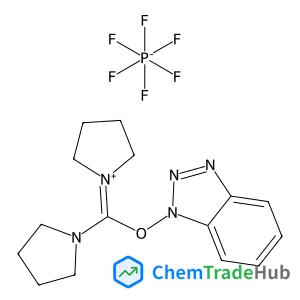
(1H-Benzotriazol-1-yloxy)(di-1-pyrrolidinyl)methylium hexafluorophosphate
CAS番号:
105379-24-6
分子式:
C15H21F6N5OP
おすすめサプライヤー



免責事項
このページに表示される学術雑誌情報は、参考および研究目的のみを目的としています。当社は雑誌出版社とは提携しておらず、投稿の取り扱いも行っておりません。出版に関するお問い合わせは、各雑誌出版社に直接ご連絡ください。
表示されている情報に誤りがある場合は、support@chemtradehub.com までご連絡ください。迅速に確認し、対応いたします。