












First principles intensity calculations of the methane rovibrational spectra in the infrared up to 9300 cm−1
文献情報
出版日
2013-04-12
DOI
10.1039/C3CP50275A
インパクトファクター
3.676
著者
Michaël Rey, Vladimir G. Tyuterev
原文を見る
要旨
We report global calculations of rovibrational spectra and dipole transition intensities of methane using our recent ab initio dipole moment and potential surfaces [Nikitin et al., Chem. Phys. Lett., 2011, 501, 179; 2013, 565, 5]. For the full symmetry account, a recently published variational tensor formalism in normal modes [Rey et al., J. Chem. Phys., 2012, 136, 244106] is applied, the convergence of high-J calculations being improved by the use of vibrational eigenfunctions to make a compressed basis set for solving the rovibrational problem. Comparisons of theoretical predictions up to J = 25 for various complex polyads of methane involving strongly coupled vibration–rotation bands support the validity of this new approach. For the first time, positions and line intensities at 80 K and 296 K are shown to be in excellent agreement with raw experimental data, even for high energy ranges. The theoretical predictions also correctly describe the isotopic effects in line positions and intensities due to the CH4 → CD4 substitution which is considered as the test for the method. This work is a first step toward the theoretical interpretation of numerous methane bands which remain still unassigned and detailed line-by-line absorption/emission spectra analyses for atmospheric and planetological applications.
関連文献
Rotamer libraries of spin labelled cysteines for protein studies
Yevhen Polyhach, Enrica Bordignon, Gunnar Jeschke
2010-11-30
Paper
DOI: 10.1039/C0CP01865A
On the path-dependence of the open-cell voltage of a galvanic cell involving a ternary or multinary compound with multiple mobile ionic species under multiple chemical potential gradients
Han-Ill Yoo, Manfred Martin
2010-10-14
Paper
DOI: 10.1039/C0CP00977F
Stability of thin film glasses of toluene and ethylbenzene formed by vapor deposition: an in situ nanocalorimetric study
Edgar Leon-Gutierrez, Alfonso Sepúlveda, Gemma Garcia, Maria Teresa Clavaguera-Mora
2010-10-13
Paper
DOI: 10.1039/C0CP00208A
On the viability of cyclometalated Ru(ii) complexes as dyes in DSSC regulated by COOH group, a DFT study
Jian Wang, Fu-Quan Bai, Lu Feng, Hong-Xing Zhang, Qing-Jiang Pan
2010-11-23
Paper
DOI: 10.1039/C0CP01556C
Mechanistical studies on the electron-induced degradation of polymethylmethacrylate and Kapton
Courtney P. Ennis, Ralf I. Kaiser
2010-10-26
Paper
DOI: 10.1039/C0CP01130D
Visible spectrum of titanium dioxide
Xiujuan Zhuang, Anh Le, Timothy C. Steimle, Ramya Nagarajan, Varun Gupta, John P. Maier
2010-10-18
Paper
DOI: 10.1039/C0CP00861C
Local defects enhanced dehydrogenation kinetics of the NaBH4-added Li–Mg–N–H system
Chu Liang, Yongfeng Liu, Ying Jiang, Zhijun Wei, Mingxia Gao, Hongge Pan, Qidong Wang
2010-10-28
Paper
DOI: 10.1039/C0CP00340A
こちらもおすすめ
化合物よくある質問
オステニ二甲磺酸塩に適用される法規ガイドラインは何ですか?
オステニ二甲磺酸塩は、GHS分類に基づき corrosive 物質として分類されます。REACH規則では、該当物質の登録が要求される可能性があります。また、FD...
2070014-82-1N-(2-{[2-(Dimethylam...
化合物よくある質問
環丁基肼盐酸盐は安全ですか?
環丁基肼盐酸盐は毒性があり、吸入や皮膚接触は有害です。使用時の安全対策として、密閉システムを使用し、適切な排気設備を備えた場所で作業することが推奨されます。
1156980-49-2Cyclobutylhydrazine ...
化合物よくある質問
N-(4-パリドン基ソニルフェニル)硫代イソシアネートを取り扱う際の実験室安全事項は何ですか?
N-(4-パリドン基ソニルフェニル)硫代イソシアネートは高毒性で、皮膚や吸入による毒性があります。取り扱う際は防毒マスク、保護用手袋、保護眼鏡などのPPEを着用...
7356-55-01-[(4-Isothiocyanato...
化合物よくある質問
5-ヒドロキシ-1,3-ジヒドロ-2H-インドン-2-酮の物理化学的性質は何ですか?
CAS番号3416-18-0の5-ヒドロキシ-1,3-ジヒドロ-2H-インドン-2-酮は、結晶性の白色粉末です。分子量は228.25であり、 aqueous m...
3416-18-05-Hydroxy-1,3-dihydr...
化合物よくある質問
O-苄基-D-丝氨醇はどのように合成されますか?
O-苄基-D-丝氨醇は、D-アミノ酸とベンゼン環の経由で合成されます。触媒としてジメチルアミノピリジンが使用され、選択性は高いです。一般的な収率は約90%です。
58577-88-1(s)-2-Amino-3-benzyl...
化合物よくある質問
ナトリウム3-ヒドロキシbutano酸とは何ですか?
ナトリウム3-ヒドロキシbutano酸は、CAS番号13613-65-5で登録されている化合物です。この化合物は、(3R)-3-ヒドロキシbutano酸とナトリ...
13613-65-5sodium;(3R)-3-hydrox...
化合物よくある質問
1-(二苯甲基)-4-甲基ベンゼンの物理化学的性質は何ですか?
CAS番号603-37-2の1-(二苯甲基)-4-甲基ベンゼンは、結晶性の固体で、分子量は244.28であり、水中的には微溶です。この化合物は有機反応において中...
603-37-21-(Diphenylmethyl)-4...
化合物よくある質問
ネアミン塩酸塩の物理化学的性質は何ですか?
ネアミン塩酸塩の分子量は321.19であり、結晶性の白色粉末です。この化合物は水に溶けやすく、pHが低くなると不溶性になります。反応活性は高く、水溶液中の酸化還...
15446-43-2NEAMINE HYDROCHLORID...
化合物よくある質問
偶氮二甲酰二哌啶の主な用途は何ですか?
偶氮二甲酰二哌啶は、医薬品、染料、高 Então 剤、触媒、溶媒、量論試薬など、様々な分野で使用されています。特に、高 Enough 反応において、グリコール酸...
10465-81-3(E)-1,2-Diazenediylb...
664969-54-44-[(2E)-3-Phenyl-2-p...
掲載誌
Physical Chemistry Chemical Physics

CiteScore:
5.5
自己引用率:
10.3%
年間論文数:
3036
Physical Chemistry Chemical Physics (PCCP) is an international journal co-owned by 19 physical chemistry and physics societies from around the world. This journal publishes original, cutting-edge research in physical chemistry, chemical physics and biophysical chemistry. To be suitable for publication in PCCP, articles must include significant innovation and/or insight into physical chemistry; this is the most important criterion that reviewers and Editors will judge against when evaluating submissions. The journal has a broad scope and welcomes contributions spanning experiment, theory, computation and data science. Topical coverage includes spectroscopy, dynamics, kinetics, statistical mechanics, thermodynamics, electrochemistry, catalysis, surface science, quantum mechanics, quantum computing and machine learning. Interdisciplinary research areas such as polymers and soft matter, materials, nanoscience, energy, surfaces/interfaces, and biophysical chemistry are welcomed if they demonstrate significant innovation and/or insight into physical chemistry. Joined experimental/theoretical studies are particularly appreciated when complementary and based on up-to-date approaches.
おすすめ化合物
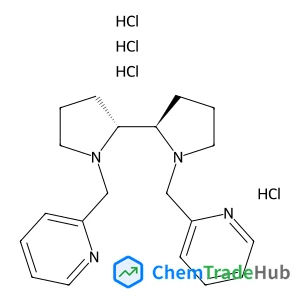
(2R,2'R)-1,1'-Bis(2-pyridinylmethyl)-2,2'-bipyrrolidine tetrahydrochloride
CAS番号:
1228077-88-0
分子式:
C20H30Cl4N4
amine structure](https://static.chemtradehub.com/structs/629/62924-61-2-0728.webp "[(2-chlorophenyl)methyl](ethyl)amine structure")
おすすめサプライヤー





免責事項
このページに表示される学術雑誌情報は、参考および研究目的のみを目的としています。当社は雑誌出版社とは提携しておらず、投稿の取り扱いも行っておりません。出版に関するお問い合わせは、各雑誌出版社に直接ご連絡ください。
表示されている情報に誤りがある場合は、support@chemtradehub.com までご連絡ください。迅速に確認し、対応いたします。