












Dissecting the structural determinants for the difference in mechanical stability of silk and amyloid beta-sheet stacks
文献情報
出版日
2013-04-11
DOI
10.1039/C3CP00067B
インパクトファクター
3.676
著者
Senbo Xiao, Shijun Xiao
原文を見る
要旨
Stacking of β-sheets results in a protein super secondary structure with remarkable mechanical properties. β-Stacks are the determinants of a silk fiber's resilience and are also the building blocks of amyloid fibrils. While both silk and amyloid-type crystals are known to feature a high resistance against rupture, their structural and mechanical similarities and particularities are yet to be fully understood. Here, we systematically compare the rupture force and stiffness of amyloid and spider silk poly-alanine β-stacks of comparable sizes using Molecular Dynamics simulations. We identify the direction of force application as the primary determinant of the rupture strength; β-sheets in silk are orientated along the fiber axis, i.e. the pulling direction, and consequently require high forces in the several nanoNewton range for shearing β-strands apart, while β-sheets in amyloid are oriented vertically to the fiber, allowing a zipper-like rupture at sub-nanoNewton forces. A secondary factor rendering amyloid β-stacks softer and weaker than their spider silk counterparts is the sub-optimal side-chain packing between β-sheets due to the sequence variations of amyloid-forming proteins as opposed to the perfectly packed poly-alanine β-sheets of silk. Taken together, amyloid fibers can reach the stiffness of silk fibers in spite of their softer and weaker β-sheet arrangement as they are missing a softening amorphous matrix.
関連文献
Unforeseen distance-dependent SERS spectroelectrochemistry from surface-tethered Nile Blue: the role of molecular orientation
Andrew J. Wilson, Katherine A. Willets
2016-06-20
Paper
DOI: 10.1039/C6AN01266C
Wearable superhigh energy density supercapacitors using a hierarchical ternary metal selenide composite of CoNiSe2 microspheres decorated with CoFe2Se4 nanorods
Chandu V. V. Muralee Gopi, Araveeti Eswar Reddy, Hee-Je Kim
2018-03-19
Paper
DOI: 10.1039/C8TA01141A
Protein hydration in living cells probed by Fourier transform infrared (FT-IR) spectroscopic imaging
B. Turner, J. Mizukado, S. G. Kazarian
2017-05-15
Paper
DOI: 10.1039/C7AN00337D
Bio-nanocapsules for oriented immobilization of DNA aptamers on aptasensors
Hideo Nakano, Tsutomu Nakayama
2022-01-13
Paper
DOI: 10.1039/D1AN02278D
HIV detection from human serum with paper-based isotachophoretic RNA extraction and reverse transcription recombinase polymerase amplification
Andrew T. Bender, Benjamin P. Sullivan, Jane Y. Zhang, David C. Juergens, Lorraine Lillis, David S. Boyle
2021-04-06
Paper
DOI: 10.1039/D0AN02483J
Tethering of spherical DOTAP liposome gold nanoparticles on cysteamine monolayer for sensitive label free electrochemical detection of DNA and transfection
Mohanlal Bhuvana, Venkataraman Dharuman
2014-02-10
Paper
DOI: 10.1039/C4AN00017J
Rhodamine 6G-based efficient chemosensor for trivalent metal ions (Al3+, Cr3+ and Fe3+) upon single excitation with applications in combinational logic circuits and memory devices
Dipankar Das, Rabiul Alam
2021-12-10
Paper
DOI: 10.1039/D1AN01788H
Self-assembled nanomaterials for biosensing and therapeutics: recent advances and challenges
Shan Huang, Yuexin Song, Zhimei He, Jian-Rong Zhang, Jun-Jie Zhu
2021-03-10
Minireview
DOI: 10.1039/D1AN00077B
Supramolecular self-assembly and perfected in vitro/vivo property of 5-fluorouracil and ferulic acid on the strength of double optimized strategy: the first 5-fluorouracial-phenolic acid nutraceutical cocrystal with synergistic antitumor efficacy
Yue-Ming Yu, Yuan-Yuan Niu, Ling-Yang Wang, Zhi-Yong Wu, Cui-Wei Yan
2021-03-10
Paper
DOI: 10.1039/D1AN00171J
O species-decorated graphene shell encapsulating iridium–nickel alloy as an efficient electrocatalyst towards hydrogen evolution reaction
Shipeng Gong, Changlai Wang, Peng Jiang, Kang Yang, Jian Lu, Minxue Huang, Shi Chen, Junzheng Wang
2019-06-06
Communication
DOI: 10.1039/C9TA04361F
こちらもおすすめ
化合物よくある質問
3-イチチルビフェニルはどのように合成されますか?
3-イチチルビフェニルは、ビフェニルとイチプロピオニトリルを回収率約90%で反応させて合成されます。触媒は通常、亜リチウムホウ素を用います。
5668-93-93-Ethylbiphenyl
化合物よくある質問
8-溴-5-三氟甲基喹啉はどのように合成されますか?
8-溴-5-三氟甲基喹啉は、5-トリフルオロメチル-2-メチル-1,3-ベンゼンジオールをブロモエタノールと反応させて生成します。この反応は塩基性条件下で行われ...
917251-92-48-Bromo-5-(trifluoro...
化合物よくある質問
ジメチル4-(4,4,5,5-テトラメチル-1,3,2-ドioxaborolan-2-基)-2,6-ピリジンジカルボイル酸フェニルアミニドの代替品はありますか?
ジメチル4-(4,4,5,5-テトラメチル-1,3,2-ドioxaborolan-2-基)-2,6-ピリジンジカルボイル酸フェニルアミニドの代替品としては、4-...
741709-66-0Dimethyl 4-(4,4,5,5-...
化合物よくある質問
N-(3,5-ヘキサクロロ-4-ピリドインイル)-8-メチオキシ-5-キノリンカーボン酸の市場動向や研究トレンドはどのようなものでしょうか?
N-(3,5-ヘキサクロロ-4-ピリドインイル)-8-メチオキシ-5-キノリンカーボン酸の市場動向は、主に産業用途での需要により影響を受けます。研究トレンドとし...
199871-63-1N-(3,5-Dichloro-4-py...
化合物よくある質問
イソステアロイルグリセリルは安全ですか?
イソステアロイルグリセリルは一般的に安全性が高いとされていますが、過度な使用や個人差により皮�owsん炎などの反応が起こる可能性があります。使用前に医師に相談す...
222723-55-92-[(5Z,8Z,11Z,14Z)-5...
化合物よくある質問
1-(二苯甲基)-3,3-二氟-氮杂环丁烷の市場動向や研究トレンドはどうですか?
1-(二苯甲基)-3,3-二氟-氮杂环丁烷の市場動向は、医薬品や合成化学の研究分野で注目を集めています。新興研究は、該当化合物の合成改良と生体内での作用メカニズ...
288315-02-61-Benzhydryl-3,3-dif...
化合物よくある質問
3-チオフェンスチオールの物理化学的性質は何ですか?
3-チオフェンスチオールのCAS番号は7774-73-4です。結晶性の白色粉末で、分子量は122.17です。この化合物は水に微溶解し、エタノールやジクロロメタン...
7774-73-43-Thiophenethiol
化合物よくある質問
2-Methyl-2-propanyl (2S)-2-(aminomethyl)-1-piperidinecarboxylateは安全ですか?
2-Methyl-2-propanyl (2S)-2-(aminomethyl)-1-piperidinecarboxylateは一定の安全性基準を満たしていま...
475105-35-22-Methyl-2-propanyl ...
化合物よくある質問
CAS番号1316822-90-8の化合物は安全ですか?
CAS番号1316822-90-8の化合物は安全性に関しては評価が不足していますが、一般的には生物学的に活性な物質であり、取り扱いには適切な安全防護措置が必要で...
1316822-90-8Gal beta(1-3)[Neu5Ac...
化合物よくある質問
Tert-butyl 2-(2-羟基乙基)哌嗪-1-羧酸はどのように保存すればよいですか?
Tert-butyl 2-(2-羟基乙基)哌嗪-1-羧酸は、冷暗所で保存し、直射日光から遠ざけてください。容器は密閉し、高湿度や高温を避けて保管してください。
517866-79-4Tert-butyl 2-(2-hydr...
掲載誌
Physical Chemistry Chemical Physics

CiteScore:
5.5
自己引用率:
10.3%
年間論文数:
3036
Physical Chemistry Chemical Physics (PCCP) is an international journal co-owned by 19 physical chemistry and physics societies from around the world. This journal publishes original, cutting-edge research in physical chemistry, chemical physics and biophysical chemistry. To be suitable for publication in PCCP, articles must include significant innovation and/or insight into physical chemistry; this is the most important criterion that reviewers and Editors will judge against when evaluating submissions. The journal has a broad scope and welcomes contributions spanning experiment, theory, computation and data science. Topical coverage includes spectroscopy, dynamics, kinetics, statistical mechanics, thermodynamics, electrochemistry, catalysis, surface science, quantum mechanics, quantum computing and machine learning. Interdisciplinary research areas such as polymers and soft matter, materials, nanoscience, energy, surfaces/interfaces, and biophysical chemistry are welcomed if they demonstrate significant innovation and/or insight into physical chemistry. Joined experimental/theoretical studies are particularly appreciated when complementary and based on up-to-date approaches.
おすすめ化合物
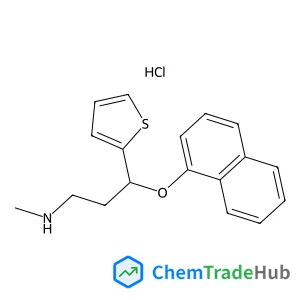
N-Methyl-3-(1-naphthyloxy)-3-(2-thienyl)-1-propanamine hydrochloride (1:1)
CAS番号:
1188266-11-6
分子式:
C18H20ClNOS
おすすめサプライヤー




免責事項
このページに表示される学術雑誌情報は、参考および研究目的のみを目的としています。当社は雑誌出版社とは提携しておらず、投稿の取り扱いも行っておりません。出版に関するお問い合わせは、各雑誌出版社に直接ご連絡ください。
表示されている情報に誤りがある場合は、support@chemtradehub.com までご連絡ください。迅速に確認し、対応いたします。