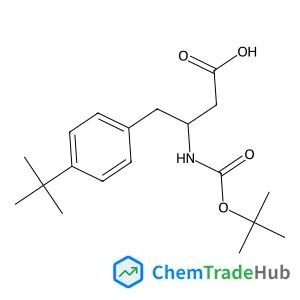
(S)-3-((tert-Butoxycarbonyl)amino)-4-(4-(tert-butyl)phenyl)butanoic acid
CAS番号:
403661-85-8
分子式:
C19H29NO4
Megumi Shintani, Yushi Matsuo, Shun Sakuraba
The location, orientation, and dynamics of hydrophobic small molecules in lipid membranes are studied through combined use of solution-state 1H-NMR and MD simulation. 1-Naphthol and 1-methylnaphthalene were adopted as the small molecules with or without hydrophilic groups. The nuclear Overhauser effect (NOE) measurement was performed for large unilamellar vesicles (100 nm in diameter) composed of dimyristoylphosphatidylcholine (DMPC) and the naphthalene derivative. The transient NOE-SE (spin–echo) scheme previously reported (J. Phys. Chem. B, 2011, 115, 9106–9115) was employed to quantitatively determine the NOE cross relaxation rate constant between DMPC and the naphthalene derivative. The observed NOE shows that both the naphthalene derivatives distribute over a wide domain across the normal of the essentially planar membrane ranging from the hydrophobic core to the hydrophilic headgroup. The experimental NOE information was further refined in combination with the analysis of time correlation functions in MD simulation. It was found that 1-naphthol exhibits a slight preference for pointing its OH group toward the hydrophilic domain of the membrane and that no definite preference can be concluded for the orientation of 1-methylnaphthalene. When 1-naphthol and 1-methylnaphthalene are compared, the NOE is stronger for 1-naphthol due to the restricted motion of the OH group. The slowdown of the 1-naphthol motion is also evidenced by the 1H spectral line width.

Russian Chemical Reviews

Kinetics and Catalysis

Pure and Applied Chemistry

Journal of Physics and Chemistry of Solids

Organic Preparations and Procedures International

Pharmacological Reviews

Journal of Catalysis

Israel Journal of Chemistry

Journal of Medicinal Chemistry

Proceedings of the National Academy of Sciences of the United States of America
Yan-Bo Wang, Dong-Sheng Sun, Hui Zhou, Wen-Zhen Zhang, Xiao-Bing Lu
DOI: 10.1039/C3GC42346H
Haonan Chen, Wujie Dai, Yi Chen, Qing Xu, Jianhui Chen, Yajuan Zhao, Mingde Ye
DOI: 10.1039/C3GC42310G
Mohd Azri Ab Rani, Nadine Borduas, Victoria Colquhoun, Robert Hanley, Henry Johnson, Solène Larger, Paul D. Lickiss, Veronica Llopis-Mestre, Selina Luu, Martin Mogstad, Philipp Oczipka, James R. Sherwood, Tom Welton, Jun-Yi Xing
DOI: 10.1039/C3GC42036A
Jennifer Neumann, Stephanie Steudte, Chul-Woong Cho, Jorg Thöming
DOI: 10.1039/C3GC41997E
Mike Horne, Alan M. Bond, Jie Zhang
DOI: 10.1039/C3GC42404A
Wenjun Lin, Fang Ding, Xiaoyan Luo, Xi He, Congmin Wang
DOI: 10.1039/C3GC41458B
Gregory Chatel, Jorge F. B. Pereira, Varun Debbeti, Hui Wang, Robin D. Rogers
DOI: 10.1039/C3GC41389F
José González-Rivera, Ignacio R. Galindo-Esquivel, Massimo Onor, Emilia Bramanti, Iginio Longo, Carlo Ferrari
DOI: 10.1039/C3GC42207K
Yong Qian, Yonghong Deng, Xueqing Qiu, Hao Li, Dongjie Yang
DOI: 10.1039/C3GC42131G
Jian-An Jiang, Cheng Chen, Jian-Gang Huang, Hong-Wei Liu, Song Cao, Ya-Fei Ji
DOI: 10.1039/C3GC41946K
4-アミノフェノール酸ナトリウム水和物は、CAS番号206557-08-6の化合物で、4-アミノフェノールとナトリウムが結合した塩と水和物です。この化合物は、白...
この化合物は特定の合成プロセスに使用される可能性がありますが、代替品として、他の类似的な化合物、例えばMethyl 3-methyl-N-{[(2-methyl...
4-Boc-2-哌嗪甲酸は、薬品開発や合成化学分野で広く使用されており、その需要は継続的に推移しています。特に、新薬開発における合成化学分野での需要が高まってい...
4,4'-二羟甲基联苯のCAS番号は1667-12-5です。この化合物は白色の結晶粉末で、分子量は154.20です。水にわずかに溶けますが、アルコールや有機溶媒...
5-甲硫基戊腈は医薬品産業で使用される可能性があります。また、ポリマー合成の触媒として、センサー製造の一部として、半導体製造のプロセス改善に使用される可能性があ...
この化合物は、1-abieta-8,11,13-trien-19-イルと6'-メトキシシンコナナン-9-基を含有する窒素含有化合物から合成されます。一般的な合成...
6-ブロモベンジジミダゾール-2-カルビルデオキシドは、避光・乾燥した容器(密閉容器)で-20℃~4℃の低温で保存してください。高温や直射日光、湿気は避けてくだ...
621-65-8のCAS番号を持つBoc-N-甲基氨甲环酸は、化学式C7H13NO5を有する化合物です。この化合物は白色の結晶性粉末で、吸湿性があります。
乙基三氟硼酸钾は、トリフLUオール酸カリウムとエチルブロミドを反応させて合成されます。この反応は高い選択性と収率を持ち、触媒を用いることで効率的に進行します。
2-フロウロ-5-クロロ-4-アミノフェノールは、直射日光を避けて冷却された暗所で保存し、密閉容器に保管してください。温度は常温か低温が適しています。

Physical Chemistry Chemical Physics (PCCP) is an international journal co-owned by 19 physical chemistry and physics societies from around the world. This journal publishes original, cutting-edge research in physical chemistry, chemical physics and biophysical chemistry. To be suitable for publication in PCCP, articles must include significant innovation and/or insight into physical chemistry; this is the most important criterion that reviewers and Editors will judge against when evaluating submissions. The journal has a broad scope and welcomes contributions spanning experiment, theory, computation and data science. Topical coverage includes spectroscopy, dynamics, kinetics, statistical mechanics, thermodynamics, electrochemistry, catalysis, surface science, quantum mechanics, quantum computing and machine learning. Interdisciplinary research areas such as polymers and soft matter, materials, nanoscience, energy, surfaces/interfaces, and biophysical chemistry are welcomed if they demonstrate significant innovation and/or insight into physical chemistry. Joined experimental/theoretical studies are particularly appreciated when complementary and based on up-to-date approaches.
![[3-(2,6-Dichlorophenyl)-5-isopropyl-1,2-oxazol-4-yl]methanol structure](https://static.chemtradehub.com/structs/278/278597-30-1-5c79.webp "[3-(2,6-Dichlorophenyl)-5-isopropyl-1,2-oxazol-4-yl]methanol structure")