


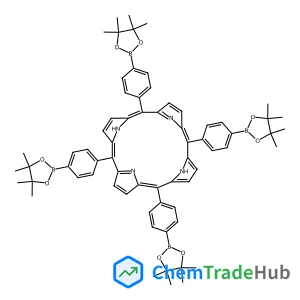
5,10,15,20-tetrakis(4-boronic acid pinacol ester phenyl) porphyrin
CAS番号:
1332748-00-1
分子式:
C68H74B4N4O8
Ming-Jie Wei, Luzheng Zhang, Linghong Lu, Yudan Zhu, Keith E. Gubbins, Xiaohua Lu
It is well known that titanium dioxide (TiO2) is biocompatible and environmentally friendly. Consequently, TiO2 is widely applied in many fields, such as implant materials, photocatalysis, pigments, cosmetic additives, etc. Mesoporous TiO2 finds many industrial applications, because of its high surface area and stable structure. However, the strong interaction between TiO2 and water molecules sometimes limits its application to solution environments. Our previous computational work showed that changes to the surface chemistry of TiO2 can affect the hydrogen bond network of water molecules on the TiO2 surface, and so influence the diffusion of water in the slits. Thus, a carbon-modified TiO2 surface could be an alternative way to avoid this limitation. In this work, a slit pore model with a modified TiO2 surface (pore widths 1.2 nm, 1.6 nm and 2.0 nm) with varying carbon coverages (0%, 7%, 47%, 53%, 93% and 100%) was presented. Molecular dynamics (MD) simulations were then performed to investigate the sorption and diffusion of water in these slits. Simulation results showed that the interfacial water molecules on bare TiO2 regions were little affected by the neighboring carbon, and they have the same properties as those on bare TiO2 surfaces. However, the diffusion of water molecules in the center of the slit was enhanced on increase of carbon coverage, because the carbon layer broke the hydrogen bond network between the interfacial water molecules and those on the bare TiO2 surface. It was found that in the slits (>1.2 nm) fully covered by carbon the diffusion coefficients of water are larger than that of bulk water. Moreover, large pore sizes caused an increase in the mobility of water molecules in carbon-modified TiO2, in agreement with previous experimental work.

Israel Journal of Chemistry

Helvetica Chimica Acta

Russian Chemical Reviews

Pure and Applied Chemistry

Proceedings of the National Academy of Sciences of the United States of America

European Journal of Wood and Wood Products

Nature

Organic Preparations and Procedures International

Journal of Physics and Chemistry of Solids

Journal of Organometallic Chemistry
Mohammad G. Al-Shaal, Adam Dzierbinski, Regina Palkovits
DOI: 10.1039/C3GC41803K
Mohd Azri Ab Rani, Nadine Borduas, Victoria Colquhoun, Robert Hanley, Henry Johnson, Solène Larger, Paul D. Lickiss, Veronica Llopis-Mestre, Selina Luu, Martin Mogstad, Philipp Oczipka, James R. Sherwood, Tom Welton, Jun-Yi Xing
DOI: 10.1039/C3GC42036A
DOI: 10.1039/C3GC42124D
Roger A. Sheldon
DOI: 10.1039/C3GC41935E
Lik H. Wee, Francesca Bonino, Carlo Lamberti, Silvia Bordiga, Johan A. Martens
DOI: 10.1039/C3GC41988F
Yawen Wei, Chao Wang, Xue Jiang, Dong Xue, Zhao-Tie Liu
DOI: 10.1039/C3GC42125B
DOI: 10.1039/C3GC42044B
Ying Yang, Yang Ren, Chengjun Sun, Shijie Hao
DOI: 10.1039/C3GC42121J
Arno Behr, Andreas J. Vorholt, Karoline A. Ostrowski, Thomas Seidensticker
DOI: 10.1039/C3GC41960F
Sivasubramanian Muthusaravanan, Chinnathambi Sasikumar, Balasubramanian Devi Bala, Subbu Perumal
DOI: 10.1039/C3GC42150C
4-アミノフェノール酸ナトリウム水和物は、CAS番号206557-08-6の化合物で、4-アミノフェノールとナトリウムが結合した塩と水和物です。この化合物は、白...
この化合物は特定の合成プロセスに使用される可能性がありますが、代替品として、他の类似的な化合物、例えばMethyl 3-methyl-N-{[(2-methyl...
4-Boc-2-哌嗪甲酸は、薬品開発や合成化学分野で広く使用されており、その需要は継続的に推移しています。特に、新薬開発における合成化学分野での需要が高まってい...
4,4'-二羟甲基联苯のCAS番号は1667-12-5です。この化合物は白色の結晶粉末で、分子量は154.20です。水にわずかに溶けますが、アルコールや有機溶媒...
5-甲硫基戊腈は医薬品産業で使用される可能性があります。また、ポリマー合成の触媒として、センサー製造の一部として、半導体製造のプロセス改善に使用される可能性があ...
この化合物は、1-abieta-8,11,13-trien-19-イルと6'-メトキシシンコナナン-9-基を含有する窒素含有化合物から合成されます。一般的な合成...
6-ブロモベンジジミダゾール-2-カルビルデオキシドは、避光・乾燥した容器(密閉容器)で-20℃~4℃の低温で保存してください。高温や直射日光、湿気は避けてくだ...
621-65-8のCAS番号を持つBoc-N-甲基氨甲环酸は、化学式C7H13NO5を有する化合物です。この化合物は白色の結晶性粉末で、吸湿性があります。
乙基三氟硼酸钾は、トリフLUオール酸カリウムとエチルブロミドを反応させて合成されます。この反応は高い選択性と収率を持ち、触媒を用いることで効率的に進行します。
2-フロウロ-5-クロロ-4-アミノフェノールは、直射日光を避けて冷却された暗所で保存し、密閉容器に保管してください。温度は常温か低温が適しています。

Physical Chemistry Chemical Physics (PCCP) is an international journal co-owned by 19 physical chemistry and physics societies from around the world. This journal publishes original, cutting-edge research in physical chemistry, chemical physics and biophysical chemistry. To be suitable for publication in PCCP, articles must include significant innovation and/or insight into physical chemistry; this is the most important criterion that reviewers and Editors will judge against when evaluating submissions. The journal has a broad scope and welcomes contributions spanning experiment, theory, computation and data science. Topical coverage includes spectroscopy, dynamics, kinetics, statistical mechanics, thermodynamics, electrochemistry, catalysis, surface science, quantum mechanics, quantum computing and machine learning. Interdisciplinary research areas such as polymers and soft matter, materials, nanoscience, energy, surfaces/interfaces, and biophysical chemistry are welcomed if they demonstrate significant innovation and/or insight into physical chemistry. Joined experimental/theoretical studies are particularly appreciated when complementary and based on up-to-date approaches.
![[3-(2,6-Dichlorophenyl)-5-isopropyl-1,2-oxazol-4-yl]methanol structure](https://static.chemtradehub.com/structs/278/278597-30-1-5c79.webp "[3-(2,6-Dichlorophenyl)-5-isopropyl-1,2-oxazol-4-yl]methanol structure")
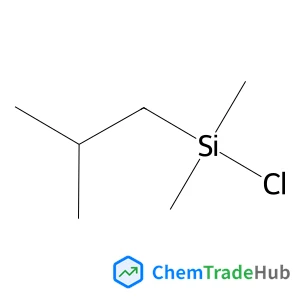
![N-{3-[Benzyl(methyl)amino]propyl}-9-chloro-5,6,7,8-tetrahydro-2-acridinecarboxamide structure](https://static.chemtradehub.com/structs/142/1426944-49-1-1e4c.webp "N-{3-[Benzyl(methyl)amino]propyl}-9-chloro-5,6,7,8-tetrahydro-2-acridinecarboxamide structure")
![6-Bromo-3-ethyl-3H-imidazo[4,5-b]pyridine structure](https://static.chemtradehub.com/structs/103/1033202-59-3-2a8f.webp "6-Bromo-3-ethyl-3H-imidazo[4,5-b]pyridine structure")




