












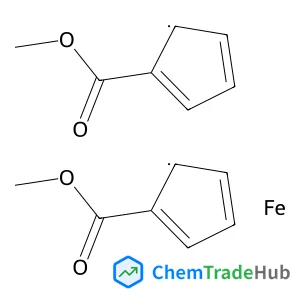
Ethylenepolymerization on a SiH4-modified Phillips catalyst: detection ofin situ produced α-olefins by operando FT-IR spectroscopy
文献情報
出版日
2011-11-29
DOI
10.1039/C2CP23269C
インパクトファクター
3.676
著者
Caterina Barzan, Elena Groppo, Elsje Alessandra Quadrelli, Vincent Monteil, Silvia Bordiga
原文を見る
要旨
Ethylene polymerization on a model Cr(II)/SiO2 Phillips catalyst modified with gas phase SiH4 leads to a waxy product containing a bimodal MW distribution of α-olefins (Mw < 3000 g mol−1) and a highly branched polyethylene, LLDPE (Mw ≈ 105 g mol−1, Tm = 123 °C), contrary to the unmodified catalyst which gives a linear and more dense PE, HDPE (Mw = 86 000 g mol−1 (PDI = 7), Tm = 134 °C). Pressure and temperature resolved FT-IR spectroscopy under operando conditions (T = 130–230 K) allows us to detect α-olefins, and in particular 1-hexene and 1-butene (characteristic IR absorption bands at 3581–3574, 1638 and 1598 cm−1) as intermediate species before their incorporation in the polymer chains. The polymerization rate is estimated, using time resolved FT-IR spectroscopy, to be 7 times higher on the SiH4-modified Phillips catalyst with respect to the unmodified one.
関連文献
Photoinduced charge recombination in dipolar D–A–A photonic liquid crystal polymorphs
Mercedes M. A. Mazza, Shiori Yamazaki, Dieu X. Mai, Suyog Padgaonkar, Samuel Peurifoy, Ariane Goncalves, Yi-Lin Wu, Qiaoyu Hu, Amy M. Scott
2017-01-11
Paper
DOI: 10.1039/C6CP08631D
Electronic structure and time-dependent description of rotational predissociation of LiH
P. Jasik, J. E. Sienkiewicz, J. Domsta, N. E. Henriksen
2017-06-06
Paper
DOI: 10.1039/C7CP02097J
On the capacitance of narrow nanotubes
Wolfgang Schmickler, Douglas Henderson
2017-07-06
Paper
DOI: 10.1039/C7CP03090H
The frequency-dependent response of single aerosol particles to vapour phase oscillations and its application in measuring diffusion coefficients
Thomas C. Preston, James F. Davies, Kevin R. Wilson
2017-01-13
Paper
DOI: 10.1039/C6CP07711K
Hybrid density functional theory modeling of Ca, Zn, and Al ion batteries using the Chevrel phase Mo6S8 cathode
Taylor R. Juran, Manuel Smeu
2017-07-18
Paper
DOI: 10.1039/C7CP03378H
The Langmuir–Hinshelwood approach for kinetic evaluation of cucurbit[7]uril-capped gold nanoparticles in the reduction of the antimicrobial nitrofurantoin
E. Blanco, P. Atienzar, P. Hernández, C. Quintana
2017-07-06
Paper
DOI: 10.1039/C7CP03534A
Initiation of wetting, filmwise condensation and condensate drainage from a surface in a gravity field
Sima Yaghoubian, C. A. Ward
2017-07-26
Paper
DOI: 10.1039/C7CP03039H
Formation of atmospheric molecular clusters consisting of sulfuric acid and C8H12O6 tricarboxylic acid
Jonas Elm, Nanna Myllys, Tinja Olenius, Roope Halonen, Theo Kurtén, Hanna Vehkamäki
2017-01-10
Paper
DOI: 10.1039/C6CP08127D
Indirect consequences of exciplex states on the phosphorescence lifetime of phenazine-based 1,2,3-triazole luminescent probes
Bárbara B. A. Costa, Guilherme A. M. Jardim, Paloma L. Santos, Hállen D. R. Calado, Andrew P. Monkman, Fernando B. Dias, Eufrânio N. da Silva Júnior, Luiz A. Cury
2016-10-21
Paper
DOI: 10.1039/C6CP06134F
こちらもおすすめ
化合物よくある質問
2-メトキシ-4-(メチルスルフィニル)アミンの主な用途は何ですか?
2-メトキシ-4-(メチルスルフィニル)アミンは、主に医薬品および農薬の製造に使用されます。また、合成化学の一部として研究用材料としても利用されます。
41608-73-52-Methoxy-4-(methyls...
118684-13-24-(Bromomethyl)-3-me...
化合物よくある質問
4,6-二氯-N-甲基ピラミジンアミンの代替品はありますか?
代替品としては、4,6-二クロロピラミジンアミンや他のピラミジン系化合物が考えられます。ただし、目的と用途によって最適な代替品は異なります。
10397-15-64,6-Dichloro-N-methy...
化合物よくある質問
6-氯-4-甲基-1H-吲哚を含む廃棄物はどのように処理すべきですか?
6-氯-4-甲基-1H-吲哚の廃棄物は、適切な容器に収集し、密閉して保管します。温度は常温、湿度は低く、直射日光を避けて保管することを推奨します。廃棄処理は専門...
885520-84-36-chloro-4-methyl-1H...
化合物よくある質問
2-フローユロ-4-(トリフルオロメチル)ベンゾイドについて「に適用される法規ガイドラインは何ですか」
2-フローユロ-4-(トリフルオロメチル)ベンゾイドのCAS番号は207974-08-1です。この化合物はGHS分類で毒性物質と有害な反応物質として分類されます...
207974-08-1[2-Fluoro-4-(trifluo...
化合物よくある質問
4-ニトロフェニルN-[(ベンゼルオキシルカーボンイル]グリシングリシングリシン酸はどのように保存すればよいですか?
4-ニトロフェニルN-[(ベンゼルオキシルカーボンイル]グリシングリシングリシン酸は、室温で暗所に保管し、乾燥した環境で保存することを推奨します。容器は密閉性の...
19811-64-44-Nitrophenyl N-[(be...
化合物よくある質問
イソデスロラタドリンの代替品はありますか?
イソデスロラタドリンの代替品としては、デスロラタドリンや他の抗ヒスタミン薬が挙げられます。具体的には、デスロラタドリン、ラセカミド、フェルタドリンなどが、症状や...
183198-49-4Iso Desloratadine
化合物よくある質問
5-甲氧基-1,2,3,4-四氢异喹啉盐酸盐はどのように合成されますか?
5-甲氧基-1,2,3,4-四氢异喹啉盐酸盐の一般的な合成方法は、メタノール中で5-メトキシ-1,2,3,4-四ヒュドロイソキシンを塩酸で塩化します。この反応で...
103030-69-95-Methoxy-1,2,3,4-te...
化合物よくある質問
4-アミノ-5-メトキシ-2-トルエンサルホニック酸についての法規ガイドラインは何ですか?
CAS番号6471-78-9の4-アミノ-5-メトキシ-2-トルエンサルホニック酸は、GHS分類では corrosive(腐食性)と識別されます。EUのREAC...
6471-78-94-Amino-5-Methoxy-2-...
化合物よくある質問
甲基孕酮を取り扱う際の実験室安全事項は何ですか?
甲基孕酮の取り扱いは、PPE(個人保護具)の使用が必要な重要な安全事項を伴います。防塵マスク、ゴーグル、手袋を着用することが推奨されます。ドラフトチャンバーを使...
204063-33-22-[(Diphenylmethyl)a...
掲載誌
Physical Chemistry Chemical Physics

CiteScore:
5.5
自己引用率:
10.3%
年間論文数:
3036
Physical Chemistry Chemical Physics (PCCP) is an international journal co-owned by 19 physical chemistry and physics societies from around the world. This journal publishes original, cutting-edge research in physical chemistry, chemical physics and biophysical chemistry. To be suitable for publication in PCCP, articles must include significant innovation and/or insight into physical chemistry; this is the most important criterion that reviewers and Editors will judge against when evaluating submissions. The journal has a broad scope and welcomes contributions spanning experiment, theory, computation and data science. Topical coverage includes spectroscopy, dynamics, kinetics, statistical mechanics, thermodynamics, electrochemistry, catalysis, surface science, quantum mechanics, quantum computing and machine learning. Interdisciplinary research areas such as polymers and soft matter, materials, nanoscience, energy, surfaces/interfaces, and biophysical chemistry are welcomed if they demonstrate significant innovation and/or insight into physical chemistry. Joined experimental/theoretical studies are particularly appreciated when complementary and based on up-to-date approaches.
おすすめ化合物
おすすめサプライヤー




免責事項
このページに表示される学術雑誌情報は、参考および研究目的のみを目的としています。当社は雑誌出版社とは提携しておらず、投稿の取り扱いも行っておりません。出版に関するお問い合わせは、各雑誌出版社に直接ご連絡ください。
表示されている情報に誤りがある場合は、support@chemtradehub.com までご連絡ください。迅速に確認し、対応いたします。