












Geometric phase and gauge connection in polyatomic molecules‡
文献情報
出版日
2012-02-08
DOI
10.1039/C2CP22974A
インパクトファクター
3.676
著者
Curt Wittig
原文を見る
要旨
Geometric phase is an interesting topic that is germane to numerous and varied research areas: molecules, optics, quantum computing, quantum Hall effect, graphene, and so on. It exists only when the system of interest interacts with something it perceives as exterior. An isolated system cannot display geometric phase. This article addresses geometric phase in polyatomic molecules from a gauge field theory perspective. Gauge field theory was introduced in electrodynamics by Fock and examined assiduously by Weyl. It yields the gauge field Aμ, particle–field couplings, and the Aharonov–Bohm phase, while Yang–Mills theory, the cornerstone of the standard model of physics, is a template for non-Abelian gauge symmetries. Electronic structure theory, including nonadiabaticity, is a non-Abelian gauge field theory with matrix-valued covariant derivative. Because the wave function of an isolated molecule must be single-valued, its global U(1) symmetry cannot be gauged, i.e., products of nuclear and electron functions such as χnψn are forbidden from undergoing local phase transformation on R, where R denotes nuclear degrees of freedom. On the other hand, the synchronous transformations (first noted by Mead and Truhlar): ψn → ψneiζ and simultaneously χn → χne−iζ, preserve single-valuedness and enable wave functions in each subspace to undergo phase transformation on R. Thus, each subspace is compatible with a U(1) gauge field theory. The central mathematical object is Berry's adiabatic connection i〈n|∇n〉, which serves as a communication link between the two subsystems. It is shown that additions to the connection according to the gauge principle are, in fact, manifestations of the synchronous (eiζ/e−iζ) nature of the ψn and χn phase transformations. Two important U(1) connections are reviewed: qAμ from electrodynamics and Berry's connection. The gauging of SU(2) and SU(3) is reviewed and then used with molecules. The largest gauge group applicable in the immediate vicinity of a two-state intersection is U(2), which factors to U(1) × SU(2). Gauging SU(2) yields three fields, whereas U(1) is not gauged, as the result cannot be brought into registry with electronic structure theory, and there are other problems as well. A parallel with spontaneous symmetry breaking in electroweak theory is noted. Loss of SU(2) symmetry as the energy gap between adiabats increases yields the inter-related U(1) symmetries of the upper and lower adiabats, with spinor character imprinted in the vicinity of the degeneracy.
関連文献
Synthesis and host–guest properties of an alternating copolymer containing calix[4]arene and calix[6]arene in its main chain
Tomoki Ogoshi, Yoko Nishida, Tada-aki Yamagishi, Yoshiaki Nakamoto
2009-12-16
Paper
DOI: 10.1039/B9PY00221A
In situ sensors for flow reactors – a review
Jun Li, Helena Šimek, David Ilioae, Nicole Jung, Stefan Bräse, Hans Zappe, Roland Dittmeyer, Bradley P. Ladewig
2021-04-16
Review Article
DOI: 10.1039/D1RE00038A
A polythiophene derivative with octyl diphenylamine-vinylene side chains: synthesis and its applications in field-effect transistors and solar cells
Bo Liu, Weiping Wu, Yunqi Liu, Yuehui He, Chunyue Pan, Yingping Zou
2010-03-09
Paper
DOI: 10.1039/C0PY00022A
High yield and greener C–H difluoromethylation reactions using copper iodide nanoparticles/boron nitride nanosheets as a versatile and recyclable heterogeneous catalyst
Gowsika Jaikumar, Fushen Lu
2021-07-29
Paper
DOI: 10.1039/D1RE00196E
Electrocatalytic hydrogenation of furfural paired with photoelectrochemical oxidation of water and furfural in batch and flow cells
Ram Ji Dixit, Aditya Singh, Vijay K. Ramani
2021-10-11
Paper
DOI: 10.1039/D1RE00080B
Hydrodeoxygenation of sulfoxides into sulfides under mild conditions over a heterogeneous cobalt catalyst
Yanxin Wang, Kaiyue Yao, Duanjian Tao, Nian Xiang, Wei Wang, Zehui Zhang
2021-05-25
Paper
DOI: 10.1039/D1RE00082A
Thiol-ene “click” reactions and recent applications in polymer and materials synthesis
Andrew B. Lowe
2009-11-25
Review Article
DOI: 10.1039/B9PY00216B
こちらもおすすめ
化合物よくある質問
2-ブロモ-9,9-ジフェニル-9H-フルオレンの主な用途は何ですか?
2-溴-9,9-二苯基芴は、医薬品、工業材料、有機合成の研究分野で応用されます。特に、レーザー材料や機能性ポリマーの合成に使用されることがあります。また、蛍光色...
474918-32-62-Bromo-9,9-diphenyl...
化合物よくある質問
四氯化铱の市場動向や研究トレンドはどうですか?
四氯化铱の市場は研究開発分野で注目されており、特にナノ技術や金属有機框架(MOFs)の分野での需要が増加傾向にあります。価格は安定しており、中国や韓国での生産が...
207399-11-9Tetrachloroiridium h...
882-06-44-Nitrocinnamic acid
化合物よくある質問
1-(4-溴-3-氟苯基)-2-氯乙酮を含む廃棄物はどのように処理すべきですか?
1-(4-溴-3-氟苯基)-2-氯乙酮 (CAS番号: 1260857-14-4) の廃棄物は専門的な廃棄処理が必要です。まず、廃棄物は密閉された容器に収集し、...
1260857-14-41-(4-Bromo-3-fluorop...
化合物よくある質問
苦参酚Kとは何ですか?
苦参酚Kは、CAS番号101236-49-1を持つ化合物で、主に天然由来の生薬から抽出されます。この化合物は、抗炎症作用や抗癌作用を持つことが報告されています。
101236-49-1Kushenol K
化合物よくある質問
POTASSIUM (1-(TERTBUTOXYCARBONYL)AZETIDIN-3-YL)TRIFLUOROBORATE を含む廃棄物はどのように処理すべきですか?
POTASSIUM (1-(TERTBUTOXYCARBONYL)AZETIDIN-3-YL)TRIFLUOROBORATE を含む廃棄物は、まず安全なエント...
1430219-73-0Potassium (1-(tert-b...
化合物よくある質問
4-庚基-4’-联苯羧酸の市場動向や研究トレンドはどうですか?
4-庚基-4’-聯苯羧酸は、特殊化学品や合成化学の分野で用いられる化学物質ですが、市場動向としては、研究開発の進展とともに需要が増加しています。また、環境配慮型...
58573-94-74'-Heptyl-4-biphenyl...
化合物よくある質問
6-ブロモ-3-メトキシ-1-フェニル-1H-インドゾールを含む廃棄物はどのように処理すべきですか?
6-ブロモ-3-メトキシ-1-フェニル-1H-インドゾールを含む廃棄物は、適切な化学廃棄処理が必要です。通常、廃棄物は密閉容器に収集され、専門の廃棄処理業者に引...
1332527-03-36-Bromo-3-methoxy-1-...
化合物よくある質問
4,4-二甲基-2-吡咯烷酮はどの業界で使用されていますか?
4,4-二甲基-2-吡咯烷酮は医薬、ポリマー、センサー、半導体などの業界で広く使用されています。特に溶媒としての性能が高く評価されています。
66899-02-34,4-dimethylpyrrolid...
51312-42-6Sodium Phosphotungst...
掲載誌
Physical Chemistry Chemical Physics

CiteScore:
5.5
自己引用率:
10.3%
年間論文数:
3036
Physical Chemistry Chemical Physics (PCCP) is an international journal co-owned by 19 physical chemistry and physics societies from around the world. This journal publishes original, cutting-edge research in physical chemistry, chemical physics and biophysical chemistry. To be suitable for publication in PCCP, articles must include significant innovation and/or insight into physical chemistry; this is the most important criterion that reviewers and Editors will judge against when evaluating submissions. The journal has a broad scope and welcomes contributions spanning experiment, theory, computation and data science. Topical coverage includes spectroscopy, dynamics, kinetics, statistical mechanics, thermodynamics, electrochemistry, catalysis, surface science, quantum mechanics, quantum computing and machine learning. Interdisciplinary research areas such as polymers and soft matter, materials, nanoscience, energy, surfaces/interfaces, and biophysical chemistry are welcomed if they demonstrate significant innovation and/or insight into physical chemistry. Joined experimental/theoretical studies are particularly appreciated when complementary and based on up-to-date approaches.
おすすめ化合物
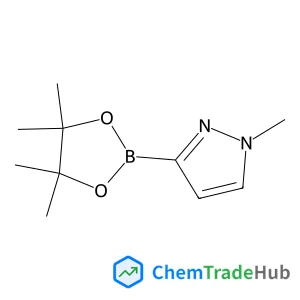
1-Methyl-3-(4,4,5,5-tetramethyl-1,3,2-dioxaborolan-2-yl)-1H-pyrazole
CAS番号:
1020174-04-2
分子式:
C10H17BN2O2

おすすめサプライヤー





免責事項
このページに表示される学術雑誌情報は、参考および研究目的のみを目的としています。当社は雑誌出版社とは提携しておらず、投稿の取り扱いも行っておりません。出版に関するお問い合わせは、各雑誌出版社に直接ご連絡ください。
表示されている情報に誤りがある場合は、support@chemtradehub.com までご連絡ください。迅速に確認し、対応いたします。