



Liposomes in biosensors
文献情報
出版日
2012-09-25
DOI
10.1039/C2AN36140J
インパクトファクター
4.616
著者
Qingtao Liu, Ben J. Boyd
原文を見る
要旨
Liposomes have been widely applied as carriers of molecules in the fields of nanodevices, drug delivery and gene delivery, as well as a mimic for cell membranes. In the biosensor field, liposomes find special application in signal amplification, due to their excellent carrier properties for encapsulation of signal marker compounds across a wide spectrum of sensing modalities. Additionally, the ability to modify the liposome surface structure to perform recognition functions with a wide range of types of analytes is an important aspect of their use in bioanalysis. This article provides an extensive review of the utility of liposomes in the fields of biosensor and bioanalysis with a focus on these two aspects. The aspects related to the translation of liposomes into commercially viable devices for biosensing are also discussed, and the hurdles to more widespread deployment in point of care systems are addressed.
おすすめジャーナル

Foundations of Chemistry

Angewandte Chemie International Edition

Journal of Medical Biochemistry

Coloration Technology

Faraday Discussions

Lab on a Chip

Journal of Enzyme inhibition and Medicinal Chemistry

European Journal of Organic Chemistry

Current Pharmaceutical Biotechnology

Environmental Toxicology and Pharmacology
関連文献
Oxygen defect regulation, catalytic mechanism, and modification of HfO2 as a novel catalyst for lithium–oxygen batteries
Lei Zhang, Xingyi Zhan, Yifan Zhang, Yuanhao Wang
2023-12-12
Paper
DOI: 10.1039/D3TA06287B
Segregation and interdiffusion processes in perovskites: a review of recent advances
Natalia Porotnikova
2024-01-09
Review Article
DOI: 10.1039/D3TA06708D
Liquid polybutadiene reinforced inverse vulcanised polymers
Veronica Hanna, Michael Graysmark, Helen Willcock, Tom Hasell
2023-12-12
Paper
DOI: 10.1039/D3TA05470E
Synthesis of completely solvent-free biomedical waterborne polyurethane with excellent mechanical property retention and satisfactory water absorption
Ao Zhen, Guanyu Zhang, Ao Wang, Feng Luo, Jiehua Li, Hong Tan, Zhen Li
2023-12-13
Paper
DOI: 10.1039/D3TA06813G
Strategies to enhance figures of merit in ICP-ToF-MS
T. E. Lockwood, R. Gonzalez de Vega, Z. Du, L. Schlatt, X. Xu, D. Clases
2023-11-30
Paper
DOI: 10.1039/D3JA00288H
In situ built nanoconfined Nb2O5 particles in a 3D interconnected Nb2C MXene@rGO conductive framework for high-performance potassium-ion batteries
Zhitang Fang, Weizhi Kou, Xiaoge Li, Jinhua Zhou, Gang Yang, Luming Peng, Xuefeng Guo, Weiping Ding, Wenhua Hou
2023-11-10
Research Article
DOI: 10.1039/D3QI01775C
こちらもおすすめ
化合物よくある質問
2,3-スチオエポキシマドルを取り扱う際の実験室安全事項は何ですか?
取り扱いにはPPE(プロテクティブ・パーソナル・エイド)が必要で、防ぐ手袋と保護眼鏡を着用してください。ドラフトチャンバーの使用を推奨します。漏洩した場合は、適...
4267-80-52,3-Thioepoxy Madol
53981-25-22-Amino-6-fluorophen...
化合物よくある質問
BOC-S-3-アミニ-4-(4-メチオキシベンチル)-ブタン酸の代替品はありますか?
この化合物の代替品としては、BOC保護基を有さないアミノ酸やその他の保護基化合物が考えられます。また、メチオキシ基を有しない他の芳香族アミノ酸も代替品として挙げ...
126800-59-7(3S)-4-(4-Methoxyphe...
化合物よくある質問
Methyl 2-(chloromethyl)-3-nitrobenzoate(1218910-61-2)の代替品はありますか?
Methyl 2-(chloromethyl)-3-nitrobenzoate(1218910-61-2)の代替品としては、化学組成を変えることで効果を達成する...
1218910-61-2Methyl 2-(chlorometh...
化合物よくある質問
(2R)-2-アミノ-N-ベンジル-3-ヒドロキシプロパナミドを含む廃棄物はどのように処理すべきですか?
(2R)-2-アミノ-N-ベンジル-3-ヒドロキシプロパナミドを含む廃棄物は、適切な廃棄物管理ガイドラインに基づき処理する必要があります。まず、廃棄物を適切に収...
175481-39-7(2R)-2-amino-N-benzy...
化合物よくある質問
6,7-二氢-咪唑並[1,2-a]ピリドイン-8(5h)-酮はどのように合成されますか?
6,7-二氢-咪唑並[1,2-a]ピリドイン-8(5h)-酮は、2-ブロモフェニルアセトインとリン酸ハロゲン化物を反応させることで合成できます。この反応は高温で...
457949-09-66,7-Dihydroimidazo[1...
化合物よくある質問
エチル(3R)-3-ピロリジニル酢酸水和塩とは何ですか?
エチル(3R)-3-ピロリジニル酢酸水和塩は、CAS番号1332459-32-1の化合物で、(R)-乙基2-(ピロリジン-3-基)酢酸塩水和塩と呼ばれます。この...
1332459-32-1Ethyl (3R)-3-pyrroli...
化合物よくある質問
(2S)-{[(2-メチルエチルオキシ]カルボニル}アミノ)[2-(トリアフルオロメチルフェニル]エチカシック酸の物理化学的性質は何ですか?
(2S)-{[(2-メチルエチルオキシ]カルボニル}アミノ)[2-(トリアフルオロメチルフェニル]エチカシック酸のCAS番号は1203454-45-8です。この...
1203454-45-8(2S)-({[(2-Methyl-2-...
化合物よくある質問
2-ブロモ-1-(2-メチル-2-プロパニル)-4-ニトロベンゼンはどのように保存すればよいですか?
2-ブロモ-1-(2-メチル-2-プロパニル)-4-ニトロベンゼンは、直射日光を避けて暗所で、室温(約15℃〜25℃)、乾燥した場所に保存する必要があります。ま...
6310-17-42-Bromo-1-(2-methyl-...
化合物よくある質問
1-[(4-硝基フェニル)スルホニル]-1H-1,2,4-三唑の市場動向や研究トレンドはどうですか?
市場動向としては、1-[(4-硝基フェニル)スルホニル]-1H-1,2,4-三唑は主に農業用除草剤や合成化学製品の原料として利用されています。研究トレンドとして...
57777-84-11-[(4-Nitrophenyl)su...
掲載誌
Analyst

CiteScore:
7.8
自己引用率:
5.6%
年間論文数:
653
Analyst publishes analytical and bioanalytical research that reports premier fundamental discoveries and inventions, and the applications of those discoveries, unconfined by traditional discipline barriers.
おすすめ化合物
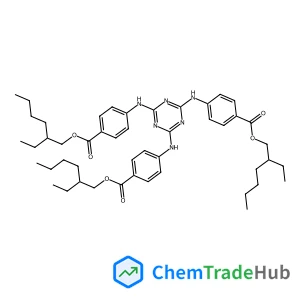
Tris(2-ethylhexyl) 4,4',4''-(1,3,5-triazine-2,4,6-triyltriimino)tribenzoate
CAS番号:
88122-99-0
分子式:
C48H66N6O6



おすすめサプライヤー






免責事項
このページに表示される学術雑誌情報は、参考および研究目的のみを目的としています。当社は雑誌出版社とは提携しておらず、投稿の取り扱いも行っておりません。出版に関するお問い合わせは、各雑誌出版社に直接ご連絡ください。
表示されている情報に誤りがある場合は、support@chemtradehub.com までご連絡ください。迅速に確認し、対応いたします。