












Modular synthesis of poly(perylene bisimides) using click chemistry: a comparative study
文献情報
出版日
2011-07-13
DOI
10.1039/C1PY00191D
インパクトファクター
5.582
著者
Andreas S. Lang, Mukundan Thelakkat
原文を見る
要旨
A systematic study of the influence of the chemical substitution pattern of side chain polymers carrying perylene bisimide (PBI) pendants is presented. To achieve a high comparability, the modular approach of copper-catalyzed azide–alkyne cycloaddition (CuAAC, “click” chemistry) was chosen to attach six differently substituted PBI azide moieties to a poly(propargyloxystyrene) backbone to obtain poly(perylene bisimides), PPBIs. The N, N′ substituted PPBIs differ structurally in two ways. On the one hand, the N-swallow-tail substituent was varied between hydrophilic oligoethyleneglycol and hydrophobic alkyl groups. On the other hand, the length of the N′-alkyl spacer, connecting PBI moiety and polymer backbone, was varied from (CH2)6 to (CH2)8 and to (CH2)11. The polymer analogous reactions between PBI-azides and poly(propargyloxystyrene) were monitored by 1H NMR and were found to be nearly quantitative in all cases. The resulting PPBIs exhibit Mn around 60 000 g mol−1 and narrow PDIs of 1.1. Structure–property relationships of all polymers were elucidated by studying their thermal behaviour using DSC and their structural properties with XRD measurements.
関連文献
Two-dimensional lead-free silver-bismuth double perovskite nanobelts with intrinsic chirality via co-antisolvent modulation strategy
Xuexia Yu, Rong Lu, Pengfei Zhang
2023-10-27
Communication
DOI: 10.1039/D3CC04308H
N-Sulfonyl amidine polypeptides: new polymeric biomaterials with conformation transition responsive to tumor acidity
Xiang Xu, Jinjuan Ma, Aiguo Wang
2023-12-20
Edge Article
DOI: 10.1039/D3SC05504C
Regulating the electronic structure of metal–organic frameworks via ion-exchanged Ir dispersion for robust overall water splitting
Shunfa Zhou, Jiawei Shi, Jing Li, Weiwei Cai
2023-11-13
Communication
DOI: 10.1039/D3CC04990F
Ultrathin RhCo alloy nanowires with defect-rich active sites for alkaline hydrogen evolution electrocatalysis
Luyu Zhu, Dongdong Xu, Chenglin Yi
2023-10-20
Communication
DOI: 10.1039/D3CC04195F
Hyperbranched polyphthalocyanine micelles with dual PTT/PDT functions for bacteria eradication under an NIR window
Ying Du, Guangyu Chu, Rui Yu, Rui Cui, Yuling Wang, Yiyong Mai, Ming Guan, Fugui Xu, Yongfeng Zhou
2023-11-01
Communication
DOI: 10.1039/D3CC04082H
Microwave-assisted chemoselective transamidation of secondary amides by selective N–C(O) bond cleavage under catalyst, additive and solvent-free conditions
Vishal Singh, Khushbu Rajput, Ankush Mishra, Sundaram Singh, Vandana Srivastava
2023-11-09
Communication
DOI: 10.1039/D3CC04128J
Enhancement of cryopreservation with intracellularly permeable zwitterionic polymers
Ryota Yamasaki, Robin Rajan, Kazuaki Matsumura
2023-11-02
Communication
DOI: 10.1039/D3CC04092E
Creating glassy states of dicarboxylate-bridged coordination polymers
Zeyu Fan, Yong-Sheng Wei, Chinmoy Das, Kazuyoshi Kanamori, Hiroki Yamada, Koji Ohara
2023-11-07
Communication
DOI: 10.1039/D3CC04518H
こちらもおすすめ
化合物よくある質問
間溴苯甲酰腈の市場動向や研究トレンドはどうですか?
間 brom 苯甲酰腈は、合成化学や薬物化学において重要な Intermediate として使用されています。市場動向としては、その合成性と機能性により、研究開...
24999-51-7(3-Bromophenyl)(oxo)...
287966-62-5Desulfo Glucoraphani...
化合物よくある質問
Methyl 2-amino-5-(trifluoromethyl)benzoateに適用される法規ガイドラインは何ですか?
CAS番号117324-58-0の塩酸メチル2アミノ-5-トリフルオロメチルベンゼートは、GHS分類により腐食性物質と判定されます。REACH規則では、製造、販...
117324-58-0Methyl 2-amino-5-(tr...
化合物よくある質問
3-ブロモ-1,3,4,5-四水化-2H-1-ベンザアゼピン-2-オンは安全ですか?
毒性があるため、適切な安全対策が必須です。皮膚や粘膜への刺激性が強く、吸入や誤飲により健康被害を引き起こす可能性があります。取扱時にはガスマスクや手袋、眼鏡を使...
86499-96-93-Bromo-1,3,4,5-tetr...
化合物よくある質問
三氟甲基ピリジン-2-甲アミン塩酸塩は安全ですか?
三氟甲基ピリジン-2-甲アミン塩酸塩は安全性に注意が必要です。毒性は低レベルですが、直接的接触や吸入は避けるべきです。適切な手袋や防塵マスクを着用し、密閉された...
871826-12-9(5-(Trifluoromethyl)...
化合物よくある質問
1-エチル-4-(4-硝基フェニル)ピペリジンは安全ですか?
1-エチル-4-(4-硝基フェニル)ピペリジンは有毒であり、取扱には注意が必要です。保管や作業中に手袋を着用し、目や皮膚に接触しないように注意する必要があります...
115619-00-61-Ethyl-4-(4-nitroph...
化合物よくある質問
1,1-ジメトキシプロパン-2-オンは安全ですか?
1,1-ジメトキシプロパン-2-オンは一般的に低毒性ですが、皮膚や目への刺激性があるため、取扱いには注意が必要です。蒸気や液体の吸入には有害な可能性があり、適切...
6342-56-91,1-dimethoxypropan-...
化合物よくある質問
コバルト(II) 3,3'-{[(1S,2S)-1,2-ジメチルフENCYCLICALE-1,2-エチエンジイル]ビス[ニトロリルメチルイリデン]}ビス[4-オキソ-2-ペンテン-2-olate]について「に適用される法規ガイドラインは何ですか?
この化合物はCAS番号259259-80-8に対応しています。GHS分類では、毒性、燃焼性、反応性、炎症性を考慮に入れ、適切な危険性分類が行われます。REACH...
259259-80-8Cobalt(2+) (2E,2'E)-...
化合物よくある質問
「カーバミル酸, N-[8-[[2-[[2-(2,6-ジオキソ-3-ピペリジニル)-2,3-ジオキソ-1,3-ジヒドロ-1H-イソイソインドール-4-イルオキシ]アセチル]アミノ]オクチル]-1,1-ジメチレチルエステル」はどのように保存すればよいですか?
この化合物は、冷却庫で-20℃の温度、乾燥した容器に保管し、直日光から保護する必要があります。湿度の高い環境や高温は避けてください。
1950635-34-32-Methyl-2-propanyl ...
1433975-21-3FMoc-D-4-Aph(tBu-CbM...
掲載誌
Polymer Chemistry

CiteScore:
8.6
自己引用率:
7.3%
年間論文数:
457
Polymer Chemistry welcomes submissions in all areas of polymer science that have a strong focus on macromolecular chemistry. Manuscripts may cover a broad range of fields, yet no direct application focus is required.
おすすめ化合物
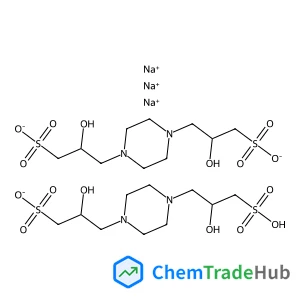
3,3'-(Piperazine-1,4-diyl)bis(2-hydroxypropane-1-sulfonic acid) Sodium Salt
CAS番号:
108321-08-0
分子式:
C20H41N4Na3O16S4
おすすめサプライヤー



免責事項
このページに表示される学術雑誌情報は、参考および研究目的のみを目的としています。当社は雑誌出版社とは提携しておらず、投稿の取り扱いも行っておりません。出版に関するお問い合わせは、各雑誌出版社に直接ご連絡ください。
表示されている情報に誤りがある場合は、support@chemtradehub.com までご連絡ください。迅速に確認し、対応いたします。