


![4-[2-(Trichlorosilyl)ethyl]benzenesulfonyl chloride structure](https://static.chemtradehub.com/structs/797/79793-00-3-de16.webp "4-[2-(Trichlorosilyl)ethyl]benzenesulfonyl chloride structure")
Intermolecular vibrations of (CH2)2O–HF and –DF hydrogen bonded complexes investigated by Fourier transform infrared spectroscopy and ab initio calculations
文献情報
出版日
2010-08-18
DOI
10.1039/C004100A
インパクトファクター
3.676
著者
原文を見る
要旨
A series of Fourier transform infrared spectra (FTIR) of the hydrogen bonded complexes (CH2)2O–HF and –DF have been recorded in the 50–750 cm−1 range up to 0.1 cm−1 resolution in a static cell maintained at near room temperature. The direct observation of three intermolecular transitions enabled us to perform band contour analysis of congested cell spectra and to determine reliable rovibrational parameters such as intermolecular frequencies, rovibrational and anharmonic coupling constants involving two l1 and l2 librations and one σ stretching intermolecular motion. Inter-inter anharmonic couplings could be identified between νl1, νl2, νσ and the two lowest frequency bending modes. The positive sign of coupling constants (opposite with respect to acid stretching intra-inter ones) reveals a weakening of the hydrogen bond upon intermolecular excitation. The four rovibrational parameters νσ and xσj (j = σ, δ1, δ2) derived in the present far-infrared study and also in a previous mid-infrared one [Phys. Chem. Chem. Phys. 2005, 1, 592] make deviations appear smaller than 1% for frequencies and 12% for coupling constants which gives confidence to the reliability of the data obtained. Anharmonic frequencies obtained at the MP2 level with Aug-cc-pvTZ basis set agree well with experimental values over a large set of frequencies and coupling constants. An estimated anharmonic corrected value of the dissociation energy DCP0 for both oxirane–HF (2424 cm−1) and –DF (2566 cm−1) has been derived using a level of theory as high as CCSD(T)/Aug-cc-pvQZ, refining the harmonic value previously calculated for oxirane–HF with the MP2 method and a smaller basis set. Finally, contrary to short predissociation lifetimes evidenced for acid stretching excited states, any homogeneous broadening related to vibrational dynamics of (CH2)2O–HF and –DF has been observed within the three highest frequency intermolecular states, as expected with low excitation energies largely below the dissociation limit as well as a negligible IVR contribution.
おすすめジャーナル

Accounts of Chemical Research

Journal of the American Chemical Society

Bulletin of the Chemical Society of Japan

Chemistry of Natural Compounds

Doklady Chemistry

Advances in Colloid and Interface Science

Australian Journal of Chemistry

Canadian Metallurgical Quarterly

Journal of the Chinese Chemical Society

Corrosion Science
関連文献
Strong-pump strong-probe spectroscopy: effects of higher excited electronic states
Maxim F. Gelin, Dassia Egorova, Wolfgang Domcke
2013-03-22
Paper
DOI: 10.1039/C3CP44454F
Single-layered V2O5 a promising cathode material for rechargeable Li and Mg ion batteries: an ab initio study
Zhiguo Wang, Qiulei Su, Huiqiu Deng
2013-04-12
Communication
DOI: 10.1039/C3CP51167G
Synchrotron high energy X-ray methods coupled to phase sensitive analysis to characterize aging of solid catalysts with enhanced sensitivity
Mark A. Newton, Marco Di Michiel, Songhak Yoon, Gian Luca Chiarello, Santhosh Kumar Matam, Myriam H. Aguirre, Anke Weidenkaff, Fei Wen, Jürgen Gieshoff
2013-04-26
Paper
DOI: 10.1039/C3CP44638G
A simple reduction process to synthesize MoO2/C composites with cage-like structure for high-performance lithium-ion batteries
Bing Liu, Xinyu Zhao, Yuan Tian, Di Zhao, Changwen Hu, Minhua Cao
2013-03-28
Paper
DOI: 10.1039/C3CP44707C
The chemical sensitivity of X-ray spectroscopy: high energy resolution XANESversusX-ray emission spectroscopy of substituted ferrocenes
Andrew J. Atkins, Matthias Bauer, Christoph R. Jacob
2013-04-12
Paper
DOI: 10.1039/C3CP50999K
Field effect transistors and RC filters from pencil-trace on paper
Narendra Kurra, Dipanwita Dutta, Giridhar U. Kulkarni
2013-03-25
Paper
DOI: 10.1039/C3CP50675D
The interaction of H2S with the ZnO(100) surface
Jakub Goclon, Bernd Meyer
2013-04-26
Paper
DOI: 10.1039/C3CP44546A
Tandem cathode for proton exchange membrane fuel cells
Samira Siahrostami, Mårten E. Björketun, Peter Strasser, Jeff Greeley, Jan Rossmeisl
2013-04-22
Paper
DOI: 10.1039/C3CP51479J
A kinetic and mechanistic study into the formation of the Cu–Cr layered double hydroxide
Alexander Clout, Jonathan C. Burley
2013-02-04
Paper
DOI: 10.1039/C3CP44339F
Self-discharge of electrochemical double layer capacitors
Andrzej Lewandowski, Pawel Jakobczyk, Maciej Galinski, Marcin Biegun
2013-03-22
Perspective
DOI: 10.1039/C3CP44612C
こちらもおすすめ
化合物よくある質問
2-氟-4-イオドベンzo酸エチルエステルを取り扱う際の実験室安全事項は何ですか?
2-氟-4-イオドベンzo酸エチルエステルは有機溶媒を用いた反応であり、ドラフトチャンバーでの操作が必要です。漏洩時にはSDS参照の安全措置を講じ、PPE(防護...
205750-82-9Benzoic acid, 2-fluo...
化合物よくある質問
血根碱の主な用途は何ですか?
血根碱は主に医薬分野で利用され、抗炎症や抗がん剤としての潜在的な効果が研究されています。また、化学研究や薬物開発において、新しい薬剤設計の参考となる化合物として...
2447-54-313-Methyl[1,3]benzod...
化合物よくある質問
Methyl 3-methoxythiophene-2-carboxylateの主な用途は何ですか?
Methyl 3-メトキシスチフェン-2-カルボン酸メチルエステルは、薬品合成、染料製造、以及合成中間体としての用途が広がっています。
62353-75-7Methyl 3-methoxythio...
化合物よくある質問
丹磺酰-L-亮氨酸はどのように保存すればよいですか?
丹磺酰-L-亮氨酸は乾燥した場所で、直射日光から保護し、低温(室温以下)で保存してください。密閉容器に入れて保管することをおすすめします。
1100-22-7N-{[5-(Dimethylamino...
化合物よくある質問
5-(苄氧基)ピラミジン-4-アミンの代替品はありますか?
5-(苄氧基)ピラミジン-4-アミンの代替品として、6-メトキシピラミジンや5-フェニルピラミジンなどが挙げられます。これらの化合物は、5-(苄氧基)ピラミジン...
92289-50-45-benzyloxypyrimidin...
化合物よくある質問
8-ヒドロキシノルデコペントアセートの物理化学的性質は何ですか?
8-ヒドロキシノルデコペントアセートはCAS番号84807-87-4の化合物で、分子量は750.02 uです。これは油溶性で、水に溶けにくい特徴があります。反応...
84807-87-4(5Z,8Z,11Z,13E,15S)-...
化合物よくある質問
tert-ブチル(エス)-1-ヒドロキシペンタ-4-エン-2-イルカルバamateの主な用途は何ですか?
tert-ブチル(エス)-1-ヒドロキシペンタ-4-エン-2-イルカルバamateは主に医薬品の合成材料や分析化学の試薬として使用されます。
116613-81-12-Methyl-2-propanyl ...
化合物よくある質問
ブコール-L-2-フローヨルブリンについて適切な法規ガイドラインは何ですか?
ブコール-L-2-フローヨルブリン(CAS番号: 1196107-73-9)は、GHS(グローバルハザードアサessmentシステム)に基づく危害分類と表示が求...
1196107-73-92-Bromo-13,13-dimeth...
化合物よくある質問
6-ブロモ-N-環丙基-2-ピリジニニメタンの市場動向や研究トレンドはどうですか
6-ブロモ-N-環丙基-2-ピリジニニメタンは、薬理学研究や合成化学に使用される化合物であり、特に抗ウイルス薬や抗がん薬の開発に注目されています。市場では、薬物...
959237-20-86-Bromo-N-cyclopropy...
化合物よくある質問
RS-AMPÀはどのように保存すればよいですか?
RS-AMPÀは、遮光容器に保存し、室温(15〜25℃)で保管することが推奨されます。高湿や熱は物質を劣化させるため、湿度は50%以下に保つことが重要です。また...
74341-63-2(RS)-AMPA
掲載誌
Physical Chemistry Chemical Physics

CiteScore:
5.5
自己引用率:
10.3%
年間論文数:
3036
Physical Chemistry Chemical Physics (PCCP) is an international journal co-owned by 19 physical chemistry and physics societies from around the world. This journal publishes original, cutting-edge research in physical chemistry, chemical physics and biophysical chemistry. To be suitable for publication in PCCP, articles must include significant innovation and/or insight into physical chemistry; this is the most important criterion that reviewers and Editors will judge against when evaluating submissions. The journal has a broad scope and welcomes contributions spanning experiment, theory, computation and data science. Topical coverage includes spectroscopy, dynamics, kinetics, statistical mechanics, thermodynamics, electrochemistry, catalysis, surface science, quantum mechanics, quantum computing and machine learning. Interdisciplinary research areas such as polymers and soft matter, materials, nanoscience, energy, surfaces/interfaces, and biophysical chemistry are welcomed if they demonstrate significant innovation and/or insight into physical chemistry. Joined experimental/theoretical studies are particularly appreciated when complementary and based on up-to-date approaches.
おすすめ化合物
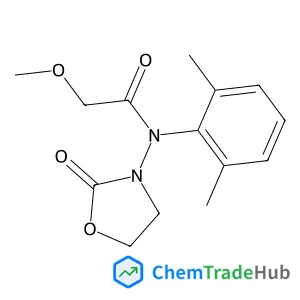
N-(2,6-Dimethylphenyl)-2-methoxy-N-(2-oxo-1,3-oxazolidin-3-yl)acetamide
CAS番号:
77732-09-3
分子式:
C14H18N2O4
おすすめサプライヤー





免責事項
このページに表示される学術雑誌情報は、参考および研究目的のみを目的としています。当社は雑誌出版社とは提携しておらず、投稿の取り扱いも行っておりません。出版に関するお問い合わせは、各雑誌出版社に直接ご連絡ください。
表示されている情報に誤りがある場合は、support@chemtradehub.com までご連絡ください。迅速に確認し、対応いたします。