












One-dimensional supramolecular surface structures: 1,4-diisocyanobenzene on Au(111) surfaces
文献情報
出版日
2010-08-16
DOI
10.1039/C003239E
インパクトファクター
3.676
著者
Jorge A. Boscoboinik, Florencia C. Calaza, Zeesham Habeeb, Dennis W. Bennett, Dario J. Stacchiola, Martin A. Purino, Wilfred T. Tysoe
原文を見る
要旨
One-dimensional supramolecular structures formed by adsorbing low coverages of 1,4-diisocyanobenzene on Au(111) at room temperature are obtained and imaged by scanning tunneling microscopy (STM) under ultrahigh vacuum (UHV) conditions. The structures originate from step edges or surface defects and arrange predominantly in a straight fashion on the substrate terraces along the 〈10〉 directions. They are proposed to consist of alternating units of 1,4-diisocyanobenzene molecules and gold atoms with a unit cell in registry with the substrate corresponding to four times the lattice interatomic distance. Their long 1-D chains and high thermal stability offer the potential to use them as conductors in nanoelectronic applications.
関連文献
Sieving di-branched from mono-branched and linear alkanes using ZIF-8: experimental proof and theoretical explanation
Marjo C. Mittelmeijer-Hazeleger, Miguel Angelo Granato, Vanessa F. Duarte Martins, Alírio E. Rodrigues, Gadi Rothenberg
2013-05-02
Paper
DOI: 10.1039/C3CP44381G
Self-discharge of electrochemical double layer capacitors
Andrzej Lewandowski, Pawel Jakobczyk, Maciej Galinski, Marcin Biegun
2013-03-22
Perspective
DOI: 10.1039/C3CP44612C
New Li-doped fullerene-intercalated phthalocyanine covalent organic frameworks designed for hydrogen storage
Jing-Hua Guo, Yoshiyuki Miyamoto
2013-04-23
Paper
DOI: 10.1039/C3CP50492A
Self-assembly of semiconductor/insulator interfaces in one-step spin-coating: a versatile approach for organic field-effect transistors
Chuan Liu, Yun Li, Michael V. Lee, Akichika Kumatani, Kazuhito Tsukagoshi
2013-02-27
Perspective
DOI: 10.1039/C3CP44715D
Tip enhanced Raman spectroscopy (TERS) as a probe for the buckling distortion in silicene
Deepthi Jose, A. Nijamudheen
2013-04-18
Communication
DOI: 10.1039/C3CP51028J
In situ pair distribution function study on lanthanum doped ceria
Mauro Coduri, Michela Brunelli, Paolo Masala
2013-01-24
Paper
DOI: 10.1039/C3CP44300K
A physicochemical mechanism of chemical gas sensors using an AC analysis
Jaehyun Moon, Jin-Ah Park, Su-Jae Lee, Jeong-Ik Lee, Taehyong Zyung, Eui-Chol Shin, Jong-Sook Lee
2013-04-16
Paper
DOI: 10.1039/C3CP44684K
Raman spectral characteristics of 4-aminobenzenethiol adsorbed on ZnO nanorod arrays
Kwan Kim, Kyung Lock Kim, Kuan Soo Shin
2013-05-09
Paper
DOI: 10.1039/C3CP51204E
Atomic pair distribution functions analysis of disordered low-Z materials
V. Petkov, Y. Ren, S. Kabekkodu, D. Murphy
2012-12-13
Paper
DOI: 10.1039/C2CP43378H
こちらもおすすめ
化合物よくある質問
2-氟-4-イオドベンzo酸エチルエステルを取り扱う際の実験室安全事項は何ですか?
2-氟-4-イオドベンzo酸エチルエステルは有機溶媒を用いた反応であり、ドラフトチャンバーでの操作が必要です。漏洩時にはSDS参照の安全措置を講じ、PPE(防護...
205750-82-9Benzoic acid, 2-fluo...
化合物よくある質問
血根碱の主な用途は何ですか?
血根碱は主に医薬分野で利用され、抗炎症や抗がん剤としての潜在的な効果が研究されています。また、化学研究や薬物開発において、新しい薬剤設計の参考となる化合物として...
2447-54-313-Methyl[1,3]benzod...
化合物よくある質問
Methyl 3-methoxythiophene-2-carboxylateの主な用途は何ですか?
Methyl 3-メトキシスチフェン-2-カルボン酸メチルエステルは、薬品合成、染料製造、以及合成中間体としての用途が広がっています。
62353-75-7Methyl 3-methoxythio...
化合物よくある質問
丹磺酰-L-亮氨酸はどのように保存すればよいですか?
丹磺酰-L-亮氨酸は乾燥した場所で、直射日光から保護し、低温(室温以下)で保存してください。密閉容器に入れて保管することをおすすめします。
1100-22-7N-{[5-(Dimethylamino...
化合物よくある質問
5-(苄氧基)ピラミジン-4-アミンの代替品はありますか?
5-(苄氧基)ピラミジン-4-アミンの代替品として、6-メトキシピラミジンや5-フェニルピラミジンなどが挙げられます。これらの化合物は、5-(苄氧基)ピラミジン...
92289-50-45-benzyloxypyrimidin...
化合物よくある質問
8-ヒドロキシノルデコペントアセートの物理化学的性質は何ですか?
8-ヒドロキシノルデコペントアセートはCAS番号84807-87-4の化合物で、分子量は750.02 uです。これは油溶性で、水に溶けにくい特徴があります。反応...
84807-87-4(5Z,8Z,11Z,13E,15S)-...
化合物よくある質問
tert-ブチル(エス)-1-ヒドロキシペンタ-4-エン-2-イルカルバamateの主な用途は何ですか?
tert-ブチル(エス)-1-ヒドロキシペンタ-4-エン-2-イルカルバamateは主に医薬品の合成材料や分析化学の試薬として使用されます。
116613-81-12-Methyl-2-propanyl ...
化合物よくある質問
ブコール-L-2-フローヨルブリンについて適切な法規ガイドラインは何ですか?
ブコール-L-2-フローヨルブリン(CAS番号: 1196107-73-9)は、GHS(グローバルハザードアサessmentシステム)に基づく危害分類と表示が求...
1196107-73-92-Bromo-13,13-dimeth...
化合物よくある質問
6-ブロモ-N-環丙基-2-ピリジニニメタンの市場動向や研究トレンドはどうですか
6-ブロモ-N-環丙基-2-ピリジニニメタンは、薬理学研究や合成化学に使用される化合物であり、特に抗ウイルス薬や抗がん薬の開発に注目されています。市場では、薬物...
959237-20-86-Bromo-N-cyclopropy...
化合物よくある質問
RS-AMPÀはどのように保存すればよいですか?
RS-AMPÀは、遮光容器に保存し、室温(15〜25℃)で保管することが推奨されます。高湿や熱は物質を劣化させるため、湿度は50%以下に保つことが重要です。また...
74341-63-2(RS)-AMPA
掲載誌
Physical Chemistry Chemical Physics

CiteScore:
5.5
自己引用率:
10.3%
年間論文数:
3036
Physical Chemistry Chemical Physics (PCCP) is an international journal co-owned by 19 physical chemistry and physics societies from around the world. This journal publishes original, cutting-edge research in physical chemistry, chemical physics and biophysical chemistry. To be suitable for publication in PCCP, articles must include significant innovation and/or insight into physical chemistry; this is the most important criterion that reviewers and Editors will judge against when evaluating submissions. The journal has a broad scope and welcomes contributions spanning experiment, theory, computation and data science. Topical coverage includes spectroscopy, dynamics, kinetics, statistical mechanics, thermodynamics, electrochemistry, catalysis, surface science, quantum mechanics, quantum computing and machine learning. Interdisciplinary research areas such as polymers and soft matter, materials, nanoscience, energy, surfaces/interfaces, and biophysical chemistry are welcomed if they demonstrate significant innovation and/or insight into physical chemistry. Joined experimental/theoretical studies are particularly appreciated when complementary and based on up-to-date approaches.
おすすめ化合物
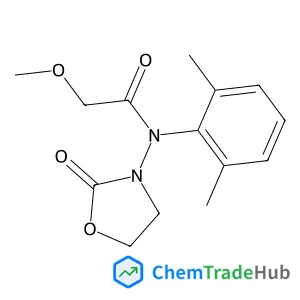
N-(2,6-Dimethylphenyl)-2-methoxy-N-(2-oxo-1,3-oxazolidin-3-yl)acetamide
CAS番号:
77732-09-3
分子式:
C14H18N2O4
おすすめサプライヤー




免責事項
このページに表示される学術雑誌情報は、参考および研究目的のみを目的としています。当社は雑誌出版社とは提携しておらず、投稿の取り扱いも行っておりません。出版に関するお問い合わせは、各雑誌出版社に直接ご連絡ください。
表示されている情報に誤りがある場合は、support@chemtradehub.com までご連絡ください。迅速に確認し、対応いたします。