












Acid–base properties of functionalised tripodal polyamines and their interaction with nucleotides and nucleic acids
文献情報
出版日
2010-03-26
DOI
10.1039/C000124D
インパクトファクター
3.876
著者
Alejandra Sornosa-Ten, M. Teresa Albelda, Juan C. Frías, Enrique García-España, José M. Llinares, Ana Budimir, Ivo Piantanida
原文を見る
要旨
Novel, highly positively charged tripodal polyamines with appended heterocyclic moieties revealed an intriguing panel of protonation species within the biologically relevant range. Studied compounds bind nucleotide monophosphates by mostly electrostatic interactions but only the imidazole analogue showed selectivity toward UMP in respect to other nucleotides. Strong binding of all the studied compounds to both ds-DNA and ds-RNA is to some extent selective toward the latter, showing rather rare RNA over DNA preference.
関連文献
Highly ordered TiN nanotube arrays as counter electrodes for dye-sensitized solar cells
Q. W. Jiang, G. R. Li, X. P. Gao
2009-09-25
Communication
DOI: 10.1039/B912776C
Site-specific incorporation of perylene into an N-terminally modified light-harvesting complex II‡
Kalina Peneva, Kristina Gundlach, Andreas Herrmann, Harald Paulsen, Klaus Müllen
2010-09-06
Communication
DOI: 10.1039/C0OB00492H
Combinatorial approach toward synthesis of small molecule libraries as bacterial transglycosylase inhibitors
Hao-Wei Shih, Kuo-Ting Chen, Shao-Kang Chen, Chia-Ying Huang, Ting-Jen R Cheng, Che Ma, Chi-Huey Wong, Wei-Chieh Cheng
2010-03-29
Paper
DOI: 10.1039/C000622J
Copper(i)-catalyzed cycloaddition of silver acetylides and azides: Incorporation of volatile acetylenes into the triazole core
Ilaria Proietti Silvestri, Fikre Andemarian, George N. Khairallah, Su Wan Yap, Tim Quach, Sammi Tsegay, Craig M. Williams, Richard A. J. O'Hair, Paul S. Donnelly, Spencer J. Williams
2011-06-03
Paper
DOI: 10.1039/C1OB05360D
Reversible circularization of an anthracene-modified DNA conjugate through bimolecular triplex formation and its analytical application
Pelin Arslan, Akinori Jyo
2010-08-24
Paper
DOI: 10.1039/C0OB00282H
Stereoselective synthesis of enynones via base-catalyzed isomerization of 1,5-disubstituted-2,4-pentadiynyl silyl ethers or their alcohol derivatives
Jingjin Chen, Guoqin Fan, Yuanhong Liu
2010-09-16
Communication
DOI: 10.1039/C0OB00344A
Differentiating quadruplexes: binding preferences of a luminescent dinuclear ruthenium(ii) complex with four-stranded DNA structures
Mike P. Williamson, Jim A Thomas
2010-03-29
Paper
DOI: 10.1039/B924263E
Raman spectroscopy of strained single-walled carbon nanotubes
Zhongfan Liu, Jin Zhang, Bo Gao
2009-10-07
Feature Article
DOI: 10.1039/B914588E
A nanophase segregated mesophase morphology in self-organized novel disc–rod oligomesogens
Hari Krishna Bisoyi, V. A. Raghunathan, Sandeep Kumar
2009-10-14
Communication
DOI: 10.1039/B911383E
New facets of an old ligand: titanium and zirconium complexes of phenylenediamine bis(phenolate) in lactide polymerisation catalysis
Ayellet L. Zelikoff, Jacob Kopilov, Israel Goldberg, Geoffrey W. Coates, Moshe Kol
2009-10-02
Communication
DOI: 10.1039/B915211C
こちらもおすすめ
化合物よくある質問
環戊烷-1,3-二甲酸甲酯はどのように合成されますか?
環戊烷-1,3-二甲酸甲酯は、環戊烷と塩酸によるヒンデンブルク反応を経由して合成されます。この反応では、環戊烷が塩酸と作用し、1,3-ジカルボキシ基が導入されま...
2435-36-1Dimethyl 1,3-cyclope...
化合物よくある質問
4-メトキシ-1,2,3-スチアゼ-3,5-ジオンとは何ですか?
4-メトキシ-1,2,3-スチアゼ-3,5-ジオンは、CAS番号107843-77-6の化合物で、(E)-ベンジル3-(3,4-ジヒドロキシフェニル) acry...
107843-77-6(E)-Benzyl 3-(3,4-di...
化合物よくある質問
プロスタグランジンA2について「に適用される法規ガイドラインは何ですか?'
プロスタグランジンA2 (CAS番号: 41691-92-3) は、化学物質の安全管理に関する規制として、GHS (危険物質の国際的ハザード分類・ラベル付けシス...
41691-92-316,16-DIMETHYL PROST...
化合物よくある質問
4-アミノ-1-ナフタレン sulfonic 酸についての物理化学的性質は何ですか?
4-アミノ-1-ナフタレン sulfonic 酸のCAS番号は84-86-6です。この化合物は結晶性で、分子量は212.15 g/molです。アルコールや水など...
84-86-64-Amino-1-naphthalen...
化合物よくある質問
N-GlcNAc-生物素を取り扱う際の実験室安全事項は何ですか?
N-GlcNAc-生物素は吸収性があり、皮膚や目への接触を避けることが重要です。PPE(個体保護具)は使用し、ドラフトチャンバーは必要に応じて使用します。漏洩時...
1272755-69-72-Acetamido-2-deoxy-...
化合物よくある質問
3-アミノメチルフローラノピペリジン-1-カルボニル酸テルブチルエステルとは何ですか?
CAS番号1209781-11-2の3-アミノメチルフローラノピペリジン-1-カルボニル酸テルブチルエステルは、有機化合物の一種で、化学式はC10H17FNO3...
1209781-11-22-Methyl-2-propanyl ...
化合物よくある質問
6-溴-1-甲基-1H-ベンゾ[d][1,2,3]三氮唑はどのように合成されますか?
6- bromo-1-methyl-1H-benzotriazoleは、ブロモフリオリンと1-メチル-1H-ベンゾ[d][1,2,3]三氮唑の反応により合成され...
944718-32-56-Bromo-1-methyl-1H-...
化合物よくある質問
4-硫代尿苷はどのように合成されますか?
4-硫代尿苷は、尿素とD-リボシルヒドロキシアルデヒドを用いてスルホン化反応を経て合成されます。通常は塩酸ヒドロキシチオニルスルホン酸などの触媒を使用し、選択性...
6741-73-71-(4-thio-beta-D-rib...
化合物よくある質問
ブレインナトリユリックペプチド32ラットとは何ですか?
ブレインナトリユリックペプチド32ラット(CAS番号: 133448-20-1)は、心臓で作られるホルモンの一つで、心不全の診断や予後評価に使用されます。
133448-20-1Brain Natriuretic Pe...
化合物よくある質問
1-(3-氮杂啶)-4-羟基哌啶双盐酸盐の物理化学的性質は何ですか?
CAS番号810680-60-5の1-(3-氮杂啶)-4-羟基哌啶双盐酸盐は、白色の結晶性粉末である。分子量は360.84 g/molで、水に溶けやすい。反応活...
810680-60-51-(3-Azetidinyl)-4-p...
掲載誌
Organic & Biomolecular Chemistry

CiteScore:
3.4
自己引用率:
10.3%
年間論文数:
1041
Organic & Biomolecular Chemistry (OBC) publishes original and high impact research and reviews in organic chemistry. We welcome research that shows new or significantly improved protocols or methodologies in total synthesis, synthetic methodology or physical and theoretical organic chemistry as well as research that shows a significant advance in the organic chemistry or molecular design aspects of chemical biology, catalysis, supramolecular and macromolecular chemistry, theoretical chemistry, mechanism-oriented physical organic chemistry, medicinal chemistry or natural products. Articles published in the journal should report new work which makes a highly-significant impact in the field. Routine and incremental work is generally not suitable for publication in the journal. More details about key areas of our scope are below. In all cases authors should include in their article clear rationale for why their research has been carried out.
おすすめ化合物
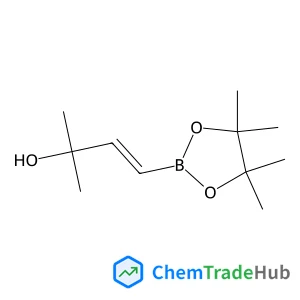
(E)-2-methyl-4-(4,4,5,5-tetramethyl-1,3,2-dioxaborolan-2-yl)but-3-en-2-ol
CAS番号:
581802-26-8
分子式:
C11H21BO3
おすすめサプライヤー



免責事項
このページに表示される学術雑誌情報は、参考および研究目的のみを目的としています。当社は雑誌出版社とは提携しておらず、投稿の取り扱いも行っておりません。出版に関するお問い合わせは、各雑誌出版社に直接ご連絡ください。
表示されている情報に誤りがある場合は、support@chemtradehub.com までご連絡ください。迅速に確認し、対応いたします。