













2H and 19F solid-state NMR studies of the ionic liquid [C2Py][BTA]-d10 confined in mesoporous silica materials
文献情報
出版日
2010-08-16
DOI
10.1039/B926836G
インパクトファクター
3.676
著者
Maria Waechtler, Martin Sellin, Annegret Stark, Dilek Akcakayiran, Gerhard Findenegg, Anna Gruenberg, Hergen Breitzke, Gerd Buntkowsky
原文を見る
要旨
Ionic liquids confined in porous materials are important solvents which allow a simple heterogenization of homogenous liquids. The perdeuterated ionic liquid N-ethylpyridinium-bis(trifluoromethanesulfonyl)amide ([C2Py][BTA]-d10) was prepared and its bulk phase behavior was studied by differential scanning calorimetry (DSC) and temperature-resolved 2H and 19F solid-state NMR spectroscopy. Its bulk properties were compared to [C2Py][BTA]-d10 confined in a mesoporous silica support material as model material usable in SILP catalysts. The line shape analysis of the temperature-dependent NMR spectra of the bulk material reveals two phase transitions, one at 287–289 K (solid II/solid I) and one extending over a temperature range of 298–306 K (solid I/liquid). While the first phase transition is caused by the onset of an intramolecular rotation of the ethyl group of the cation, the second is due to the melting of the ionic liquid. In the bulk material, a hysteresis between the transition temperatures in heating and cooling scans occurs. In confinement, the dynamics of the ionic liquid changes considerably: no hysteresis is observed for [C2Py][BTA]-d10 confined in the mesopores. Instead, only a broad transition from solid II to the liquid state, which spans the temperature range of 215–245 K, is observed. This transition is identified as the result of a broad distribution of molecular environments of the confined ionic liquid, which thus forms an amorphous phase inside the pores. Hence, the behavior of the ionic liquid in confinement is similar to the behavior of non-ionic guest molecules in the mesoporous silica. Finally, it was found that the anion and cation of the ionic liquid exhibit the same dynamic behavior in confinement.
関連文献
Ultra-slow dynamics in low density amorphous ice revealed by deuteron NMR: indication of a glass transition
Florian Löw, Katrin Amann-Winkel, Thomas Loerting, Franz Fujara, Burkhard Geil
2013-05-10
Paper
DOI: 10.1039/C3CP50818H
On the dual emission of p-dimethylaminobenzonitrile and its photophysical implications
Javier Catalán
2013-04-11
Paper
DOI: 10.1039/C3CP44627A
Synchrotron high energy X-ray methods coupled to phase sensitive analysis to characterize aging of solid catalysts with enhanced sensitivity
Mark A. Newton, Marco Di Michiel, Songhak Yoon, Gian Luca Chiarello, Santhosh Kumar Matam, Myriam H. Aguirre, Anke Weidenkaff, Fei Wen, Jürgen Gieshoff
2013-04-26
Paper
DOI: 10.1039/C3CP44638G
A kinetic and mechanistic study into the formation of the Cu–Cr layered double hydroxide
Alexander Clout, Jonathan C. Burley
2013-02-04
Paper
DOI: 10.1039/C3CP44339F
Low-density nanoporous phases of group-III nitrides built from sodalite cage clusters
Zhifeng Liu, Xinqiang Wang, Gaobin Liu, Jian Sui, Xuefang Wang, Hengjiang Zhu, Zhilin Hou
2013-04-03
Paper
DOI: 10.1039/C3CP50814E
A multi-scale molecular dynamics study of the assembly of micron-size supraparticles from 30 nm alkyl-coated nanoparticles
Damien Thompson, Mateusz Sikora, Piotr Szymczak, Marek Cieplak
2013-04-09
Paper
DOI: 10.1039/C3CP50523E
Chronoamperometric study of membrane electrode assembly operation in continuous flow photoelectrochemical water splitting
Jan Rongé, Dorien Nijs, Stef Kerkhofs, Kasper Masschaele, Johan A. Martens
2013-04-11
Paper
DOI: 10.1039/C3CP50890K
Study of the tryptophan–terbium FRET pair coupled to silver nanoprisms for biosensing applications
Ane K. di Gennaro, Leonid Gurevich, Esben Skovsen, Michael T. Overgaard, Peter Fojan
2013-04-16
Paper
DOI: 10.1039/C3CP50742D
A time resolved high energy X-ray diffraction study of cooling liquid SiO2
C. J. Benmore, M. C. Wilding, S. K. Tumber
2013-04-05
Paper
DOI: 10.1039/C3CP44347G
Photoinduced electron transfer of platinum(ii) bipyridine diacetylides linked by triphenylamine- and naphthaleneimide-derivatives and their application to photoelectric conversion systems
Yuma Matsumoto, Mai Tsubamoto, Ryoji Sugimura, Masatoshi Kozaki, Kenshi Kimoto, Munetaka Iwamura, Koichi Nozaki, Naoki Senju, Chiasa Uragami, Yohei Muramatsu, Akinori Konno
2013-02-28
Paper
DOI: 10.1039/C3CP50182E
こちらもおすすめ
化合物よくある質問
2-氟-4-イオドベンzo酸エチルエステルを取り扱う際の実験室安全事項は何ですか?
2-氟-4-イオドベンzo酸エチルエステルは有機溶媒を用いた反応であり、ドラフトチャンバーでの操作が必要です。漏洩時にはSDS参照の安全措置を講じ、PPE(防護...
205750-82-9Benzoic acid, 2-fluo...
化合物よくある質問
血根碱の主な用途は何ですか?
血根碱は主に医薬分野で利用され、抗炎症や抗がん剤としての潜在的な効果が研究されています。また、化学研究や薬物開発において、新しい薬剤設計の参考となる化合物として...
2447-54-313-Methyl[1,3]benzod...
化合物よくある質問
Methyl 3-methoxythiophene-2-carboxylateの主な用途は何ですか?
Methyl 3-メトキシスチフェン-2-カルボン酸メチルエステルは、薬品合成、染料製造、以及合成中間体としての用途が広がっています。
62353-75-7Methyl 3-methoxythio...
化合物よくある質問
丹磺酰-L-亮氨酸はどのように保存すればよいですか?
丹磺酰-L-亮氨酸は乾燥した場所で、直射日光から保護し、低温(室温以下)で保存してください。密閉容器に入れて保管することをおすすめします。
1100-22-7N-{[5-(Dimethylamino...
化合物よくある質問
5-(苄氧基)ピラミジン-4-アミンの代替品はありますか?
5-(苄氧基)ピラミジン-4-アミンの代替品として、6-メトキシピラミジンや5-フェニルピラミジンなどが挙げられます。これらの化合物は、5-(苄氧基)ピラミジン...
92289-50-45-benzyloxypyrimidin...
化合物よくある質問
8-ヒドロキシノルデコペントアセートの物理化学的性質は何ですか?
8-ヒドロキシノルデコペントアセートはCAS番号84807-87-4の化合物で、分子量は750.02 uです。これは油溶性で、水に溶けにくい特徴があります。反応...
84807-87-4(5Z,8Z,11Z,13E,15S)-...
化合物よくある質問
tert-ブチル(エス)-1-ヒドロキシペンタ-4-エン-2-イルカルバamateの主な用途は何ですか?
tert-ブチル(エス)-1-ヒドロキシペンタ-4-エン-2-イルカルバamateは主に医薬品の合成材料や分析化学の試薬として使用されます。
116613-81-12-Methyl-2-propanyl ...
化合物よくある質問
ブコール-L-2-フローヨルブリンについて適切な法規ガイドラインは何ですか?
ブコール-L-2-フローヨルブリン(CAS番号: 1196107-73-9)は、GHS(グローバルハザードアサessmentシステム)に基づく危害分類と表示が求...
1196107-73-92-Bromo-13,13-dimeth...
化合物よくある質問
6-ブロモ-N-環丙基-2-ピリジニニメタンの市場動向や研究トレンドはどうですか
6-ブロモ-N-環丙基-2-ピリジニニメタンは、薬理学研究や合成化学に使用される化合物であり、特に抗ウイルス薬や抗がん薬の開発に注目されています。市場では、薬物...
959237-20-86-Bromo-N-cyclopropy...
化合物よくある質問
RS-AMPÀはどのように保存すればよいですか?
RS-AMPÀは、遮光容器に保存し、室温(15〜25℃)で保管することが推奨されます。高湿や熱は物質を劣化させるため、湿度は50%以下に保つことが重要です。また...
74341-63-2(RS)-AMPA
掲載誌
Physical Chemistry Chemical Physics

CiteScore:
5.5
自己引用率:
10.3%
年間論文数:
3036
Physical Chemistry Chemical Physics (PCCP) is an international journal co-owned by 19 physical chemistry and physics societies from around the world. This journal publishes original, cutting-edge research in physical chemistry, chemical physics and biophysical chemistry. To be suitable for publication in PCCP, articles must include significant innovation and/or insight into physical chemistry; this is the most important criterion that reviewers and Editors will judge against when evaluating submissions. The journal has a broad scope and welcomes contributions spanning experiment, theory, computation and data science. Topical coverage includes spectroscopy, dynamics, kinetics, statistical mechanics, thermodynamics, electrochemistry, catalysis, surface science, quantum mechanics, quantum computing and machine learning. Interdisciplinary research areas such as polymers and soft matter, materials, nanoscience, energy, surfaces/interfaces, and biophysical chemistry are welcomed if they demonstrate significant innovation and/or insight into physical chemistry. Joined experimental/theoretical studies are particularly appreciated when complementary and based on up-to-date approaches.
おすすめ化合物
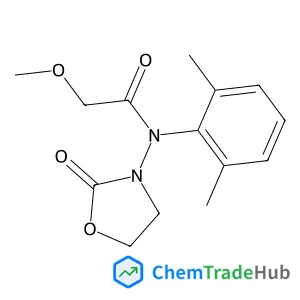
N-(2,6-Dimethylphenyl)-2-methoxy-N-(2-oxo-1,3-oxazolidin-3-yl)acetamide
CAS番号:
77732-09-3
分子式:
C14H18N2O4
![(1R)-3-Bromo-1,7,7-trimethylbicyclo[2.2.1]heptan-2-one structure](https://static.chemtradehub.com/structs/102/10293-06-8-dd8a.webp "(1R)-3-Bromo-1,7,7-trimethylbicyclo[2.2.1]heptan-2-one structure")

おすすめサプライヤー






免責事項
このページに表示される学術雑誌情報は、参考および研究目的のみを目的としています。当社は雑誌出版社とは提携しておらず、投稿の取り扱いも行っておりません。出版に関するお問い合わせは、各雑誌出版社に直接ご連絡ください。
表示されている情報に誤りがある場合は、support@chemtradehub.com までご連絡ください。迅速に確認し、対応いたします。