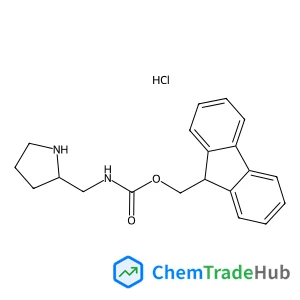
(S)-(9H-Fluoren-9-yl)methyl (pyrrolidin-2-ylmethyl)carbamate hydrochloride
CAS番号:
1217813-15-4
分子式:
C20H23ClN2O2
Vitali Grozovski, Víctor Climent, Enrique Herrero, Juan M. Feliu
Pulsed voltammetry has been used to study formic acid oxidation on platinum stepped surfaces to determine the kinetics of the reaction and the role of the surface structure in the reactivity. From the current transients at different potentials, the intrinsic activity of the electrode through the active intermediate reaction path (jθ = 0), as well as the rate constant for the CO formation (kads) have been calculated. The kinetics for formic acid oxidation through the active intermediate reaction path is strongly dependent on the surface structure of the electrode, with the highest activity found for the Pt(100) surface. The presence of steps, both on (100) and (111) terraces, does not increase the activity of these surfaces. CO formation only takes place in a narrow potential window very close to the local potential of zero total charge. The extrapolation of the results obtained with stepped surfaces with (111) terraces to zero step density indicates that CO formation should not occur on an ideal Pt(111) electrode. Additionally, the analysis of the Tafel slopes obtained for the different electrodes suggests that the oxidation of formic acid is strongly affected by the presence of adsorbed anions, hydrogen and water.
Akira Yamaguchi, Tomoki Kujirai, Takeshi Fujita, Hideki Abe, Masahiro Miyauchi
DOI: 10.1039/D3SE01346D
Alberto García-Fernández, Stefania Riva, Håkan Rensmo
DOI: 10.1039/D3CP05061K
Robert Tirawat, Mengjin Yang, Severin N. Habisreutinger, Soňa Uličná, Ross A. Kerner, Kai Zhu, Laura T. Schelhas, Axel F. Palmstrom
DOI: 10.1039/D3SE01268A
Iosif V. Leibin, Dmitry S. Bezrukov, Alexei A. Buchachenko
DOI: 10.1039/D3CP04178F
Jinfan Wu, Tao Wang, Fen Xu, Lixian Sun, Yuan Gao, Hehui Wang, Guorong Zhang, Zhong Cao, Julan Zeng
DOI: 10.1039/D3SE01162C
Qian Wang, Yu Zhuang, Abuduwayiti Aierken, Qiaogang Song, Qin Zhang, Youbo Dou, Qiuli Zhang, Shuyi Zhang
DOI: 10.1039/D3CP05309A
Sergey S. Nikitin, Alexander D. Koryakov, Elizaveta A. Antipinskaya, Mikhail V. Patrakeev
DOI: 10.1039/D3CP05421G
Fakhrul H. Bhuiyan, Ashlie Martini
DOI: 10.1039/D3CP05320B
2-メトキシ-4-(メチルスルフィニル)アミンは、主に医薬品および農薬の製造に使用されます。また、合成化学の一部として研究用材料としても利用されます。
代替品としては、4,6-二クロロピラミジンアミンや他のピラミジン系化合物が考えられます。ただし、目的と用途によって最適な代替品は異なります。
6-氯-4-甲基-1H-吲哚の廃棄物は、適切な容器に収集し、密閉して保管します。温度は常温、湿度は低く、直射日光を避けて保管することを推奨します。廃棄処理は専門...
2-フローユロ-4-(トリフルオロメチル)ベンゾイドのCAS番号は207974-08-1です。この化合物はGHS分類で毒性物質と有害な反応物質として分類されます...
4-ニトロフェニルN-[(ベンゼルオキシルカーボンイル]グリシングリシングリシン酸は、室温で暗所に保管し、乾燥した環境で保存することを推奨します。容器は密閉性の...
イソデスロラタドリンの代替品としては、デスロラタドリンや他の抗ヒスタミン薬が挙げられます。具体的には、デスロラタドリン、ラセカミド、フェルタドリンなどが、症状や...
5-甲氧基-1,2,3,4-四氢异喹啉盐酸盐の一般的な合成方法は、メタノール中で5-メトキシ-1,2,3,4-四ヒュドロイソキシンを塩酸で塩化します。この反応で...
CAS番号6471-78-9の4-アミノ-5-メトキシ-2-トルエンサルホニック酸は、GHS分類では corrosive(腐食性)と識別されます。EUのREAC...
甲基孕酮の取り扱いは、PPE(個人保護具)の使用が必要な重要な安全事項を伴います。防塵マスク、ゴーグル、手袋を着用することが推奨されます。ドラフトチャンバーを使...

Physical Chemistry Chemical Physics (PCCP) is an international journal co-owned by 19 physical chemistry and physics societies from around the world. This journal publishes original, cutting-edge research in physical chemistry, chemical physics and biophysical chemistry. To be suitable for publication in PCCP, articles must include significant innovation and/or insight into physical chemistry; this is the most important criterion that reviewers and Editors will judge against when evaluating submissions. The journal has a broad scope and welcomes contributions spanning experiment, theory, computation and data science. Topical coverage includes spectroscopy, dynamics, kinetics, statistical mechanics, thermodynamics, electrochemistry, catalysis, surface science, quantum mechanics, quantum computing and machine learning. Interdisciplinary research areas such as polymers and soft matter, materials, nanoscience, energy, surfaces/interfaces, and biophysical chemistry are welcomed if they demonstrate significant innovation and/or insight into physical chemistry. Joined experimental/theoretical studies are particularly appreciated when complementary and based on up-to-date approaches.