











A density functional study of defect migration in gadolinium doped ceria
文献情報
出版日
2010-05-26
DOI
10.1039/B924534K
インパクトファクター
3.676
著者
Pratik P. Dholabhai, James B. Adams, Peter Crozier, Renu Sharma
原文を見る
要旨
Oxygen ion conductivity of doped ceria is observed to be two-three orders of magnitude higher than yttria stabilized zirconia, the most widely used solid electrolyte material at temperatures below 600 °C. Gadolinium doped ceria (GDC) is known to be one of the most promising solid electrolyte materials for operation of solid oxide fuel cells below 600 °C. To understand the atomic defect migration in GDC, we have used total energy calculations within the framework of density functional theory to follow oxygen vacancy migration in GDC. We report activation energies for various oxygen vacancy migration pathways in GDC. Oxygen vacancy formation and migration were evaluated for first, second, and third nearest neighbor positions to a Gd3+ ion. Due to the comparable ionic radii of Gd3+ and host Ce4+ ions, the first nearest neighbor site with respect to the dopant cation is found to be the most favorable oxygen vacancy formation site. The migration pathway where the vacancy migrates from a second to first nearest neighbor is found to be most favorable. The calculated activation energies for oxygen vacancy migration in GDC are compared against the reported measured and calculated values from the literature. This work will provide a foundation for the development of a kinetic lattice Monte Carlo model for vacancy diffusion in GDC, which will improve the understanding of oxygen ion conductivity in doped ceria.
関連文献
Correction: Nickel carbonate (Ni2(CO3)3) as an electrocatalyst and photo-electrocatalyst for methanol electro-oxidation
Iranna Udachyan, Jayesh T. Bhanushali, Tomer Zidki, Amir Mizrahi
2023-11-06
Correction
DOI: 10.1039/D3TA90234J
Engineering yeast for the production of plant terpenoids using synthetic biology approaches
Jean-Alexandre Bureau, Magdalena Escobar Oliva, Yueming Dong, Codruta Ignea
2023-07-31
Review Article
DOI: 10.1039/D3NP00005B
Exploring the potential of triple conducting perovskite cathodes for high-performance solid oxide fuel cells: a comprehensive review
Yujie Xu
2023-10-07
Review Article
DOI: 10.1039/D3TA05035A
Chemistry, biosynthesis and biology of floral volatiles: roles in pollination and other functions
Stefan Dötterl, Jonathan Gershenzon
2023-09-04
Review Article
DOI: 10.1039/D3NP00024A
Industrial total synthesis of natural medicines
Xiao-Yu Liu, Yong Qin
2023-08-09
Viewpoint
DOI: 10.1039/D3NP00020F
Huperzine alkaloids: forty years of total syntheses
Lili Song
2023-10-11
Review Article
DOI: 10.1039/D3NP00029J
Topological insulator bismuth selenide with a unique cloud-like hollow structure as a bidirectional electrocatalyst for robust lithium–sulfur batteries
Mincai Zhao, Junjie Fu, Daoping Cai, Chaoqi Zhang, Yinggan Zhang, Baisheng Sa, Qidi Chen, Hongbing Zhan
2023-10-20
Paper
DOI: 10.1039/D3TA04930B
Halogen-engineered metal–organic frameworks enable high-performance electrochemical glucose sensing
Le Wang, Yong-Shuang Li, Yu Cao
2023-12-16
Paper
DOI: 10.1039/D3NJ05053J
Synthesis of chiral hexynones for use as precursors to native photosynthetic hydroporphyrins
Khiem Chau Nguyen, Duy T. M. Chung, Phattananawee Nalaoh, Jonathan S. Lindsey
2024-01-11
Paper
DOI: 10.1039/D3NJ03900E
Emerging disorder in Gd2(Ti1−xZrx)2O7 pyrochlores matrices for radioactive waste disposal: symmetry lowering versus defect clustering
Armando di Biase, Carlo Castellano, Giorgia Confalonieri, Patrizia Fumagalli, Simone Tumiati, Davide Ceresoli
2023-10-26
Paper
DOI: 10.1039/D3TA04847K
こちらもおすすめ
化合物よくある質問
2-メトキシ-4-(メチルスルフィニル)アミンの主な用途は何ですか?
2-メトキシ-4-(メチルスルフィニル)アミンは、主に医薬品および農薬の製造に使用されます。また、合成化学の一部として研究用材料としても利用されます。
41608-73-52-Methoxy-4-(methyls...
118684-13-24-(Bromomethyl)-3-me...
化合物よくある質問
4,6-二氯-N-甲基ピラミジンアミンの代替品はありますか?
代替品としては、4,6-二クロロピラミジンアミンや他のピラミジン系化合物が考えられます。ただし、目的と用途によって最適な代替品は異なります。
10397-15-64,6-Dichloro-N-methy...
化合物よくある質問
6-氯-4-甲基-1H-吲哚を含む廃棄物はどのように処理すべきですか?
6-氯-4-甲基-1H-吲哚の廃棄物は、適切な容器に収集し、密閉して保管します。温度は常温、湿度は低く、直射日光を避けて保管することを推奨します。廃棄処理は専門...
885520-84-36-chloro-4-methyl-1H...
化合物よくある質問
2-フローユロ-4-(トリフルオロメチル)ベンゾイドについて「に適用される法規ガイドラインは何ですか」
2-フローユロ-4-(トリフルオロメチル)ベンゾイドのCAS番号は207974-08-1です。この化合物はGHS分類で毒性物質と有害な反応物質として分類されます...
207974-08-1[2-Fluoro-4-(trifluo...
化合物よくある質問
4-ニトロフェニルN-[(ベンゼルオキシルカーボンイル]グリシングリシングリシン酸はどのように保存すればよいですか?
4-ニトロフェニルN-[(ベンゼルオキシルカーボンイル]グリシングリシングリシン酸は、室温で暗所に保管し、乾燥した環境で保存することを推奨します。容器は密閉性の...
19811-64-44-Nitrophenyl N-[(be...
化合物よくある質問
イソデスロラタドリンの代替品はありますか?
イソデスロラタドリンの代替品としては、デスロラタドリンや他の抗ヒスタミン薬が挙げられます。具体的には、デスロラタドリン、ラセカミド、フェルタドリンなどが、症状や...
183198-49-4Iso Desloratadine
化合物よくある質問
5-甲氧基-1,2,3,4-四氢异喹啉盐酸盐はどのように合成されますか?
5-甲氧基-1,2,3,4-四氢异喹啉盐酸盐の一般的な合成方法は、メタノール中で5-メトキシ-1,2,3,4-四ヒュドロイソキシンを塩酸で塩化します。この反応で...
103030-69-95-Methoxy-1,2,3,4-te...
化合物よくある質問
4-アミノ-5-メトキシ-2-トルエンサルホニック酸についての法規ガイドラインは何ですか?
CAS番号6471-78-9の4-アミノ-5-メトキシ-2-トルエンサルホニック酸は、GHS分類では corrosive(腐食性)と識別されます。EUのREAC...
6471-78-94-Amino-5-Methoxy-2-...
化合物よくある質問
甲基孕酮を取り扱う際の実験室安全事項は何ですか?
甲基孕酮の取り扱いは、PPE(個人保護具)の使用が必要な重要な安全事項を伴います。防塵マスク、ゴーグル、手袋を着用することが推奨されます。ドラフトチャンバーを使...
204063-33-22-[(Diphenylmethyl)a...
掲載誌
Physical Chemistry Chemical Physics

CiteScore:
5.5
自己引用率:
10.3%
年間論文数:
3036
Physical Chemistry Chemical Physics (PCCP) is an international journal co-owned by 19 physical chemistry and physics societies from around the world. This journal publishes original, cutting-edge research in physical chemistry, chemical physics and biophysical chemistry. To be suitable for publication in PCCP, articles must include significant innovation and/or insight into physical chemistry; this is the most important criterion that reviewers and Editors will judge against when evaluating submissions. The journal has a broad scope and welcomes contributions spanning experiment, theory, computation and data science. Topical coverage includes spectroscopy, dynamics, kinetics, statistical mechanics, thermodynamics, electrochemistry, catalysis, surface science, quantum mechanics, quantum computing and machine learning. Interdisciplinary research areas such as polymers and soft matter, materials, nanoscience, energy, surfaces/interfaces, and biophysical chemistry are welcomed if they demonstrate significant innovation and/or insight into physical chemistry. Joined experimental/theoretical studies are particularly appreciated when complementary and based on up-to-date approaches.
おすすめ化合物
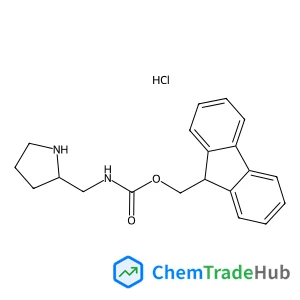
(S)-(9H-Fluoren-9-yl)methyl (pyrrolidin-2-ylmethyl)carbamate hydrochloride
CAS番号:
1217813-15-4
分子式:
C20H23ClN2O2
おすすめサプライヤー



免責事項
このページに表示される学術雑誌情報は、参考および研究目的のみを目的としています。当社は雑誌出版社とは提携しておらず、投稿の取り扱いも行っておりません。出版に関するお問い合わせは、各雑誌出版社に直接ご連絡ください。
表示されている情報に誤りがある場合は、support@chemtradehub.com までご連絡ください。迅速に確認し、対応いたします。