


Water adsorption on hydrophilic and hydrophobic self-assembled monolayers as proxies for atmospheric surfaces. A grand canonical Monte Carlo simulation study
文献情報
出版日
2010-03-16
DOI
10.1039/B923382B
インパクトファクター
3.676
著者
Martina Roeselová
原文を見る
要旨
Grand canonical Monte Carlo simulations are used to determine water adsorption on prototypical organic surfaces as a function of relative humidity at 300 K. Three model surfaces formed by well-ordered self-assembled monolayers (SAMs) of alkanethiolate chains on gold are investigated: (i) a smooth hydrophobic surface of methyl–terminated C7–CH3 SAM; (ii) a rough hydrophobic surface of randomly mixed two-component SAM, composed of equal fractions of C5–CH3 and C7–CH3 chains (C5/C7–CH3 SAM); and (iii) a smooth hydrophilic surface of carboxyl–terminated C7–COOH SAM. The all atom CHARMM22 force field is used for the SAM chains together with the SPC/E model for water. No noticeable water adsorption is observed on the smooth hydrophobic surface up to saturation. The mild surface roughness introduced by the uneven chain length of the two components constituting the C5/C7–CH3 SAM has no significant effect on the surface hydrophobicity, and the rough hydrophobic surface also remains dry up to the point when water condensation occurs. In contrast, water readily adsorbs onto the hydrophilic surface by forming hydrogen bonds with the COOH groups of the substrate. In addition, hydrogen bonding with pre-adsorbed water molecules contributes to the mechanism of water uptake. Under low humidity conditions, water is present on the hydrophilic surface as individual molecules or small water clusters and, with increasing relative humidity, the surface coverage grows continuously beyond a monolayer formation. The adsorbed water film is observed to be rather inhomogeneous with patches of bare surface exposed. The amount of water constituting a stable adsorption layer prior to condensation is estimated to consist of about 2–5 molecular layers. Detailed analysis of the simulation results is used to obtain important insights into the structure and energetics of water adsorbed on highly oxidized organic surfaces exposed to ambient air of increasing relative humidity.
おすすめジャーナル

Chemistry Education Research and Practice

Acta Materialia

Journal of Saudi Chemical Society

Current Opinion in Solid State & Materials Science

Journal of Natural Medicines

Russian Journal of General Chemistry

Russian Journal of Coordination Chemistry

Russian Journal of Organic Chemistry

Chemical Communications

Crystallography Reports
関連文献
13C NMR relaxation and reorientation dynamics in imidazolium-based ionic liquids: revising interpretation
Petri Ingman, Erkki Lähderanta
2014-04-09
Paper
DOI: 10.1039/C4CP00637B
Computational study of the Rayleigh light scattering properties of atmospheric pre-nucleation clusters
Jonas Elm, Patrick Norman, Merete Bilde, Kurt V. Mikkelsen
2014-04-15
Paper
DOI: 10.1039/C4CP01206B
Computational investigation of structural and electronic properties of aqueous interfaces of GaN, ZnO, and a GaN/ZnO alloy
Neerav Kharche, Mark S. Hybertsen, James T. Muckerman
2014-03-24
Paper
DOI: 10.1039/C4CP00486H
Self-healing mechanism of metallopolymers investigated by QM/MM simulations and Raman spectroscopy
Julien Guthmuller
2014-05-15
Paper
DOI: 10.1039/C4CP00562G
Improving BiVO4 photoanodes for solar water splitting through surface passivation
Yongqi Liang, Johannes Messinger
2014-05-01
Paper
DOI: 10.1039/C4CP00674G
Kink energy and kink dipole moments on vicinal Au(001) in halide electrolytes
M. Al-Shakran, G. Beltramo, M. Giesen
2014-03-17
Paper
DOI: 10.1039/C4CP00448E
Enhanced thermoelectric efficiency in ferromagnetic silicene nanoribbons terminated with hydrogen atoms
K. Zberecki, R. Swirkowicz, M. Wierzbicki
2014-05-01
Paper
DOI: 10.1039/C4CP01039F
Conformation of the neurotransmitter γ-aminobutyric acid in liquid water
N. Ottosson, M. Pastorczak, Sietse T. van der Post, Huib J. Bakker
2014-04-10
Communication
DOI: 10.1039/C4CP00671B
Coupled-cluster calculations of the lowest 0–0 bands of the electronic excitation spectrum of naphthalene
Heike Fliegl, Dage Sundholm
2013-12-18
Paper
DOI: 10.1039/C3CP54421D
Perfect spin filtering and large spin thermoelectric effects in organic transition-metal molecular junctions
X. F. Yang, Y. S. Liu, X. Zhang, L. P. Zhou, X. F. Wang, F. Chi, J. F. Feng
2014-04-15
Paper
DOI: 10.1039/C4CP00390J
こちらもおすすめ
化合物よくある質問
2-氟-4-イオドベンzo酸エチルエステルを取り扱う際の実験室安全事項は何ですか?
2-氟-4-イオドベンzo酸エチルエステルは有機溶媒を用いた反応であり、ドラフトチャンバーでの操作が必要です。漏洩時にはSDS参照の安全措置を講じ、PPE(防護...
205750-82-9Benzoic acid, 2-fluo...
化合物よくある質問
血根碱の主な用途は何ですか?
血根碱は主に医薬分野で利用され、抗炎症や抗がん剤としての潜在的な効果が研究されています。また、化学研究や薬物開発において、新しい薬剤設計の参考となる化合物として...
2447-54-313-Methyl[1,3]benzod...
化合物よくある質問
Methyl 3-methoxythiophene-2-carboxylateの主な用途は何ですか?
Methyl 3-メトキシスチフェン-2-カルボン酸メチルエステルは、薬品合成、染料製造、以及合成中間体としての用途が広がっています。
62353-75-7Methyl 3-methoxythio...
化合物よくある質問
丹磺酰-L-亮氨酸はどのように保存すればよいですか?
丹磺酰-L-亮氨酸は乾燥した場所で、直射日光から保護し、低温(室温以下)で保存してください。密閉容器に入れて保管することをおすすめします。
1100-22-7N-{[5-(Dimethylamino...
化合物よくある質問
5-(苄氧基)ピラミジン-4-アミンの代替品はありますか?
5-(苄氧基)ピラミジン-4-アミンの代替品として、6-メトキシピラミジンや5-フェニルピラミジンなどが挙げられます。これらの化合物は、5-(苄氧基)ピラミジン...
92289-50-45-benzyloxypyrimidin...
化合物よくある質問
8-ヒドロキシノルデコペントアセートの物理化学的性質は何ですか?
8-ヒドロキシノルデコペントアセートはCAS番号84807-87-4の化合物で、分子量は750.02 uです。これは油溶性で、水に溶けにくい特徴があります。反応...
84807-87-4(5Z,8Z,11Z,13E,15S)-...
化合物よくある質問
tert-ブチル(エス)-1-ヒドロキシペンタ-4-エン-2-イルカルバamateの主な用途は何ですか?
tert-ブチル(エス)-1-ヒドロキシペンタ-4-エン-2-イルカルバamateは主に医薬品の合成材料や分析化学の試薬として使用されます。
116613-81-12-Methyl-2-propanyl ...
化合物よくある質問
ブコール-L-2-フローヨルブリンについて適切な法規ガイドラインは何ですか?
ブコール-L-2-フローヨルブリン(CAS番号: 1196107-73-9)は、GHS(グローバルハザードアサessmentシステム)に基づく危害分類と表示が求...
1196107-73-92-Bromo-13,13-dimeth...
化合物よくある質問
6-ブロモ-N-環丙基-2-ピリジニニメタンの市場動向や研究トレンドはどうですか
6-ブロモ-N-環丙基-2-ピリジニニメタンは、薬理学研究や合成化学に使用される化合物であり、特に抗ウイルス薬や抗がん薬の開発に注目されています。市場では、薬物...
959237-20-86-Bromo-N-cyclopropy...
化合物よくある質問
RS-AMPÀはどのように保存すればよいですか?
RS-AMPÀは、遮光容器に保存し、室温(15〜25℃)で保管することが推奨されます。高湿や熱は物質を劣化させるため、湿度は50%以下に保つことが重要です。また...
74341-63-2(RS)-AMPA
掲載誌
Physical Chemistry Chemical Physics

CiteScore:
5.5
自己引用率:
10.3%
年間論文数:
3036
Physical Chemistry Chemical Physics (PCCP) is an international journal co-owned by 19 physical chemistry and physics societies from around the world. This journal publishes original, cutting-edge research in physical chemistry, chemical physics and biophysical chemistry. To be suitable for publication in PCCP, articles must include significant innovation and/or insight into physical chemistry; this is the most important criterion that reviewers and Editors will judge against when evaluating submissions. The journal has a broad scope and welcomes contributions spanning experiment, theory, computation and data science. Topical coverage includes spectroscopy, dynamics, kinetics, statistical mechanics, thermodynamics, electrochemistry, catalysis, surface science, quantum mechanics, quantum computing and machine learning. Interdisciplinary research areas such as polymers and soft matter, materials, nanoscience, energy, surfaces/interfaces, and biophysical chemistry are welcomed if they demonstrate significant innovation and/or insight into physical chemistry. Joined experimental/theoretical studies are particularly appreciated when complementary and based on up-to-date approaches.
おすすめ化合物
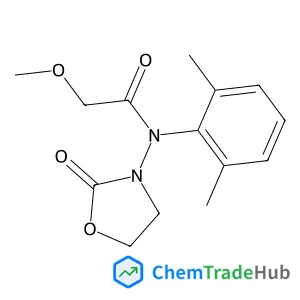
N-(2,6-Dimethylphenyl)-2-methoxy-N-(2-oxo-1,3-oxazolidin-3-yl)acetamide
CAS番号:
77732-09-3
分子式:
C14H18N2O4
おすすめサプライヤー




免責事項
このページに表示される学術雑誌情報は、参考および研究目的のみを目的としています。当社は雑誌出版社とは提携しておらず、投稿の取り扱いも行っておりません。出版に関するお問い合わせは、各雑誌出版社に直接ご連絡ください。
表示されている情報に誤りがある場合は、support@chemtradehub.com までご連絡ください。迅速に確認し、対応いたします。