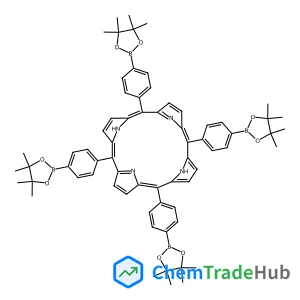
5,10,15,20-tetrakis(4-boronic acid pinacol ester phenyl) porphyrin
CAS番号:
1332748-00-1
分子式:
C68H74B4N4O8
Ângelo C. Salvador, Mickael da C. Santos, Jorge A. Saraiva
The effect of the ionic liquid 1-butyl-3-methylimidazolium chloride ([bmim]Cl) and of high pressure on the activity of cellulase from Aspergillus niger were studied separately and in combination. The enzyme activity decreased with increasing concentrations of [bmim]Cl, reaching 50% the value in aqueous buffer with 20% [bmim]Cl. However, when the enzyme is held in 10% [bmim]Cl and is then assayed in 1% [bmim]Cl, it showed only 8% reduction of activity. These results can be explained by the fact that the activity of the enzyme in [bmim]Cl is linearly correlated with the decrease of the thermodynamic water activity (aw). Under pressure the enzyme activity varied from less 60% (at 200MPa) to equal (at 400 MPa), compared to atmospheric pressure. In 10% [bmim]Cl under pressure, cellulase activity is improved compared to atmospheric pressure, varying from equal (at 600 MPa) to 1.7-fold higher (at 100 MPa). This opens the possibility to improve cellulase activity in ionic liquids, and possibly of other enzymes, by carrying out the reaction under pressure.
Carla D. Nunes, Svemir Rudić
DOI: 10.1039/C9CP06278E
Anusuya Saha
DOI: 10.1039/C9CP03881G
Madjid Zemmouche, Isabelle Navizet
DOI: 10.1039/C9CP04687A
Jinzhe Zeng, Liqun Cao, Haisheng Ren
DOI: 10.1039/C9CP05091D
Masumeh Foroutan, Vahid Fadaei Naeini, Mina Ebrahimi
DOI: 10.1039/C9CP04977K
Gregory S. Jackson, Ethan J. Crumlin, Bryan Eichhorn, Sandrine Ricote
DOI: 10.1039/C9CP04335G
Dilek Yalcin, Calum J. Drummond, Tamar L. Greaves
DOI: 10.1039/C9CP05711K
Huali Hao, Wenzhao Zhou
DOI: 10.1039/C9CP04914B
4-アミノフェノール酸ナトリウム水和物は、CAS番号206557-08-6の化合物で、4-アミノフェノールとナトリウムが結合した塩と水和物です。この化合物は、白...
この化合物は特定の合成プロセスに使用される可能性がありますが、代替品として、他の类似的な化合物、例えばMethyl 3-methyl-N-{[(2-methyl...
4-Boc-2-哌嗪甲酸は、薬品開発や合成化学分野で広く使用されており、その需要は継続的に推移しています。特に、新薬開発における合成化学分野での需要が高まってい...
4,4'-二羟甲基联苯のCAS番号は1667-12-5です。この化合物は白色の結晶粉末で、分子量は154.20です。水にわずかに溶けますが、アルコールや有機溶媒...
5-甲硫基戊腈は医薬品産業で使用される可能性があります。また、ポリマー合成の触媒として、センサー製造の一部として、半導体製造のプロセス改善に使用される可能性があ...
この化合物は、1-abieta-8,11,13-trien-19-イルと6'-メトキシシンコナナン-9-基を含有する窒素含有化合物から合成されます。一般的な合成...
6-ブロモベンジジミダゾール-2-カルビルデオキシドは、避光・乾燥した容器(密閉容器)で-20℃~4℃の低温で保存してください。高温や直射日光、湿気は避けてくだ...
621-65-8のCAS番号を持つBoc-N-甲基氨甲环酸は、化学式C7H13NO5を有する化合物です。この化合物は白色の結晶性粉末で、吸湿性があります。
乙基三氟硼酸钾は、トリフLUオール酸カリウムとエチルブロミドを反応させて合成されます。この反応は高い選択性と収率を持ち、触媒を用いることで効率的に進行します。
2-フロウロ-5-クロロ-4-アミノフェノールは、直射日光を避けて冷却された暗所で保存し、密閉容器に保管してください。温度は常温か低温が適しています。

Green Chemistry provides a unique forum for the publication of innovative research on the development of alternative green and sustainable technologies. The scope of Green Chemistry is based on, but not limited to, the definition proposed by Anastas and Warner (Green Chemistry: Theory and Practice, P T Anastas and J C Warner, Oxford University Press, Oxford, 1998). Green chemistry is the utilisation of a set of principles that reduces or eliminates the use or generation of hazardous substances in the design, manufacture and application of chemical products. Green Chemistry is at the frontiers of this continuously-evolving interdisciplinary science and publishes research that attempts to reduce the environmental impact of the chemical enterprise by developing a technology base that is inherently non-toxic to living things and the environment. Submissions on all aspects of research relating to the endeavour are welcome. The journal publishes original and significant cutting-edge research that is likely to be of wide general appeal. To be published, work must present a significant advance in green chemistry. Papers must contain a comparison with existing methods and demonstrate advantages over those methods before publication can be considered. For more information please see this Editorial. Coverage includes the following, but is not limited to: Design (e.g. biomimicry, design for degradation/recycling/reduced toxicity…) Reagents & Feedstocks (e.g. renewables, CO2, solvents, auxiliary agents, waste utilization…) Synthesis (e.g. organic, inorganic, synthetic biology…) Catalysis (e.g. homogeneous, heterogeneous, enzyme, whole cell…) Process (e.g. process design, intensification, separations, recycling, efficiency…) Energy (e.g. renewable energy, fuels, photovoltaics, fuel cells, energy storage, energy carriers…) Applications (e.g. electronics, dyes, consumer products, coatings, pharmaceuticals, preservatives, building materials, chemicals for industry/agriculture/mining…) Impact (e.g. safety, metrics, LCA, sustainability, (eco)toxicology…) Green chemistry is, by definition, a continuously-evolving frontier. Therefore, the inclusion of a particular material or technology does not, of itself, guarantee that a paper is suitable for the journal. To be suitable, the novel advance should have the potential for reduced environmental impact relative to the state of the art. Green Chemistry does not normally deal with research associated with 'end-of-pipe' or remediation issues.