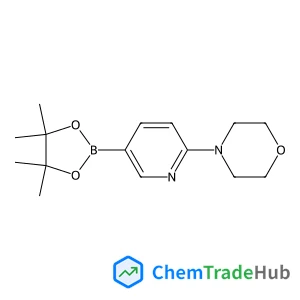
4-(5-(4,4,5,5-tetramethyl-1,3,2-dioxaborolan-2-yl)pyridin-2-yl)morpholine
CAS番号:
485799-04-0
分子式:
C15H23BN2O3
Juanjuan Gao, Shuangyang Li, Xianren Zhang, Wenchuan Wang
In this work, we study the fission process of large micelles by using dissipative particle dynamics. In general, there exist four different stages during a fission process. For the first stage, the morphological transition to the dumbbell intermediate structures occurs due to a perturbation, in this case, a change in head–head interaction. Then, in the next stage the dumbbell-like intermediate structure fluctuates for a longer or less time until it reaches mechanical instability. Simulation results indicate that the fluctuation of the intermediate structure in this stage can be regarded as a nucleation process. In the third stage, the neck breaks as a result of continuous narrowing. In the last stage the two or more freshly formed, small micelles retract and equilibrate to their final shapes. Simulation results demonstrate that the first, second and third stages are characterized by distinct dynamic features, depending on the surfactant architecture. It is found that surfactant architecture controls the micelle fission process, especially for the second stage, similar to the way it controls the size and shape of the aggregates at equilibrium. Since for most cases it is the second stage that dominates the lifetime of a micelle, we suggest that the molecule packing parameter is not only a predictor of the shape and size of aggregates, but also a predictor of kinetic properties for micelle fission.
Changwei Wang, Yama Aman, Xiaoxi Ji, Yirong Mo
DOI: 10.1039/C9CP01710K
João Especial, Antonio Rey
DOI: 10.1039/C9CP01701A
Alexandra E. Raeber, David A. Mazziotti
DOI: 10.1039/C9CP01678C
Zonghao Shen, Stephen J. Skinner, John A. Kilner
DOI: 10.1039/C9CP02175B
Joaquín Calbo, Alberto de Juan, Juan Aragó, Julia Villalva, Emilio M. Pérez, Enrique Ortí
DOI: 10.1039/C9CP01735F
Ruslan N. Tazhigulov, Pradeep Kumar Gurunathan, Yongbin Kim, Lyudmila V. Slipchenko, Ksenia B. Bravaya
DOI: 10.1039/C9CP01533G
Shintaro Fujii, Haruna Cho, Yoshifumi Hashikawa, Tomoaki Nishino, Yasujiro Murata, Manabu Kiguchi
DOI: 10.1039/C9CP02469G
Marco Flock, Lea Bosse, Dustin Kaiser, Bernd Engels, Ingo Fischer
DOI: 10.1039/C9CP02222H
Harald Knorke, Knut R. Asmis
DOI: 10.1039/C9CP01802F
Valentina Migliorati, Adriano Filipponi, Francesco Sessa, Alessandra Serva, Paola D'Angelo
DOI: 10.1039/C9CP01417A
CAS番号66981-77-9の噻奈普汀乙酯は、結晶性白色粉末であり、分子量は476.9 g/molです。この化合物は水に溶けにくく、一般的には有機溶媒で溶解し...
アミピシリン不純物Fは、CAS番号124774-48-7の化合物です。これは、抗生物質アミピシリンの生産過程で生成される不純物の一つであり、(4S)-2-({[...
イリジウム(I)ヘキサフルオロフォスファートの代替品として、他の有機金属化合物や非有機金属化合物が使用されることがあります。具体的には、ダイゾニウム塩や他の金属...
含有3-(苯氧基甲基)苯硼酸频那醇酯の廃棄物は、安全な方法で処理する必要があります。まず、廃棄物を適切な容器に収集し、避けて保管します。次に、専門の廃棄処理業者...
取り扱う際は、密閉のゴーグルと手袋を着用することが推奨されます。ドラフトチャンバーを使用し、漏洩時には速やかに取り扱いを中止し、適切な排気設備を使用してください...
3α-アセトキノイドコレステロールエステルは、常温から低温(0-5℃)の暗所で保存し、密閉容器に入れることで安定性を保つことが推奨されます。また、湿気や酸素から...
2-ぶンジロキシ-4-(トリフルオロメチル)フェノルビノン酸は、化学合成の触媒としての使用や、医薬品の合成材料としての役割があります。また、特定の合成路線で使用...
(2S,3R)-2-氨基-3-甲基丁二酸は、2-ヒドロキシ-3-メチル丁酸とアミノ化反応を行うことで合成されます。触媒としてジクロロメタンが使用され、選択性と収...
この化合物は常温で避けてください。直射日光を避け、密閉容器で保存し、湿気を防水の容器に入れて保管してください。

Physical Chemistry Chemical Physics (PCCP) is an international journal co-owned by 19 physical chemistry and physics societies from around the world. This journal publishes original, cutting-edge research in physical chemistry, chemical physics and biophysical chemistry. To be suitable for publication in PCCP, articles must include significant innovation and/or insight into physical chemistry; this is the most important criterion that reviewers and Editors will judge against when evaluating submissions. The journal has a broad scope and welcomes contributions spanning experiment, theory, computation and data science. Topical coverage includes spectroscopy, dynamics, kinetics, statistical mechanics, thermodynamics, electrochemistry, catalysis, surface science, quantum mechanics, quantum computing and machine learning. Interdisciplinary research areas such as polymers and soft matter, materials, nanoscience, energy, surfaces/interfaces, and biophysical chemistry are welcomed if they demonstrate significant innovation and/or insight into physical chemistry. Joined experimental/theoretical studies are particularly appreciated when complementary and based on up-to-date approaches.