












Integral and differential cross sections for the S(1D)+HD reaction employing the ground adiabatic electronic state
文献情報
出版日
2009-11-05
DOI
10.1039/B917972K
インパクトファクター
3.676
著者
H. Yang, K.-L. Han, G. C. Schatz, S.-H. Lee, K. Liu, S. C. Smith, M. Hankel
原文を見る
要旨
We present converged quantum mechanical calculations for the title reaction employing a time-dependent wavepacket method. We obtained integral and differential cross sections over an energy range from 0.23 to 0.35 eV total energy as well as product state distributions for both product channels. The excitation functions decrease with energy and point to statistical dynamics as do the cold vibrational distributions and highly inverted rotational distributions. The differential cross sections oscillate strongly with energy for both product channels. Our differential cross sections for both product channels at 2.5 kcal/mol, one of the experimental energies, compare well to the experimental results. The quantum results obtained in this study are similar to what has been found employing QCT methods, implying that the differences between the experimental and theoretical results are due to the potential energy surface or non-adiabatic effects rather than due to quantum effects or the methods employed.
関連文献
Sudden polarization and zwitterion formation as a pseudo-Jahn–Teller effect: a new insight into the photochemistry of alkenes
Ya Wang, Yang Liu, Isaac B. Bersuker
2019-04-26
Paper
DOI: 10.1039/C9CP01023H
Detailed kinetic model for hexyl sulfide pyrolysis and its desulfurization by supercritical water
Caleb A. Class, AnGayle K. Vasiliou, Yuko Kida, Michael T. Timko, William H. Green
2019-04-26
Paper
DOI: 10.1039/C9CP00234K
Non-equilibrium adatom thermal state enables rapid additive nanomanufacturing
Matthew R. Henry, Songkil Kim
2019-04-29
Paper
DOI: 10.1039/C9CP01478K
Red-shifted delayed fluorescence at the expense of photoluminescence quantum efficiency – an intramolecular charge-transfer molecule based on a benzodithiophene-4,8-dione acceptor
Stephanie Montanaro, Alexander J. Gillett, Sascha Feldmann, Emrys W. Evans, Felix Plasser, Richard H. Friend, Iain A. Wright
2019-05-06
Paper
DOI: 10.1039/C9CP02186H
The molecular mechanism of structural changes in the antimicrobial peptide CM15 upon complex formation with drug molecule suramin: a computational analysis
Adam Sieradzan, Ferenc Zsila, Tünde Juhász, Szilvia Bősze, Adam Liwo, Sergey A. Samsonov
2019-05-01
Paper
DOI: 10.1039/C9CP00471H
Design of arginine-based therapeutic deep eutectic solvents as drug solubilization vehicles for active pharmaceutical ingredients
Alberto Gutiérrez, Santiago Aparicio
2019-04-30
Paper
DOI: 10.1039/C9CP01408J
Characteristics of sulfur atoms adsorbed on Ag(100), Ag(110), and Ag(111) as probed with scanning tunneling microscopy: experiment and theory
Peter M. Spurgeon, Da-Jiang Liu, Junepyo Oh, Hyun Jin Yang, Yousoo Kim
2019-05-10
Paper
DOI: 10.1039/C9CP01626K
Alkaline manganese electrochemistry studied by in situ and operando spectroscopic methods – metal dissolution, oxide formation and oxygen evolution
Martin Rabe, Cigdem Toparli, Ying-Hsuan Chen, Olga Kasian
2019-04-08
Paper
DOI: 10.1039/C9CP00911F
Ultrafast photoisomerisation of an isolated retinoid
James N. Bull, Christopher W. West, Cate S. Anstöter, Gabriel da Silva, Evan J. Bieske, Jan R. R. Verlet
2019-05-02
Paper
DOI: 10.1039/C9CP01624D
Synergetic light trapping effects in organic solar cells with a patterned semi-transparent electrode
2019-05-09
Paper
DOI: 10.1039/C9CP00581A
こちらもおすすめ
化合物よくある質問
2-氟-4-イオドベンzo酸エチルエステルを取り扱う際の実験室安全事項は何ですか?
2-氟-4-イオドベンzo酸エチルエステルは有機溶媒を用いた反応であり、ドラフトチャンバーでの操作が必要です。漏洩時にはSDS参照の安全措置を講じ、PPE(防護...
205750-82-9Benzoic acid, 2-fluo...
化合物よくある質問
血根碱の主な用途は何ですか?
血根碱は主に医薬分野で利用され、抗炎症や抗がん剤としての潜在的な効果が研究されています。また、化学研究や薬物開発において、新しい薬剤設計の参考となる化合物として...
2447-54-313-Methyl[1,3]benzod...
化合物よくある質問
Methyl 3-methoxythiophene-2-carboxylateの主な用途は何ですか?
Methyl 3-メトキシスチフェン-2-カルボン酸メチルエステルは、薬品合成、染料製造、以及合成中間体としての用途が広がっています。
62353-75-7Methyl 3-methoxythio...
化合物よくある質問
丹磺酰-L-亮氨酸はどのように保存すればよいですか?
丹磺酰-L-亮氨酸は乾燥した場所で、直射日光から保護し、低温(室温以下)で保存してください。密閉容器に入れて保管することをおすすめします。
1100-22-7N-{[5-(Dimethylamino...
化合物よくある質問
5-(苄氧基)ピラミジン-4-アミンの代替品はありますか?
5-(苄氧基)ピラミジン-4-アミンの代替品として、6-メトキシピラミジンや5-フェニルピラミジンなどが挙げられます。これらの化合物は、5-(苄氧基)ピラミジン...
92289-50-45-benzyloxypyrimidin...
化合物よくある質問
8-ヒドロキシノルデコペントアセートの物理化学的性質は何ですか?
8-ヒドロキシノルデコペントアセートはCAS番号84807-87-4の化合物で、分子量は750.02 uです。これは油溶性で、水に溶けにくい特徴があります。反応...
84807-87-4(5Z,8Z,11Z,13E,15S)-...
化合物よくある質問
tert-ブチル(エス)-1-ヒドロキシペンタ-4-エン-2-イルカルバamateの主な用途は何ですか?
tert-ブチル(エス)-1-ヒドロキシペンタ-4-エン-2-イルカルバamateは主に医薬品の合成材料や分析化学の試薬として使用されます。
116613-81-12-Methyl-2-propanyl ...
化合物よくある質問
ブコール-L-2-フローヨルブリンについて適切な法規ガイドラインは何ですか?
ブコール-L-2-フローヨルブリン(CAS番号: 1196107-73-9)は、GHS(グローバルハザードアサessmentシステム)に基づく危害分類と表示が求...
1196107-73-92-Bromo-13,13-dimeth...
化合物よくある質問
6-ブロモ-N-環丙基-2-ピリジニニメタンの市場動向や研究トレンドはどうですか
6-ブロモ-N-環丙基-2-ピリジニニメタンは、薬理学研究や合成化学に使用される化合物であり、特に抗ウイルス薬や抗がん薬の開発に注目されています。市場では、薬物...
959237-20-86-Bromo-N-cyclopropy...
化合物よくある質問
RS-AMPÀはどのように保存すればよいですか?
RS-AMPÀは、遮光容器に保存し、室温(15〜25℃)で保管することが推奨されます。高湿や熱は物質を劣化させるため、湿度は50%以下に保つことが重要です。また...
74341-63-2(RS)-AMPA
掲載誌
Physical Chemistry Chemical Physics

CiteScore:
5.5
自己引用率:
10.3%
年間論文数:
3036
Physical Chemistry Chemical Physics (PCCP) is an international journal co-owned by 19 physical chemistry and physics societies from around the world. This journal publishes original, cutting-edge research in physical chemistry, chemical physics and biophysical chemistry. To be suitable for publication in PCCP, articles must include significant innovation and/or insight into physical chemistry; this is the most important criterion that reviewers and Editors will judge against when evaluating submissions. The journal has a broad scope and welcomes contributions spanning experiment, theory, computation and data science. Topical coverage includes spectroscopy, dynamics, kinetics, statistical mechanics, thermodynamics, electrochemistry, catalysis, surface science, quantum mechanics, quantum computing and machine learning. Interdisciplinary research areas such as polymers and soft matter, materials, nanoscience, energy, surfaces/interfaces, and biophysical chemistry are welcomed if they demonstrate significant innovation and/or insight into physical chemistry. Joined experimental/theoretical studies are particularly appreciated when complementary and based on up-to-date approaches.
おすすめ化合物
![(1R)-3-Bromo-1,7,7-trimethylbicyclo[2.2.1]heptan-2-one structure](https://static.chemtradehub.com/structs/102/10293-06-8-dd8a.webp "(1R)-3-Bromo-1,7,7-trimethylbicyclo[2.2.1]heptan-2-one structure")
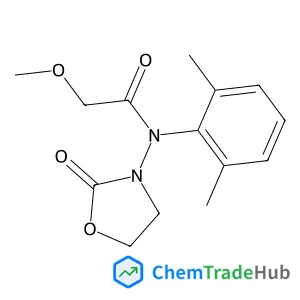
N-(2,6-Dimethylphenyl)-2-methoxy-N-(2-oxo-1,3-oxazolidin-3-yl)acetamide
CAS番号:
77732-09-3
分子式:
C14H18N2O4
おすすめサプライヤー





免責事項
このページに表示される学術雑誌情報は、参考および研究目的のみを目的としています。当社は雑誌出版社とは提携しておらず、投稿の取り扱いも行っておりません。出版に関するお問い合わせは、各雑誌出版社に直接ご連絡ください。
表示されている情報に誤りがある場合は、support@chemtradehub.com までご連絡ください。迅速に確認し、対応いたします。