












Spectroscopic characterization of Fe-doped synthetic chrysotile by EPR, DRS and magnetic susceptibility measurements
文献情報
出版日
2009-11-09
DOI
10.1039/B915182F
インパクトファクター
3.676
著者
Elena Borghi, Manlio Occhiuzzi, Elisabetta Foresti, Isidoro Giorgio Lesci, Norberto Roveri
原文を見る
要旨
Fe-doped synthetic geomimetic chrysotile nanocrystals represent a reference standard to investigate the health hazard associated with asbestos fibers and constitute interesting inorganic nanotubes for specific technological applications in light harvesting systems, optoelectronics and photonics. As the fiber toxicity is catalyzed by iron ions in specific crystallographic sites and the mechanical behaviour of synthetic chrysotile nanotubes is strongly affected by the iron doping extent, the characterization of Fe substitution to Mg and/or Si sites in the chrysotile structure appears highly important. By EPR, DRS spectroscopic analyses and magnetic investigations, Mg and/or Si ion replacement by Fe3+ in a synthetic geomimetic chrysotile structure has been investigated. The results highlight that, as a function of the Fe doping extent and of the Fe doping process, iron can replace both Mg and Si sites. The contemporary iron substitution into the octahedral and tetrahedral sheets is associated with the presence of both of isolated Fe3+ centres in high-spin 3d5 configuration (S = , 6A1(6S)) in Oh and Td symmetry and of intra-lattice clustered species. Increasing the Fe doping extent increases the concentration of aggregated species, while magnetic susceptibility confirms a paramagnetic anisotropy. The results allow to define the opportunity of using or not metallic Fe during the synthesis to obtain doped chrysotile nanocrystals with tailored morphological and structural properties suitable as a reference to study asbestos toxicity and apt to prepare new inorganic nanotubes and quantum wires for innovative technological applications.
関連文献
Predicting aromatic exciplex fluorescence emission energies
Rachel A. Krueger, Guillaume Blanquart
2019-05-03
Paper
DOI: 10.1039/C9CP02027F
Thermodynamics, kinetics and electronic properties of point defects in β-FeSi2
Jun Chai, Chen Ming, Xiaolong Du, Pengfei Qiu, Yi-Yang Sun, Lidong Chen
2019-04-18
Paper
DOI: 10.1039/C9CP00755E
New particle formation from the reactions of ozone with indene and styrene
Larisa L. B. Bracco, María E. Tucceri, Alba Escalona, Yolanda Díaz-de-Mera, Alfonso Aranda, Ana M. Rodríguez, Diana Rodríguez
2019-05-10
Paper
DOI: 10.1039/C9CP00912D
Photodissociation dynamics of CH3I probed via multiphoton ionisation photoelectron spectroscopy
Emily M. Warne, Briony Downes-Ward, Joanne Woodhouse, Michael A. Parkes, Darren Bellshaw, Emma Springate, Paulina Majchrzak, Yu Zhang, Gabriel Karras, Adam S. Wyatt, Richard T. Chapman, Adam Kirrander, Russell S. Minns
2019-05-10
Paper
DOI: 10.1039/C9CP01477B
Furthering the reaction mechanism of cationic vanadium clusters towards oxygen
Haiming Wu
2019-05-03
Paper
DOI: 10.1039/C9CP01192G
Detailed kinetic model for hexyl sulfide pyrolysis and its desulfurization by supercritical water
Caleb A. Class, AnGayle K. Vasiliou, Yuko Kida, Michael T. Timko, William H. Green
2019-04-26
Paper
DOI: 10.1039/C9CP00234K
Molecular insight into carboxylic acid–alkali metal cations interactions: reversed affinities and ion-pair formation revealed by non-linear optics and simulations
Adrien Sthoer, Jana Hladílková, Mikael Lund, Eric Tyrode
2019-05-10
Paper
DOI: 10.1039/C9CP00398C
Red-shifted delayed fluorescence at the expense of photoluminescence quantum efficiency – an intramolecular charge-transfer molecule based on a benzodithiophene-4,8-dione acceptor
Stephanie Montanaro, Alexander J. Gillett, Sascha Feldmann, Emrys W. Evans, Felix Plasser, Richard H. Friend, Iain A. Wright
2019-05-06
Paper
DOI: 10.1039/C9CP02186H
TiO2 mesoporous thin film architecture as a tool to control Au nanoparticles growth and sensing capabilities
Paula Y. Steinberg, M. Mercedes Zalduendo, Gustavo Giménez, Galo J. A. A. Soler-Illia, Paula C. Angelomé
2019-04-25
Paper
DOI: 10.1039/C9CP01896D
In situ quasi-elastic neutron scattering study on the water dynamics and reaction mechanisms in alkali-activated slags
Yongqiang Cheng, Luke L. Daemen
2019-04-30
Paper
DOI: 10.1039/C9CP00889F
こちらもおすすめ
化合物よくある質問
2-氟-4-イオドベンzo酸エチルエステルを取り扱う際の実験室安全事項は何ですか?
2-氟-4-イオドベンzo酸エチルエステルは有機溶媒を用いた反応であり、ドラフトチャンバーでの操作が必要です。漏洩時にはSDS参照の安全措置を講じ、PPE(防護...
205750-82-9Benzoic acid, 2-fluo...
化合物よくある質問
血根碱の主な用途は何ですか?
血根碱は主に医薬分野で利用され、抗炎症や抗がん剤としての潜在的な効果が研究されています。また、化学研究や薬物開発において、新しい薬剤設計の参考となる化合物として...
2447-54-313-Methyl[1,3]benzod...
化合物よくある質問
Methyl 3-methoxythiophene-2-carboxylateの主な用途は何ですか?
Methyl 3-メトキシスチフェン-2-カルボン酸メチルエステルは、薬品合成、染料製造、以及合成中間体としての用途が広がっています。
62353-75-7Methyl 3-methoxythio...
化合物よくある質問
丹磺酰-L-亮氨酸はどのように保存すればよいですか?
丹磺酰-L-亮氨酸は乾燥した場所で、直射日光から保護し、低温(室温以下)で保存してください。密閉容器に入れて保管することをおすすめします。
1100-22-7N-{[5-(Dimethylamino...
化合物よくある質問
5-(苄氧基)ピラミジン-4-アミンの代替品はありますか?
5-(苄氧基)ピラミジン-4-アミンの代替品として、6-メトキシピラミジンや5-フェニルピラミジンなどが挙げられます。これらの化合物は、5-(苄氧基)ピラミジン...
92289-50-45-benzyloxypyrimidin...
化合物よくある質問
8-ヒドロキシノルデコペントアセートの物理化学的性質は何ですか?
8-ヒドロキシノルデコペントアセートはCAS番号84807-87-4の化合物で、分子量は750.02 uです。これは油溶性で、水に溶けにくい特徴があります。反応...
84807-87-4(5Z,8Z,11Z,13E,15S)-...
化合物よくある質問
tert-ブチル(エス)-1-ヒドロキシペンタ-4-エン-2-イルカルバamateの主な用途は何ですか?
tert-ブチル(エス)-1-ヒドロキシペンタ-4-エン-2-イルカルバamateは主に医薬品の合成材料や分析化学の試薬として使用されます。
116613-81-12-Methyl-2-propanyl ...
化合物よくある質問
ブコール-L-2-フローヨルブリンについて適切な法規ガイドラインは何ですか?
ブコール-L-2-フローヨルブリン(CAS番号: 1196107-73-9)は、GHS(グローバルハザードアサessmentシステム)に基づく危害分類と表示が求...
1196107-73-92-Bromo-13,13-dimeth...
化合物よくある質問
6-ブロモ-N-環丙基-2-ピリジニニメタンの市場動向や研究トレンドはどうですか
6-ブロモ-N-環丙基-2-ピリジニニメタンは、薬理学研究や合成化学に使用される化合物であり、特に抗ウイルス薬や抗がん薬の開発に注目されています。市場では、薬物...
959237-20-86-Bromo-N-cyclopropy...
化合物よくある質問
RS-AMPÀはどのように保存すればよいですか?
RS-AMPÀは、遮光容器に保存し、室温(15〜25℃)で保管することが推奨されます。高湿や熱は物質を劣化させるため、湿度は50%以下に保つことが重要です。また...
74341-63-2(RS)-AMPA
掲載誌
Physical Chemistry Chemical Physics

CiteScore:
5.5
自己引用率:
10.3%
年間論文数:
3036
Physical Chemistry Chemical Physics (PCCP) is an international journal co-owned by 19 physical chemistry and physics societies from around the world. This journal publishes original, cutting-edge research in physical chemistry, chemical physics and biophysical chemistry. To be suitable for publication in PCCP, articles must include significant innovation and/or insight into physical chemistry; this is the most important criterion that reviewers and Editors will judge against when evaluating submissions. The journal has a broad scope and welcomes contributions spanning experiment, theory, computation and data science. Topical coverage includes spectroscopy, dynamics, kinetics, statistical mechanics, thermodynamics, electrochemistry, catalysis, surface science, quantum mechanics, quantum computing and machine learning. Interdisciplinary research areas such as polymers and soft matter, materials, nanoscience, energy, surfaces/interfaces, and biophysical chemistry are welcomed if they demonstrate significant innovation and/or insight into physical chemistry. Joined experimental/theoretical studies are particularly appreciated when complementary and based on up-to-date approaches.
おすすめ化合物
![2-Hydroxy-4-[({[(4-methylphenyl)sulfonyl]oxy}acetyl)amino]benzoic acid structure](https://static.chemtradehub.com/structs/501/501919-59-1-579f.webp "2-Hydroxy-4-[({[(4-methylphenyl)sulfonyl]oxy}acetyl)amino]benzoic acid structure")
2-Hydroxy-4-[({[(4-methylphenyl)sulfonyl]oxy}acetyl)amino]benzoic acid
CAS番号:
501919-59-1
分子式:
C16H15NO7S
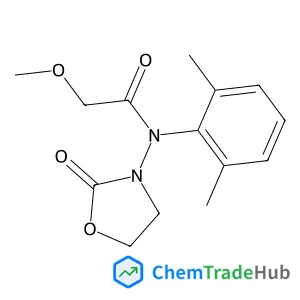
N-(2,6-Dimethylphenyl)-2-methoxy-N-(2-oxo-1,3-oxazolidin-3-yl)acetamide
CAS番号:
77732-09-3
分子式:
C14H18N2O4
おすすめサプライヤー





免責事項
このページに表示される学術雑誌情報は、参考および研究目的のみを目的としています。当社は雑誌出版社とは提携しておらず、投稿の取り扱いも行っておりません。出版に関するお問い合わせは、各雑誌出版社に直接ご連絡ください。
表示されている情報に誤りがある場合は、support@chemtradehub.com までご連絡ください。迅速に確認し、対応いたします。