












Mechanism of electro-oxidation of carbon monoxide on stepped platinum electrodes in alkaline media: a chronoamperometric and kinetic modeling study
文献情報
出版日
2009-11-02
DOI
10.1039/B914013A
インパクトファクター
3.676
著者
Gonzalo García, Marc T. M. Koper
原文を見る
要旨
From a detailed analysis of the chronoamperometry of CO stripping on stepped platinum single-crystal electrodes in alkaline solution, in combination with kinetic modeling, a mechanistic and kinetic picture of the CO oxidation mechanism is derived. On Pt(111), CO oxidation starts at defect sites (steps, kinks), following a one-dimensional nucleation-and-growth mechanism, or a Langmuir–Hinshelwood mechanism with no effective competition between CO and OH. The carbonate that is formed in this reaction blocks the active oxidation sites, so that CO adsorbed on terraces further away from the defect sites can be oxidized at defects sites only very slowly. At potentials above ca. 0.75 V vs. RHE this CO is oxidized on the Pt(111) terrace. On stepped Pt electrodes, CO oxidation is also initiated at the kink (step defects) and step sites. We postulate that carbonate partially blocks the active site, but CO from the terrace still prefers to react at the steps over the terrace sites. The oxidation of terrace-bound CO at the step sites follows a competitive Langmuir–Hinshelwood mechanism. The least reactive CO on the surface is the CO that is adsorbed on the step sites, and it is oxidized by OH on terraces. Finally, on the terrace, the Tafel slope for CO stripping is close to 60 mV dec−1, suggesting an EC mechanism, i.e. reversible OH formation followed by a chemical rate-determining step, presumably the CO + OH combination reaction. At the step site, the Tafel slope is close to 120 mV dec−1, suggesting an electrochemical rate-determining step, ascribed to slow OH formation at the step site.
関連文献
Red-shifted delayed fluorescence at the expense of photoluminescence quantum efficiency – an intramolecular charge-transfer molecule based on a benzodithiophene-4,8-dione acceptor
Stephanie Montanaro, Alexander J. Gillett, Sascha Feldmann, Emrys W. Evans, Felix Plasser, Richard H. Friend, Iain A. Wright
2019-05-06
Paper
DOI: 10.1039/C9CP02186H
Tuning the electronic structure properties of MoS2 monolayers with carbon doping
Wiliam Ferreira da Cunha, Ramiro Marcelo dos Santos, Rafael Timóteo de Sousa Júnior, Renato Batista Santos, Geraldo Magela e Silva, Luiz Antônio Ribeiro Júnior
2019-05-08
Paper
DOI: 10.1039/C9CP00980A
Synergetic light trapping effects in organic solar cells with a patterned semi-transparent electrode
2019-05-09
Paper
DOI: 10.1039/C9CP00581A
Lithium ion diffusion mechanism in covalent organic framework based solid state electrolyte
Kecheng Zhang, Bingkai Zhang, Mouyi Weng, Jiaxin Zheng, Shunning Li, Feng Pan
2019-04-23
Paper
DOI: 10.1039/C9CP02117E
Excited-state dynamics of heteroleptic copper(i) photosensitizers and their electrochemically reduced forms containing a dipyridophenazine moiety – a spectroelectrochemical transient absorption study
Linda Zedler, Michael Karnahl
2019-05-07
Paper
DOI: 10.1039/C9CP00412B
Exchange-dependent spin polarized transport and phase transition in a triple monomer molecule
Yongchen Xiong, Shijun Luo, Haiming Huang, Yanan Ma, Xiong Zhang
2019-04-25
Paper
DOI: 10.1039/C9CP01350D
Multiple glass transitions in vapor-deposited orientational glasses of the most fragile plastic crystal Freon 113
A. Vila-Costa, J. Ràfols-Ribé, M. Gonzalez-Silveira, A. Lopeandía, J. Ll. Tamarit, J. Rodríguez-Viejo
2019-04-30
Paper
DOI: 10.1039/C9CP00976K
TiO2 mesoporous thin film architecture as a tool to control Au nanoparticles growth and sensing capabilities
Paula Y. Steinberg, M. Mercedes Zalduendo, Gustavo Giménez, Galo J. A. A. Soler-Illia, Paula C. Angelomé
2019-04-25
Paper
DOI: 10.1039/C9CP01896D
こちらもおすすめ
化合物よくある質問
2-氟-4-イオドベンzo酸エチルエステルを取り扱う際の実験室安全事項は何ですか?
2-氟-4-イオドベンzo酸エチルエステルは有機溶媒を用いた反応であり、ドラフトチャンバーでの操作が必要です。漏洩時にはSDS参照の安全措置を講じ、PPE(防護...
205750-82-9Benzoic acid, 2-fluo...
化合物よくある質問
血根碱の主な用途は何ですか?
血根碱は主に医薬分野で利用され、抗炎症や抗がん剤としての潜在的な効果が研究されています。また、化学研究や薬物開発において、新しい薬剤設計の参考となる化合物として...
2447-54-313-Methyl[1,3]benzod...
化合物よくある質問
Methyl 3-methoxythiophene-2-carboxylateの主な用途は何ですか?
Methyl 3-メトキシスチフェン-2-カルボン酸メチルエステルは、薬品合成、染料製造、以及合成中間体としての用途が広がっています。
62353-75-7Methyl 3-methoxythio...
化合物よくある質問
丹磺酰-L-亮氨酸はどのように保存すればよいですか?
丹磺酰-L-亮氨酸は乾燥した場所で、直射日光から保護し、低温(室温以下)で保存してください。密閉容器に入れて保管することをおすすめします。
1100-22-7N-{[5-(Dimethylamino...
化合物よくある質問
5-(苄氧基)ピラミジン-4-アミンの代替品はありますか?
5-(苄氧基)ピラミジン-4-アミンの代替品として、6-メトキシピラミジンや5-フェニルピラミジンなどが挙げられます。これらの化合物は、5-(苄氧基)ピラミジン...
92289-50-45-benzyloxypyrimidin...
化合物よくある質問
8-ヒドロキシノルデコペントアセートの物理化学的性質は何ですか?
8-ヒドロキシノルデコペントアセートはCAS番号84807-87-4の化合物で、分子量は750.02 uです。これは油溶性で、水に溶けにくい特徴があります。反応...
84807-87-4(5Z,8Z,11Z,13E,15S)-...
化合物よくある質問
tert-ブチル(エス)-1-ヒドロキシペンタ-4-エン-2-イルカルバamateの主な用途は何ですか?
tert-ブチル(エス)-1-ヒドロキシペンタ-4-エン-2-イルカルバamateは主に医薬品の合成材料や分析化学の試薬として使用されます。
116613-81-12-Methyl-2-propanyl ...
化合物よくある質問
ブコール-L-2-フローヨルブリンについて適切な法規ガイドラインは何ですか?
ブコール-L-2-フローヨルブリン(CAS番号: 1196107-73-9)は、GHS(グローバルハザードアサessmentシステム)に基づく危害分類と表示が求...
1196107-73-92-Bromo-13,13-dimeth...
化合物よくある質問
6-ブロモ-N-環丙基-2-ピリジニニメタンの市場動向や研究トレンドはどうですか
6-ブロモ-N-環丙基-2-ピリジニニメタンは、薬理学研究や合成化学に使用される化合物であり、特に抗ウイルス薬や抗がん薬の開発に注目されています。市場では、薬物...
959237-20-86-Bromo-N-cyclopropy...
化合物よくある質問
RS-AMPÀはどのように保存すればよいですか?
RS-AMPÀは、遮光容器に保存し、室温(15〜25℃)で保管することが推奨されます。高湿や熱は物質を劣化させるため、湿度は50%以下に保つことが重要です。また...
74341-63-2(RS)-AMPA
掲載誌
Physical Chemistry Chemical Physics

CiteScore:
5.5
自己引用率:
10.3%
年間論文数:
3036
Physical Chemistry Chemical Physics (PCCP) is an international journal co-owned by 19 physical chemistry and physics societies from around the world. This journal publishes original, cutting-edge research in physical chemistry, chemical physics and biophysical chemistry. To be suitable for publication in PCCP, articles must include significant innovation and/or insight into physical chemistry; this is the most important criterion that reviewers and Editors will judge against when evaluating submissions. The journal has a broad scope and welcomes contributions spanning experiment, theory, computation and data science. Topical coverage includes spectroscopy, dynamics, kinetics, statistical mechanics, thermodynamics, electrochemistry, catalysis, surface science, quantum mechanics, quantum computing and machine learning. Interdisciplinary research areas such as polymers and soft matter, materials, nanoscience, energy, surfaces/interfaces, and biophysical chemistry are welcomed if they demonstrate significant innovation and/or insight into physical chemistry. Joined experimental/theoretical studies are particularly appreciated when complementary and based on up-to-date approaches.
おすすめ化合物

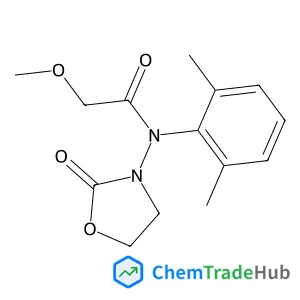
N-(2,6-Dimethylphenyl)-2-methoxy-N-(2-oxo-1,3-oxazolidin-3-yl)acetamide
CAS番号:
77732-09-3
分子式:
C14H18N2O4
おすすめサプライヤー





免責事項
このページに表示される学術雑誌情報は、参考および研究目的のみを目的としています。当社は雑誌出版社とは提携しておらず、投稿の取り扱いも行っておりません。出版に関するお問い合わせは、各雑誌出版社に直接ご連絡ください。
表示されている情報に誤りがある場合は、support@chemtradehub.com までご連絡ください。迅速に確認し、対応いたします。