












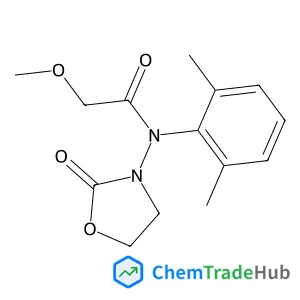
N-(2,6-Dimethylphenyl)-2-methoxy-N-(2-oxo-1,3-oxazolidin-3-yl)acetamide
CAS番号:
77732-09-3
分子式:
C14H18N2O4
J. Lawrence, E.-C. Yang, D. N. Hendrickson, S. Hill
Multi-dimensional high-field/frequency electron paramagnetic resonance (HFEPR) spectroscopy is performed on single-crystals of the high-symmetry spin S = 4 tetranuclear single-molecule magnet (SMM) [Ni(hmp)(dmb)Cl]4, where hmp− is the anion of 2-hydroxymethylpyridine and dmb is 3,3-dimethyl-1-butanol. Measurements performed as a function of the applied magnetic field strength and its orientation within the hard-plane reveal the four-fold behavior associated with the fourth order transverse zero-field splitting (ZFS) interaction, ½B44(Ŝ4+ + Ŝ4−), within the framework of a rigid spin approximation (with S = 4). This ZFS interaction mixes the ms = ±4 ground states in second order of perturbation, generating a sizeable (12 MHz) tunnel splitting, which explains the fast magnetic quantum tunneling in this SMM. Meanwhile, multi-frequency measurements performed with the field parallel to the easy-axis reveal HFEPR transitions associated with excited spin multiplets (S < 4). Analysis of the temperature dependence of the intensities of these transitions enables determination of the isotropic Heisenberg exchange constant, J = −6.0 cm−1, which couples the four spin s = 1 NiII ions within the cluster, as well as a characterization of the ZFS within excited states. The combined experimental studies support recent work indicating that the fourth order anisotropy associated with the S = 4 state originates from second order ZFS interactions associated with the individual NiII centers, but only as a result of higher-order processes that occur via S-mixing between the ground state and higher-lying (S < 4) spin multiplets. We argue that this S-mixing plays an important role in the low-temperature quantum dynamics associated with many other well known SMMs.
Hui-Juan Cui, Xian-Lei Sheng, Qing-Bo Yan, Qing-Rong Zheng, Gang Su
DOI: 10.1039/C3CP44457K
Reshma Sultana, Naser Reza, Helena Woodvine, Jonathan G. Terry, Anthony J. Walton, Charlotte L. Brady, Ilka Schmueser, Andrew R. Mount
DOI: 10.1039/C3CP50759A
Gitanjali Rai, Anil Kumar
DOI: 10.1039/C3CP50314C
Jonathon Duay, Eleanor Gillette, Junkai Hu
DOI: 10.1039/C3CP50724F
Samira Siahrostami, Mårten E. Björketun, Peter Strasser, Jeff Greeley, Jan Rossmeisl
DOI: 10.1039/C3CP51479J
Ane K. di Gennaro, Leonid Gurevich, Esben Skovsen, Michael T. Overgaard, Peter Fojan
DOI: 10.1039/C3CP50742D
C. J. Benmore, M. C. Wilding, S. K. Tumber
DOI: 10.1039/C3CP44347G
Alexander J. Cowan, Wenhua Leng, Piers R. F. Barnes, David R. Klug, James R. Durrant
DOI: 10.1039/C3CP50318F
Sergey Sirotin, Philippe Bazin, Françoise Maugé, Arnaud Travert
DOI: 10.1039/C3CP51146D
Edlira Suljoti, Kai F. Hodeck, Kathrin M. Lange, Mikhail A. Soldatov
DOI: 10.1039/C3CP50686J
2-氟-4-イオドベンzo酸エチルエステルは有機溶媒を用いた反応であり、ドラフトチャンバーでの操作が必要です。漏洩時にはSDS参照の安全措置を講じ、PPE(防護...
血根碱は主に医薬分野で利用され、抗炎症や抗がん剤としての潜在的な効果が研究されています。また、化学研究や薬物開発において、新しい薬剤設計の参考となる化合物として...
Methyl 3-メトキシスチフェン-2-カルボン酸メチルエステルは、薬品合成、染料製造、以及合成中間体としての用途が広がっています。
丹磺酰-L-亮氨酸は乾燥した場所で、直射日光から保護し、低温(室温以下)で保存してください。密閉容器に入れて保管することをおすすめします。
5-(苄氧基)ピラミジン-4-アミンの代替品として、6-メトキシピラミジンや5-フェニルピラミジンなどが挙げられます。これらの化合物は、5-(苄氧基)ピラミジン...
8-ヒドロキシノルデコペントアセートはCAS番号84807-87-4の化合物で、分子量は750.02 uです。これは油溶性で、水に溶けにくい特徴があります。反応...
tert-ブチル(エス)-1-ヒドロキシペンタ-4-エン-2-イルカルバamateは主に医薬品の合成材料や分析化学の試薬として使用されます。
ブコール-L-2-フローヨルブリン(CAS番号: 1196107-73-9)は、GHS(グローバルハザードアサessmentシステム)に基づく危害分類と表示が求...
6-ブロモ-N-環丙基-2-ピリジニニメタンは、薬理学研究や合成化学に使用される化合物であり、特に抗ウイルス薬や抗がん薬の開発に注目されています。市場では、薬物...
RS-AMPÀは、遮光容器に保存し、室温(15〜25℃)で保管することが推奨されます。高湿や熱は物質を劣化させるため、湿度は50%以下に保つことが重要です。また...

Physical Chemistry Chemical Physics (PCCP) is an international journal co-owned by 19 physical chemistry and physics societies from around the world. This journal publishes original, cutting-edge research in physical chemistry, chemical physics and biophysical chemistry. To be suitable for publication in PCCP, articles must include significant innovation and/or insight into physical chemistry; this is the most important criterion that reviewers and Editors will judge against when evaluating submissions. The journal has a broad scope and welcomes contributions spanning experiment, theory, computation and data science. Topical coverage includes spectroscopy, dynamics, kinetics, statistical mechanics, thermodynamics, electrochemistry, catalysis, surface science, quantum mechanics, quantum computing and machine learning. Interdisciplinary research areas such as polymers and soft matter, materials, nanoscience, energy, surfaces/interfaces, and biophysical chemistry are welcomed if they demonstrate significant innovation and/or insight into physical chemistry. Joined experimental/theoretical studies are particularly appreciated when complementary and based on up-to-date approaches.
![2-Hydroxy-4-[({[(4-methylphenyl)sulfonyl]oxy}acetyl)amino]benzoic acid structure](https://static.chemtradehub.com/structs/501/501919-59-1-579f.webp "2-Hydroxy-4-[({[(4-methylphenyl)sulfonyl]oxy}acetyl)amino]benzoic acid structure")




