


![1-[4-(4-Methyl-1H-imidazol-1-yl)phenyl]ethanone structure](https://static.chemtradehub.com/structs/142/142161-53-3-7f55.webp "1-[4-(4-Methyl-1H-imidazol-1-yl)phenyl]ethanone structure")
Interactions of proteins with small ionised molecules: electrochemical adsorption and facilitated ion transfer voltammetry of haemoglobin at the liquid|liquid interface
文献情報
出版日
2009-06-15
DOI
10.1039/B905441N
インパクトファクター
4.616
著者
Grégoire Herzog, Waleed Moujahid, Jörg Strutwolf, Damien W. M. Arrigan
原文を見る
要旨
The interaction of proteins with interfaces and surfaces provides a basis for studying their behaviour and methods to detect them. This paper is concerned with elucidation of the mechanism of electrochemical detection of haemoglobin (Hb) at the interface between aqueous and organic electrolyte solutions. The adsorption of Hb at the interface was investigated by alternating current (AC) voltammetry. It was found that addition of Hb to the aqueous phase induced a shift of the potential of zero charge at the liquid|liquid interface, due to interfacial adsorption of Hb. The influence of the nature and the concentration of the organic phase electrolyte on the electrochemical signal was investigated by cyclic voltammetry (CV). It was found that the electrochemical signal, in the presence of aqueous phase Hb, was due to the facilitated transfer of the anion of the organic phase electrolyte to the aqueous phase. The transfer current was dependent on both the nature and concentration of the organic phase electrolyte anion. These results confirm that adsorbed Hb molecules at the liquid|liquid interface interact with small ionised molecules and facilitate their transfer across the interface. The results will provide a basis for both biomolecular detection methods and for the study of protein–small ionised molecule interactions.
おすすめジャーナル

NDT & E International

Chinese Journal of Chemistry

Journal of the Indian Institute of Science

Herald of the Russian Academy of Sciences

Atomization and Sprays

Biocatalysis and Biotransformation

Bioorganic & Medicinal Chemistry

Critical Reviews in Solid State and Materials Sciences

Main Group Chemistry

Journal of Chemical Sciences
関連文献
Direct conversion of iron stearate into magnetic Fe and Fe3C nanocrystals encapsulated in polyhedral graphite cages
Junfeng Geng, David A. Jefferson, Brian F. G. Johnson
2004-09-21
Communication
DOI: 10.1039/B406227B
NH4[BPO4F]: A novel open-framework ammonium fluorinated borophosphate with a zeolite-like structure related to gismondine topology
Man-Rong Li, Wei Liu, Ming-Hui Ge, Hao-Hong Chen, Xin-Xin Yang, Jing-Tai Zhao
2004-04-29
Communication
DOI: 10.1039/B402966F
Novel biocompatible hydrogel-based amperometric sensor for nitric oxide gas detection: towards a non-invasive device
Corinne Wartelle, Fethi Bedioui
2004-05-07
Communication
DOI: 10.1039/B402735C
Double asymmetric induction as a mechanistic probe: conjugate addition for the asymmetric synthesis of a pseudotripeptide
Stephen G. Davies, Gesine J. Hermann, Miles J. Sweet, Andrew D. Smith
2004-04-08
Communication
DOI: 10.1039/B401293C
Template synthesis of multi-macrocycles by metathesis reaction‡
Myroslav O. Vysotsky, Anca Bogdan, Leyong Wang, Volker Böhmer
2004-04-28
Communication
DOI: 10.1039/B402719A
Ultrasonic cavitation in microspace
Yasuo Iida, Kyuichi Yasui, Toru Tuziuti, Manickam Sivakumar, Yoshishige Endo
2004-09-28
Communication
DOI: 10.1039/B410015H
Molecularly imprinted polymer sensor arrays
Nathaniel T. Greene, Stephen L. Morgan, Ken D. Shimizu
2004-04-28
Communication
DOI: 10.1039/B401677G
First cation radical salt of a tetrathiafulvalene–based phosphine metal complex
Narcis Avarvari, Marc Fourmigué
2004-05-05
Communication
DOI: 10.1039/B403168G
Synthesis of monodisperse iron oxidenanocrystals by thermal decomposition of iron carboxylate salts
William W. Yu, Joshua C. Falkner, Cafer T. Yavuz, Vicki L. Colvin
2004-09-02
Communication
DOI: 10.1039/B409601K
Zinc–proline catalyzed pathway for the formation of sugars
Jacob Kofoed, Miguel Machuqueiro, Jean-Louis Reymond, Tamis Darbre
2004-05-27
Communication
DOI: 10.1039/B404465G
こちらもおすすめ
化合物よくある質問
2,3-スチオエポキシマドルを取り扱う際の実験室安全事項は何ですか?
取り扱いにはPPE(プロテクティブ・パーソナル・エイド)が必要で、防ぐ手袋と保護眼鏡を着用してください。ドラフトチャンバーの使用を推奨します。漏洩した場合は、適...
4267-80-52,3-Thioepoxy Madol
53981-25-22-Amino-6-fluorophen...
化合物よくある質問
BOC-S-3-アミニ-4-(4-メチオキシベンチル)-ブタン酸の代替品はありますか?
この化合物の代替品としては、BOC保護基を有さないアミノ酸やその他の保護基化合物が考えられます。また、メチオキシ基を有しない他の芳香族アミノ酸も代替品として挙げ...
126800-59-7(3S)-4-(4-Methoxyphe...
化合物よくある質問
Methyl 2-(chloromethyl)-3-nitrobenzoate(1218910-61-2)の代替品はありますか?
Methyl 2-(chloromethyl)-3-nitrobenzoate(1218910-61-2)の代替品としては、化学組成を変えることで効果を達成する...
1218910-61-2Methyl 2-(chlorometh...
化合物よくある質問
(2R)-2-アミノ-N-ベンジル-3-ヒドロキシプロパナミドを含む廃棄物はどのように処理すべきですか?
(2R)-2-アミノ-N-ベンジル-3-ヒドロキシプロパナミドを含む廃棄物は、適切な廃棄物管理ガイドラインに基づき処理する必要があります。まず、廃棄物を適切に収...
175481-39-7(2R)-2-amino-N-benzy...
化合物よくある質問
6,7-二氢-咪唑並[1,2-a]ピリドイン-8(5h)-酮はどのように合成されますか?
6,7-二氢-咪唑並[1,2-a]ピリドイン-8(5h)-酮は、2-ブロモフェニルアセトインとリン酸ハロゲン化物を反応させることで合成できます。この反応は高温で...
457949-09-66,7-Dihydroimidazo[1...
化合物よくある質問
エチル(3R)-3-ピロリジニル酢酸水和塩とは何ですか?
エチル(3R)-3-ピロリジニル酢酸水和塩は、CAS番号1332459-32-1の化合物で、(R)-乙基2-(ピロリジン-3-基)酢酸塩水和塩と呼ばれます。この...
1332459-32-1Ethyl (3R)-3-pyrroli...
化合物よくある質問
(2S)-{[(2-メチルエチルオキシ]カルボニル}アミノ)[2-(トリアフルオロメチルフェニル]エチカシック酸の物理化学的性質は何ですか?
(2S)-{[(2-メチルエチルオキシ]カルボニル}アミノ)[2-(トリアフルオロメチルフェニル]エチカシック酸のCAS番号は1203454-45-8です。この...
1203454-45-8(2S)-({[(2-Methyl-2-...
化合物よくある質問
2-ブロモ-1-(2-メチル-2-プロパニル)-4-ニトロベンゼンはどのように保存すればよいですか?
2-ブロモ-1-(2-メチル-2-プロパニル)-4-ニトロベンゼンは、直射日光を避けて暗所で、室温(約15℃〜25℃)、乾燥した場所に保存する必要があります。ま...
6310-17-42-Bromo-1-(2-methyl-...
化合物よくある質問
1-[(4-硝基フェニル)スルホニル]-1H-1,2,4-三唑の市場動向や研究トレンドはどうですか?
市場動向としては、1-[(4-硝基フェニル)スルホニル]-1H-1,2,4-三唑は主に農業用除草剤や合成化学製品の原料として利用されています。研究トレンドとして...
57777-84-11-[(4-Nitrophenyl)su...
掲載誌
Analyst

CiteScore:
7.8
自己引用率:
5.6%
年間論文数:
653
Analyst publishes analytical and bioanalytical research that reports premier fundamental discoveries and inventions, and the applications of those discoveries, unconfined by traditional discipline barriers.
おすすめ化合物
![5,10-Dihydroindeno[2,1-a]indene structure](https://static.chemtradehub.com/structs/654/6543-29-9-71ca.webp "5,10-Dihydroindeno[2,1-a]indene structure")
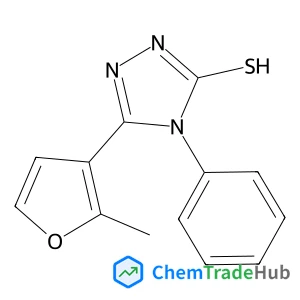
5-(2-Methyl-3-furyl)-4-phenyl-2,4-dihydro-3H-1,2,4-triazole-3-thione
CAS番号:
346464-59-3
分子式:
C13H11N3OS
おすすめサプライヤー




免責事項
このページに表示される学術雑誌情報は、参考および研究目的のみを目的としています。当社は雑誌出版社とは提携しておらず、投稿の取り扱いも行っておりません。出版に関するお問い合わせは、各雑誌出版社に直接ご連絡ください。
表示されている情報に誤りがある場合は、support@chemtradehub.com までご連絡ください。迅速に確認し、対応いたします。