












Pulsed electrodeposition of porous ZnO on Ag-coated polyamide filaments
文献情報
出版日
2009-03-13
DOI
10.1039/B822534F
インパクトファクター
3.676
著者
Melanie Rudolph, Thomas Loewenstein, Elisa Arndt, Yvonne Zimmermann, Andreas Neudeck, Derck Schlettwein
原文を見る
要旨
Silver-coated polyamide filaments were used as substrates for the electrodeposition of ZnO/eosinY hybrid thin films from aqueous mixed solutions containing Zn(NO3)2 and eosinY. Electrodeposition under pulsed potentiostatic control turned out advantageous to control the conditions of mass flow and to suppress parasitic currents and thereby obtain homogeneous porous films of ZnO as proven by scanning electron microscopy. Crystalline films of ZnO were formed as shown by X-ray diffraction. Diffuse optical reflectance spectra revealed the successful processing of the dye content of the porous ZnO coatings on the textile substrates. Photovoltage measurements served to proof sensitization of the textile based ZnO films.
関連文献
Superior spin-polarized electronic structure in MoS2/MnO2 heterostructures with an efficient hole injection
Baozeng Zhou, Zheng Li, Jiaming Wang, Kangqiang Wang
2019-04-27
Paper
DOI: 10.1039/C9CP01146C
Peroxy self-reaction leading to the formation of furfural
Audrey R. Smith, Simone Di Muzio, Fabio Ramondo, Giovanni Meloni
2019-03-20
Paper
DOI: 10.1039/C8CP07571A
Characteristics of sulfur atoms adsorbed on Ag(100), Ag(110), and Ag(111) as probed with scanning tunneling microscopy: experiment and theory
Peter M. Spurgeon, Da-Jiang Liu, Junepyo Oh, Hyun Jin Yang, Yousoo Kim
2019-05-10
Paper
DOI: 10.1039/C9CP01626K
Density functional approach to the description of the structure of dimer nanoparticles at liquid–liquid interfaces
Stefan Sokołowski, Orest Pizio
2019-05-09
Paper
DOI: 10.1039/C9CP01087D
Deviations from Beer's law on the microscale – nonadditivity of absorption cross sections
Sonja Höfer
2019-04-18
Paper
DOI: 10.1039/C9CP01987A
Entangling non planar molecules via inversion doublet transition with negligible spontaneous emission
Isabel Gonzalo, Miguel A. Antón
2019-04-25
Paper
DOI: 10.1039/C8CP07764A
The effect of methylation on the intrinsic photophysical properties of simple rhodamines
Jocky C. K. Kung, Adam Forman, Rebecca A. Jockusch
2019-04-22
Paper
DOI: 10.1039/C9CP00730J
Understanding the size effects on the electronic structure of ThO2 nanoparticles
Tatiana V. Plakhova, Anna Yu. Romanchuk, Stephan Weiss, Anna Efimenko, Christoph J. Sahle, Sergei M. Butorin, Stepan N. Kalmykov
2019-04-29
Paper
DOI: 10.1039/C9CP01283D
Ferroelectric field manipulated nonvolatile resistance switching in Al:ZnO/Pb(Mg1/3Nb2/3)0.7Ti0.3O3 heterostructures at room temperature‡
Shasha Liu, Chao Jin, Dongxing Zheng, Xin Pang, Yuchen Wang, Ping Wang, Wanchao Zheng, Haili Bai
2019-05-03
Paper
DOI: 10.1039/C9CP01809C
Controlling intramolecular hydrogen migration by asymmetric laser fields: the water case
Emmanouil Kechaoglou, Spyridon Kaziannis, Constantine Kosmidis
2019-05-09
Paper
DOI: 10.1039/C9CP01470E
こちらもおすすめ
化合物よくある質問
2-氟-4-イオドベンzo酸エチルエステルを取り扱う際の実験室安全事項は何ですか?
2-氟-4-イオドベンzo酸エチルエステルは有機溶媒を用いた反応であり、ドラフトチャンバーでの操作が必要です。漏洩時にはSDS参照の安全措置を講じ、PPE(防護...
205750-82-9Benzoic acid, 2-fluo...
化合物よくある質問
血根碱の主な用途は何ですか?
血根碱は主に医薬分野で利用され、抗炎症や抗がん剤としての潜在的な効果が研究されています。また、化学研究や薬物開発において、新しい薬剤設計の参考となる化合物として...
2447-54-313-Methyl[1,3]benzod...
化合物よくある質問
Methyl 3-methoxythiophene-2-carboxylateの主な用途は何ですか?
Methyl 3-メトキシスチフェン-2-カルボン酸メチルエステルは、薬品合成、染料製造、以及合成中間体としての用途が広がっています。
62353-75-7Methyl 3-methoxythio...
化合物よくある質問
丹磺酰-L-亮氨酸はどのように保存すればよいですか?
丹磺酰-L-亮氨酸は乾燥した場所で、直射日光から保護し、低温(室温以下)で保存してください。密閉容器に入れて保管することをおすすめします。
1100-22-7N-{[5-(Dimethylamino...
化合物よくある質問
5-(苄氧基)ピラミジン-4-アミンの代替品はありますか?
5-(苄氧基)ピラミジン-4-アミンの代替品として、6-メトキシピラミジンや5-フェニルピラミジンなどが挙げられます。これらの化合物は、5-(苄氧基)ピラミジン...
92289-50-45-benzyloxypyrimidin...
化合物よくある質問
8-ヒドロキシノルデコペントアセートの物理化学的性質は何ですか?
8-ヒドロキシノルデコペントアセートはCAS番号84807-87-4の化合物で、分子量は750.02 uです。これは油溶性で、水に溶けにくい特徴があります。反応...
84807-87-4(5Z,8Z,11Z,13E,15S)-...
化合物よくある質問
tert-ブチル(エス)-1-ヒドロキシペンタ-4-エン-2-イルカルバamateの主な用途は何ですか?
tert-ブチル(エス)-1-ヒドロキシペンタ-4-エン-2-イルカルバamateは主に医薬品の合成材料や分析化学の試薬として使用されます。
116613-81-12-Methyl-2-propanyl ...
化合物よくある質問
ブコール-L-2-フローヨルブリンについて適切な法規ガイドラインは何ですか?
ブコール-L-2-フローヨルブリン(CAS番号: 1196107-73-9)は、GHS(グローバルハザードアサessmentシステム)に基づく危害分類と表示が求...
1196107-73-92-Bromo-13,13-dimeth...
化合物よくある質問
6-ブロモ-N-環丙基-2-ピリジニニメタンの市場動向や研究トレンドはどうですか
6-ブロモ-N-環丙基-2-ピリジニニメタンは、薬理学研究や合成化学に使用される化合物であり、特に抗ウイルス薬や抗がん薬の開発に注目されています。市場では、薬物...
959237-20-86-Bromo-N-cyclopropy...
化合物よくある質問
RS-AMPÀはどのように保存すればよいですか?
RS-AMPÀは、遮光容器に保存し、室温(15〜25℃)で保管することが推奨されます。高湿や熱は物質を劣化させるため、湿度は50%以下に保つことが重要です。また...
74341-63-2(RS)-AMPA
掲載誌
Physical Chemistry Chemical Physics

CiteScore:
5.5
自己引用率:
10.3%
年間論文数:
3036
Physical Chemistry Chemical Physics (PCCP) is an international journal co-owned by 19 physical chemistry and physics societies from around the world. This journal publishes original, cutting-edge research in physical chemistry, chemical physics and biophysical chemistry. To be suitable for publication in PCCP, articles must include significant innovation and/or insight into physical chemistry; this is the most important criterion that reviewers and Editors will judge against when evaluating submissions. The journal has a broad scope and welcomes contributions spanning experiment, theory, computation and data science. Topical coverage includes spectroscopy, dynamics, kinetics, statistical mechanics, thermodynamics, electrochemistry, catalysis, surface science, quantum mechanics, quantum computing and machine learning. Interdisciplinary research areas such as polymers and soft matter, materials, nanoscience, energy, surfaces/interfaces, and biophysical chemistry are welcomed if they demonstrate significant innovation and/or insight into physical chemistry. Joined experimental/theoretical studies are particularly appreciated when complementary and based on up-to-date approaches.
おすすめ化合物
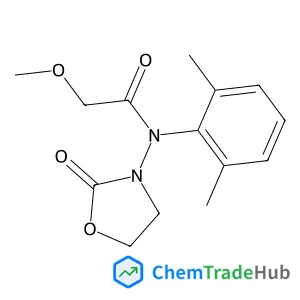
N-(2,6-Dimethylphenyl)-2-methoxy-N-(2-oxo-1,3-oxazolidin-3-yl)acetamide
CAS番号:
77732-09-3
分子式:
C14H18N2O4
おすすめサプライヤー





免責事項
このページに表示される学術雑誌情報は、参考および研究目的のみを目的としています。当社は雑誌出版社とは提携しておらず、投稿の取り扱いも行っておりません。出版に関するお問い合わせは、各雑誌出版社に直接ご連絡ください。
表示されている情報に誤りがある場合は、support@chemtradehub.com までご連絡ください。迅速に確認し、対応いたします。