












![3-[(4-Nitrobenzyl)oxy]-3-oxopropanoic Acid structure](https://static.chemtradehub.com/structs/773/77359-11-6-0d04.webp "3-[(4-Nitrobenzyl)oxy]-3-oxopropanoic Acid structure")
The role of copper in cysteine oxidation: study of intra- and inter-molecular reactions in mass spectrometry
文献情報
出版日
2008-12-24
DOI
10.1039/B817061D
インパクトファクター
0
著者
Michel Prudent, Hubert H. Girault
原文を見る
要旨
Cysteine-containing peptide oxidation was studied both by using an inert platinum electrode and a sacrificial electrode (copper or zinc) generating metallic ions in electrospray ionization mass spectrometry (ESI-MS). Using peptides containing one, two and three cysteines, we have compared the different chemical and electrochemical oxidation pathways of cysteine (RS−IIH) to cystine (RS−IS−IR) and to sulfenic, sulfinic and sulfonic acid (RS0OH, RSIIO2H and RSIVO3H, respectively). In the absence of copper ions, intra-molecular reactions were the most abundant, whereas inter-molecular reactions were found to be enhanced by the presence of copper ions. These cations favor the formation of 2 : 1 (peptide : copper) complexes compared to 1 : 1 complexes, thus enhancing the formation of inter-molecular bridges. This study highlights the importance of the position of cysteine inside a peptide during disulfide bridge formation.
関連文献
Electromagnetic interference shielding in 1–18 GHz frequency and electrical property correlations in poly(vinylidene fluoride)–multi-walled carbon nanotube composites
G. Sudheer Kumar, D. Vishnupriya, Anupama Joshi, Suwarna Datar, T. Umasankar Patro
2015-07-07
Paper
DOI: 10.1039/C5CP02585K
Step dynamics and oxide formation during CO oxidation over a vicinal Pd surface
Mikhail Shipilin, Johan Gustafson, Chu Zhang, Lindsay Richard Merte, Edvin Lundgren
2016-01-20
Paper
DOI: 10.1039/C5CP07488F
A first principles study of CO2 adsorption on α-SiO2(001) surfaces
Oleksandr I. Malyi, Priyadarshini Thiyam, Mathias Boström
2015-07-01
Paper
DOI: 10.1039/C5CP02279G
From underwear to non-equilibrium thermodynamics: physical chemistry informs the origin of life
Mattanjah S. de Vries
2016-07-08
Editorial
DOI: 10.1039/C6CP90169G
The cis-isomer performs better than the trans-isomer in porphyrin-sensitized solar cells: interfacial electron transport and charge recombination investigations
Liyang Luo, Ram B. Ambre, Sandeep B. Mane, Eric Wei-Guang Diau, Chen-Hsiung Hung
2015-06-30
Paper
DOI: 10.1039/C5CP02367J
Formic acid oxidation on platinum: a simple mechanistic study
Kathleen A. Schwarz, Ravishankar Sundararaman, Thomas P. Moffat, Thomas C. Allison
2015-07-15
Paper
DOI: 10.1039/C5CP03045E
Ultra-fast single-file transport of a simple liquid beyond the collective behavior zone
Jiaye Su, Keda Yang, Decai Huang
2016-01-22
Communication
DOI: 10.1039/C5CP07253K
Conformational preferences of monohydrated clusters of imidazole derivatives revisited
Aditi Bhattacherjee, Sanjay Wategaonkar
2015-06-15
Paper
DOI: 10.1039/C5CP02422F
Excited state structural evolution during charge-transfer reactions in betaine-30
W. Ruchira Silva, Renee R. Frontiera
2016-01-04
Paper
DOI: 10.1039/C5CP06195D
Thermodynamic properties of neutral and charged oxygen vacancies in BaZrO3 based on first principles phonon calculations
Tor S. Bjørheim, Marco Arrigoni, Denis Gryaznov, Joachim Maier
2015-07-27
Paper
DOI: 10.1039/C5CP02529J
こちらもおすすめ
化合物よくある質問
1-{3-[5-(エチルカルボンイル)-2,4-ジメチル-1H-ピロロール-3-基]プロパニル}ピペリジン-4-カルボン酸について、適用される法規ガイドラインは何ですか?
この化合物はCAS番号1142209-81-1であり、GHS分類では corrosive (腐食性物質) と classified (分類物質) として指定され...
1142209-81-11-{3-[5-(Ethoxycarbo...
化合物よくある質問
2,2-二氟-1,3-ベンゾジオキサン-5-カルボキシlic酸とは何ですか?
2,2-二氟-1,3-ベンゾジオキサン-5-カルボキシlic酸は、CAS番号656-46-2の化合物で、化学式はC8H4F2O4です。この化合物は白色の結晶性粉...
656-46-22,2-Difluoro-1,3-ben...
化合物よくある質問
8-氯-4-色原酮の代替品はありますか?
8-氯-4-色原酮(CAS番号: 49701-11-3)の代替品には、他の色原酮類似物や、構造が似ている化合物があります。例えば、8-メチル-4-色原酮や、他の...
49701-11-38-Chloro-2,3-dihydro...
化合物よくある質問
エチル6,6-ジメチル-4,5,6,7-テトラヒドロ-1H-インドアゼー-3-カルボキシレートとは何ですか?
エチル6,6-ジメチル-4,5,6,7-テトラヒドロ-1H-インドアゼー-3-カルボキシレートは、CAS番号1233243-56-5を有する化合物です。これは有...
1233243-56-5Ethyl 6,6-dimethyl-4...
化合物よくある質問
4-叔丁基-6-氯-嘧啶に適用される法規ガイドラインは何ですか?
4-叔丁基-6-氯-嘧啶はCAS番号3435-24-3で、GHS分類では毒性物質とみなし、GHSの危険性分類が適用されます。REACH規則では登録が必要で、Eu...
3435-24-34-Tert-butyl-6-chlor...
化合物よくある質問
維库溴铵杂质Bはどのように合成されますか?
維库溴铵杂质Bは、アンドロステンデンから始まり、一連の合成反応、包括的な選択性と高い収率で合成されます。具体的には、ブロミド化、酸化、ジマーゼ反応、アミド化など...
50587-95-6(2beta,3alpha,5alpha...
化合物よくある質問
2-(4-氟苄基)-吡咯烷の物理化学的性質は何ですか?
CAS番号350017-04-8の2-(4-氟苄基)-吡咯烷は、結晶性の白色粉末です。分子量は199.17 g/molで、水に溶けにくいです。化学反応では比較的...
350017-04-82-(4-Fluorobenzyl)py...
化合物よくある質問
3-喹啉甲醛(2-チロール-8-エチル)は安全ですか?
3-喹啉甲醛(2-チロール-8-エチル)は一定の毒性を持つため、取扱には注意が必要です。使用する際は適切な防護具を着用し、密閉容器で保管・搬送し、直接的な接触を...
335196-05-92-Chloro-8-ethyl-3-q...
化合物よくある質問
エチル3-(ヒドロキシメチル)-1H-ピロール-2-カルボキシレートはどのように保存すればよいですか?
エチル3-(ヒドロキシメチル)-1H-ピロール-2-カルボキシレートは、室温(25℃)以下で保存し、直射日光を避け、乾燥した環境で保管することが推奨されます。ま...
75448-69-0Ethyl 3-(hydroxymeth...
119410-05-88-Chloro-11-(4-piper...
掲載誌
Metallomics
CiteScore:
7
自己引用率:
6.9%
年間論文数:
77
Metallomics publishes cutting-edge investigations aimed at elucidating the identification, distribution, dynamics, role and impact of metals and metalloids in biological systems. Studies that address the “what, where, when, how and why” of these inorganic elements in cells, tissues, organisms, and various environmental niches are welcome, especially those employing multidisciplinary approaches drawn from the analytical, bioinorganic, medicinal, environmental, biophysical, cell biology, plant biology and chemical biology communities. We are particularly interested in articles that enhance our chemical and/or physical understanding of the molecular mechanisms of metal-dependent life processes, and those that probe the common space between metallomics and other ‘omics approaches to uncover new insights into biological processes. Metallomics seeks to position itself at the forefront of those advances in analytical chemistry destined to clarify the enormous complexity of biological systems. As such, we particularly welcome those papers that outline cutting-edge analytical technologies, e.g., in the development and application of powerful new imaging, spectroscopic and mass spectrometric modalities. Work that describes new insights into metal speciation, trafficking and dynamics in complex systems or as a function of microenvironment are also strongly encouraged. Studies that examine the interconnectivity of metal-dependent processes with systems level responses relevant to organismal health or disease are also strongly encouraged, for example those that probe the effect of chemical exposure on metal homeostasis or the impact of metal-based drugs on cellular processes.
おすすめ化合物
![1-(Hexopyranosyloxy)-4a,5-dihydroxy-7-methyl-1,4a,5,6,7,7a-hexahydrocyclopenta[c]pyran-7-yl 3-phenylacrylate structure](https://static.chemtradehub.com/structs/192/19210-12-9-ecae.webp "1-(Hexopyranosyloxy)-4a,5-dihydroxy-7-methyl-1,4a,5,6,7,7a-hexahydrocyclopenta[c]pyran-7-yl 3-phenylacrylate structure")

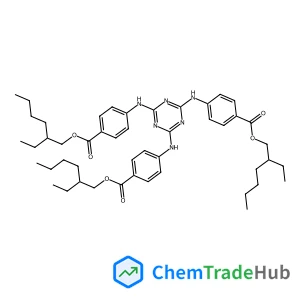
Tris(2-ethylhexyl) 4,4',4''-(1,3,5-triazine-2,4,6-triyltriimino)tribenzoate
CAS番号:
88122-99-0
分子式:
C48H66N6O6
おすすめサプライヤー




免責事項
このページに表示される学術雑誌情報は、参考および研究目的のみを目的としています。当社は雑誌出版社とは提携しておらず、投稿の取り扱いも行っておりません。出版に関するお問い合わせは、各雑誌出版社に直接ご連絡ください。
表示されている情報に誤りがある場合は、support@chemtradehub.com までご連絡ください。迅速に確認し、対応いたします。