


Determination of the neurotoxinBMAA (β-N-methylamino-l-alanine) in cycad seed and cyanobacteria by LC-MS/MS (liquid chromatography tandem mass spectrometry)
文献情報
出版日
2008-10-09
DOI
10.1039/B809231A
インパクトファクター
4.616
著者
Johan Rosén, Karl-Erik Hellenäs
原文を見る
要旨
A highly specific method for the analysis of β-N-methylamino-L-alanine (BMAA) by LC-MS/MS (liquid chromatography tandem mass spectrometry) has been developed and applied for cycad seeds and cyanobacteria. BMAA was analysed as a free fraction or as total BMAA after acidic hydrolysis to release any protein-bound BMAA. Deuterium labelled BMAA was synthesised and used as internal standard. The method comprises HILIC (hydrophilic interaction chromatography) and positive electrospray ionisation of the native compound, i.e. no derivatisation was used. For safe identification five specific product ions (m/z 102, 88, 76, 73 and 44), all derived from a precursor ion of m/z 119 and originating from different parts of the molecule, were detected (typical relative abundance 100%, 16%, 14%, 12% and 22% respectively). Cyanobacteria or muscle tissue was spiked with BMAA (10 to 1000 µg g−1) to validate the method (accuracy 95% to 109%, relative standard deviation 1% to 6%). The detection limit for free and total BMAA in tissue was <1 µg g−1 and <4 µg g−1 respectively. BMAA was successfully identified and quantified in cycad seeds, whereas previously reported findings of BMAA in samples of cyanobacteria could not be confirmed. Instead, the presence of α-,γ-diamino butyric acid (DAB), an isomer of BMAA, was confirmed in one sample. The possible implications of this finding are discussed.
おすすめジャーナル

New Journal of Chemistry

Russian Journal of Applied Chemistry

Crystallography Reports

Nature Medicine

Chemistry Education Research and Practice

Current Opinion in Colloid & Interface Science

Drug Discovery Today

Chemical Communications

Russian Journal of Organic Chemistry

Organic Process Research & Development
関連文献
Silicon based tandem cells: novel photocathodes for hydrogen production
W. Calvet, E. Murugasen, J. Klett, B. Kaiser, W. Jaegermann, F. Finger, S. Hoch, M. Blug, J. Busse
2014-03-12
Paper
DOI: 10.1039/C3CP55198A
Molecular self-assembly at nanometer scale modulated surfaces: trimesic acid on Ag(111), Cu(111) and Ag/Cu(111)
Mahdi Sadeghzadeh Baviloliaei, Lars Diekhöner
2014-04-24
Paper
DOI: 10.1039/C4CP01429D
Introducing manganese complexes as redox mediators for dye-sensitized solar cells
Ishanie Rangeeka Perera, Wanchun Xiang, Torben Daeneke, Richard A. Evans, C. André Ohlin, Leone Spiccia
2013-12-06
Paper
DOI: 10.1039/C3CP54894E
Long-term self-assembly of inorganic layered materials influenced by the local states of the interlayer cations
Kiminori Sato, Kazuomi Numata, Weili Dai, Michael Hunger
2014-04-22
Paper
DOI: 10.1039/C4CP00990H
Electrochemical properties of oxygenated cup-stacked carbon nanofiber-modified electrodes
Seongjae Ko, Tetsu Tatsuma, Akiyoshi Sakoda, Yasuyuki Sakai, Kikuo Komori
2014-05-12
Paper
DOI: 10.1039/C4CP01278J
Artificial photosynthesis – functional devices for light driven water splitting with photoactive anodes based on molecular catalysts
Yan Gao, Linlin Zhang, Xin Ding
2014-03-07
Paper
DOI: 10.1039/C3CP55204G
An acetate bound cobalt oxide catalyst for water oxidation: role of monovalent anions and cations in lowering overpotential
Subal Dey, Biswajit Mondal, Abhishek Dey
2014-04-11
Paper
DOI: 10.1039/C4CP01205D
Probing crystal structure and mesoscale assembly of cellulose microfibrils in plant cell walls, tunicate tests, and bacterial films using vibrational Sum Frequency Generation (SFG) spectroscopy
Christopher M. Lee, Kabindra Kafle, Yong Bum Park, Seong H. Kim
2014-04-24
Paper
DOI: 10.1039/C4CP00515E
Effect of post-treatments on the photocatalytic activity of Sm2Ti2S2O5 for the hydrogen evolution reaction
Wen Zhao, Fuxiang Zhang, Takashi Hisatomi, Kazunari Domen
2013-12-06
Paper
DOI: 10.1039/C3CP54668C
Mechanisms of enhanced sulfur tolerance on samarium (Sm)-doped cerium oxide (CeO2) from first principles
Hee Su Kim, Sung Pil Yoon, Jonghee Han, Chang Won Yoon, Sun Hee Choi, Suk Woo Nam, Hyung Chul Ham
2014-04-01
Paper
DOI: 10.1039/C4CP00777H
こちらもおすすめ
化合物よくある質問
2-氟-4-イオドベンzo酸エチルエステルを取り扱う際の実験室安全事項は何ですか?
2-氟-4-イオドベンzo酸エチルエステルは有機溶媒を用いた反応であり、ドラフトチャンバーでの操作が必要です。漏洩時にはSDS参照の安全措置を講じ、PPE(防護...
205750-82-9Benzoic acid, 2-fluo...
化合物よくある質問
血根碱の主な用途は何ですか?
血根碱は主に医薬分野で利用され、抗炎症や抗がん剤としての潜在的な効果が研究されています。また、化学研究や薬物開発において、新しい薬剤設計の参考となる化合物として...
2447-54-313-Methyl[1,3]benzod...
化合物よくある質問
Methyl 3-methoxythiophene-2-carboxylateの主な用途は何ですか?
Methyl 3-メトキシスチフェン-2-カルボン酸メチルエステルは、薬品合成、染料製造、以及合成中間体としての用途が広がっています。
62353-75-7Methyl 3-methoxythio...
化合物よくある質問
丹磺酰-L-亮氨酸はどのように保存すればよいですか?
丹磺酰-L-亮氨酸は乾燥した場所で、直射日光から保護し、低温(室温以下)で保存してください。密閉容器に入れて保管することをおすすめします。
1100-22-7N-{[5-(Dimethylamino...
化合物よくある質問
5-(苄氧基)ピラミジン-4-アミンの代替品はありますか?
5-(苄氧基)ピラミジン-4-アミンの代替品として、6-メトキシピラミジンや5-フェニルピラミジンなどが挙げられます。これらの化合物は、5-(苄氧基)ピラミジン...
92289-50-45-benzyloxypyrimidin...
化合物よくある質問
8-ヒドロキシノルデコペントアセートの物理化学的性質は何ですか?
8-ヒドロキシノルデコペントアセートはCAS番号84807-87-4の化合物で、分子量は750.02 uです。これは油溶性で、水に溶けにくい特徴があります。反応...
84807-87-4(5Z,8Z,11Z,13E,15S)-...
化合物よくある質問
tert-ブチル(エス)-1-ヒドロキシペンタ-4-エン-2-イルカルバamateの主な用途は何ですか?
tert-ブチル(エス)-1-ヒドロキシペンタ-4-エン-2-イルカルバamateは主に医薬品の合成材料や分析化学の試薬として使用されます。
116613-81-12-Methyl-2-propanyl ...
化合物よくある質問
ブコール-L-2-フローヨルブリンについて適切な法規ガイドラインは何ですか?
ブコール-L-2-フローヨルブリン(CAS番号: 1196107-73-9)は、GHS(グローバルハザードアサessmentシステム)に基づく危害分類と表示が求...
1196107-73-92-Bromo-13,13-dimeth...
化合物よくある質問
6-ブロモ-N-環丙基-2-ピリジニニメタンの市場動向や研究トレンドはどうですか
6-ブロモ-N-環丙基-2-ピリジニニメタンは、薬理学研究や合成化学に使用される化合物であり、特に抗ウイルス薬や抗がん薬の開発に注目されています。市場では、薬物...
959237-20-86-Bromo-N-cyclopropy...
化合物よくある質問
RS-AMPÀはどのように保存すればよいですか?
RS-AMPÀは、遮光容器に保存し、室温(15〜25℃)で保管することが推奨されます。高湿や熱は物質を劣化させるため、湿度は50%以下に保つことが重要です。また...
74341-63-2(RS)-AMPA
掲載誌
Analyst

CiteScore:
7.8
自己引用率:
5.6%
年間論文数:
653
Analyst publishes analytical and bioanalytical research that reports premier fundamental discoveries and inventions, and the applications of those discoveries, unconfined by traditional discipline barriers.
おすすめ化合物
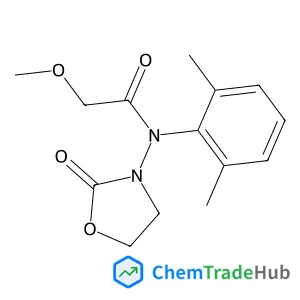
N-(2,6-Dimethylphenyl)-2-methoxy-N-(2-oxo-1,3-oxazolidin-3-yl)acetamide
CAS番号:
77732-09-3
分子式:
C14H18N2O4
おすすめサプライヤー




免責事項
このページに表示される学術雑誌情報は、参考および研究目的のみを目的としています。当社は雑誌出版社とは提携しておらず、投稿の取り扱いも行っておりません。出版に関するお問い合わせは、各雑誌出版社に直接ご連絡ください。
表示されている情報に誤りがある場合は、support@chemtradehub.com までご連絡ください。迅速に確認し、対応いたします。