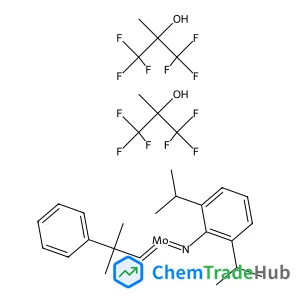
2,6-Diisopropylphenylimidoneophylidene molybdenum(VI) bis(hexafluoro-t-butoxide)
CAS番号:
139220-25-0
分子式:
C30H37F12MoNO2
J. R. C. Salgado, J. J. Quintana, L. Calvillo, M. J. Lázaro, P. L. Cabot, I. Esparbé, E. Pastor
The influence of different functionalization treatments of the support on the electrocatalytic activity towards CO and methanol oxidation at platinum nanoparticles deposited on ordered mesoporous carbons (OMC) has been studied for the first time. Before deposition of the metal, the carbon support was functionalized applying several procedures, with the purpose to generate oxygenated groups for anchoring the Pt nanoparticles by the formic acid (FM) and borohydride (BM) reduction methods. Good dispersion of the catalyst was obtained in all cases. It has been shown that particle size, and consequently the lattice parameter and metal surface area, depends on the functionalization treatment employed. CO and methanol electrooxidation was studied at all prepared catalysts applying cyclic voltammetry. It was observed that CO stripping occurs at more negative potentials (around 0.10–0.15 V) with these supports with respect to Vulcan XC-72 supported catalysts, and the best results for both methods were achieved with OMC functionalized with concentrated nitric acid for 0.5 h. This carbon support presents a higher amount of oxygenated groups without the loss of the ordered structure. In situ infrared studies have been performed for the first time with this type of catalyst, showing that the effect of the carbon support on the CO oxidation potential is similar to the presence of a second metal as Ru under the same experimental conditions. Methanol electrooxidation is also dependent on the nature of the support, as proved from both cyclic voltammetry and chronoamperometry. In this case, results depend on the method of nanoparticles preparation and seem to be better for BM.
Wilver A. Muriel, Rodrigo Morales-Cueto, William Rodríguez-Córdoba
DOI: 10.1039/C8CP06298F
Yafei Luo, Zhongzhu Chen, Jianping Hu, Zhigang Xu, Qingxi Meng, Dianyong Tang
DOI: 10.1039/C8CP06804F
Ilhan Yavuz, Janice B. Lin
DOI: 10.1039/C8CP06982D
Riccardo Checchetto, Paolo Bettotti, Gianfranco Carotenuto, Werner Egger, Christoph Hugenschmidt, Antonio Miotello
DOI: 10.1039/C8CP03879A
DOI: 10.1039/C8CP06087H
Yue-Jie Shi, Rong-Jun Zhang, Xin Chen, Lei Wang, Lei Chen, Qing-Hua Huang, Da-Hai Li, Yu-Xiang Zheng, Song-You Wang, Ning Dai, Liang-Yao Chen
DOI: 10.1039/C8CP04942D
Bianka M. D. Puscher, Ali Asghar Katbab, Ievgen Levchuk, Negar Kazerouni, Nicola Gasparini, Nadia Camaioni, Andres Osvet, Miroslaw Batentschuk, Rainer H. Fink, Dirk M. Guldi
DOI: 10.1039/C8CP03743D
Xiaolin Guo, Zhihuan Qiu, Jianxin Mao, Renxian Zhou
DOI: 10.1039/C8CP03696A
四氢-3-呋喃羧酰胺を含む廃棄物の処理は、まず安全に収集し、化学的処理または専門廃棄処理を行うことが推奨されます。高温焼却は一般的な選択肢ですが、環境保護の観点...
DIMETHYL 3-AMINO-2,5-THIOPHENEDICARBOXYLATE(CAS番号: 785803-74-9)は、GHS( Globally H...
5-フェニル-2,2'-ビピリジンは、ピリジン環とフェニル基を有する化合物から合成されます。一般的な合成方法は、4-ブロミノ苯と2,2'-ビピリジンの窒素上的ウ...
三溴甲基苯砜はCAS番号17025-47-7の化合物で、(Tribromomethyl)sulfonyl]benzeneと呼ばれています。この物質は、芳香族化合...
四氢吡喃-4,4-二甲酸二甲酯の廃棄物は、専門の廃棄処理業者に委託して安全に処理することが推奨されます。具体的には、反応性の点から常温で保存し、容器は密閉状態で...
N-叔丁氧羰基-N-甲乙二胺は、N-叔丁氧羰基アミンとプロピニルアミンのジアミン反応により合成されます。反応は無機触媒なしで行え、選択性と収率は良好です。
1,2-プロパンジオール-D6は、プロパン-1,2-ジオールをD6同位体と交換反応を行うことで合成されます。この反応は触媒を必要とし、選択性と収率が良好です。
4,4'-異プロピルジキレートは、CAS番号7418-16-8の化合物で、4,4'-(2,2-プロパネディイル)ジシクロヘキサンカーボン酸は、白色の粉末またはク...
この化合物は主に医薬品の開発に関与しており、特に抗炎症薬や神経保護剤の研究に利用されます。また、有機合成の中間体として工業製品の製造にも応用されることがあります...
ナトリウム5'-O-{ヘキシロキシ[(ヘキシロキシフォスフィニルオキシ)フィロホスフィル]アデノシン}を含む廃棄物は、適切な化学廃棄処理施設に引き渡す必要があり...

Physical Chemistry Chemical Physics (PCCP) is an international journal co-owned by 19 physical chemistry and physics societies from around the world. This journal publishes original, cutting-edge research in physical chemistry, chemical physics and biophysical chemistry. To be suitable for publication in PCCP, articles must include significant innovation and/or insight into physical chemistry; this is the most important criterion that reviewers and Editors will judge against when evaluating submissions. The journal has a broad scope and welcomes contributions spanning experiment, theory, computation and data science. Topical coverage includes spectroscopy, dynamics, kinetics, statistical mechanics, thermodynamics, electrochemistry, catalysis, surface science, quantum mechanics, quantum computing and machine learning. Interdisciplinary research areas such as polymers and soft matter, materials, nanoscience, energy, surfaces/interfaces, and biophysical chemistry are welcomed if they demonstrate significant innovation and/or insight into physical chemistry. Joined experimental/theoretical studies are particularly appreciated when complementary and based on up-to-date approaches.