












Another role of proline: stabilization interactions in proteins and protein complexes concerning proline and tryptophane
文献情報
出版日
2008-09-11
DOI
10.1039/B805087B
インパクトファクター
3.676
著者
Kevin E. Riley, Karel Berka, Pavel Hobza
原文を見る
要旨
Proline–tryptophan complexes derived from experimental structures are investigated by quantum chemical procedures known to properly describe the London dispersion energy. We study two geometrical arrangements: the “L-shaped”, stabilized by an H-bond, and the “stacked-like”, where the two residues are in parallel orientation without any H-bond. Interestingly, the interaction energies in both cases are comparable and very large (∼7 kcal mol−1). The strength of stabilization in the stacked arrangement is rather surprising considering the fact that only one partner has an aromatic character. The interaction energy decomposition using the SAPT method further demonstrates the very important role of dispersion energy in such arrangement. To elucidate the structural features responsible for this unexpectedly large stabilization we examined the role of the nitrogen heteroatom and the importance of the cyclicity of the proline residue. We show that the electrostatic interaction due to the presence of the dipole, caused by the nitrogen heteroatom, contributes largely to the strength of the interaction. Nevertheless, the cyclic arrangement of proline, which allows for the largest amount of dispersive contact with the aromatic partner, also has a notable-effect. Geometry optimizations carried out for the “stacked-like” complexes show that the arrangements derived from protein structure are close to their gas phase optimum geometry, suggesting that the environment has only a minor effect on the geometry of the interaction. We conclude that the strength of proline non-covalent interactions, combined with this residue’s rigidity, might be the explanation for its prominent role in protein stabilization and recognition processes.
おすすめジャーナル
関連文献
Influence of Mn co-doping on the magnetic properties of planar arrays of GaxFe4−xN nanocrystals in a GaN matrix
L. Del Bianco, F. Spizzo, Tian Li, R. Adhikari, A. Bonanni
2018-09-26
Paper
DOI: 10.1039/C8CP04475A
Origin of high thermoelectric performance with a wide range of compositions for BixSb2−xTe3 single quintuple layers
Zhen Li, Siyu Han, Yuanchun Pan, Jian Zhou, Huibin Xu
2018-12-10
Paper
DOI: 10.1039/C8CP06534A
Confinement-driven radical change in a sequence of rotator phases: a study on n-octacosane
Sujeet Dutta, S. Krishna Prasad
2018-08-30
Paper
DOI: 10.1039/C8CP03603A
Pressure-induced phase transition, metallization and superconductivity in ZrS2
Hang Zhai, Zhen Qin, Dan Sun, Jianyun Wang, Chang Liu, Nan Min, Quan Li
2018-08-23
Paper
DOI: 10.1039/C8CP04271C
Charge transport parameters for carbon based nanohoops and donor–acceptor derivatives
Ángel José Pérez-Jiménez, Juan-Carlos Sancho-García
2018-12-17
Paper
DOI: 10.1039/C8CP06727A
Understanding charge carrier dynamics in a P3HT:FLR blend
Jessica Patel, Mihirsinh Chauhan, Nikita Vashistha, Mahesh Kumar, Brijesh Tripathi, Manoj Kumar Pandey
2019-01-08
Paper
DOI: 10.1039/C8CP05518A
In situ XPS analysis of the atomic layer deposition of aluminium oxide on titanium dioxide
Robert H. Temperton, Andrew Gibson, James N. O'Shea
2018-12-19
Paper
DOI: 10.1039/C8CP06912C
Theoretical study on the reaction mechanism and selectivity of acetylene semi-hydrogenation on Ni–Sn intermetallic catalysts
Tao Sun, Yu-Sen Yang, Pan Yin, Min Pu, Hong Yan, Min Wei
2018-12-12
Paper
DOI: 10.1039/C8CP06032K
こちらもおすすめ
化合物よくある質問
四氢-3-呋喃羧酰胺を含む廃棄物はどのように処理すべきですか?
四氢-3-呋喃羧酰胺を含む廃棄物の処理は、まず安全に収集し、化学的処理または専門廃棄処理を行うことが推奨されます。高温焼却は一般的な選択肢ですが、環境保護の観点...
871677-92-8Tetrahydro-3-furanca...
化合物よくある質問
DIMETHYL 3-AMINO-2,5-THIOPHENEDICARBOXYLATEについて「に適用される法規ガイドラインは何ですか」
DIMETHYL 3-AMINO-2,5-THIOPHENEDICARBOXYLATE(CAS番号: 785803-74-9)は、GHS( Globally H...
785803-74-9Dimethyl 3-amino-2,5...
化合物よくある質問
5-フェニル-2,2'-ビピリジンはどのように合成されますか?
5-フェニル-2,2'-ビピリジンは、ピリジン環とフェニル基を有する化合物から合成されます。一般的な合成方法は、4-ブロミノ苯と2,2'-ビピリジンの窒素上的ウ...
156972-80-45-Phenyl-2,2'-bipyri...
化合物よくある質問
三溴甲基苯砜とは何ですか?
三溴甲基苯砜はCAS番号17025-47-7の化合物で、(Tribromomethyl)sulfonyl]benzeneと呼ばれています。この物質は、芳香族化合...
17025-47-7[(Tribromomethyl)sul...
化合物よくある質問
四氢吡喃-4,4-二甲酸二甲酯を含む廃棄物はどのように処理すべきですか?
四氢吡喃-4,4-二甲酸二甲酯の廃棄物は、専門の廃棄処理業者に委託して安全に処理することが推奨されます。具体的には、反応性の点から常温で保存し、容器は密閉状態で...
149777-00-4Dimethyl tetrahydro-...
化合物よくある質問
N-叔丁氧羰基-N-甲乙二胺はどのように合成されますか?
N-叔丁氧羰基-N-甲乙二胺は、N-叔丁氧羰基アミンとプロピニルアミンのジアミン反応により合成されます。反応は無機触媒なしで行え、選択性と収率は良好です。
121492-06-62-Methyl-2-propanyl ...
化合物よくある質問
1,2-プロパンジオール-D6はどのように合成されますか?
1,2-プロパンジオール-D6は、プロパン-1,2-ジオールをD6同位体と交換反応を行うことで合成されます。この反応は触媒を必要とし、選択性と収率が良好です。
52910-80-21,2-Propane-d6-diol
化合物よくある質問
4,4'-異プロピルジキレートとは何ですか?
4,4'-異プロピルジキレートは、CAS番号7418-16-8の化合物で、4,4'-(2,2-プロパネディイル)ジシクロヘキサンカーボン酸は、白色の粉末またはク...
7418-16-84,4'-(2,2-Propanediy...
化合物よくある質問
2-メチル-2-プロパンチル (2S)-4-酸化-2-(1,3-チアゾリジン-3-イルカルベニル)-1-ピロリジンカルボキシレートの主な用途は何ですか?
この化合物は主に医薬品の開発に関与しており、特に抗炎症薬や神経保護剤の研究に利用されます。また、有機合成の中間体として工業製品の製造にも応用されることがあります...
401564-36-12-Methyl-2-propanyl ...
化合物よくある質問
ナトリウム5'-O-{ヘキシロキシ[(ヘキシロキシフォスフィニルオキシ)フィロホスフィル]アデノシン}を含む廃棄物はどのように処理すべきですか?
ナトリウム5'-O-{ヘキシロキシ[(ヘキシロキシフォスフィニルオキシ)フィロホスフィル]アデノシン}を含む廃棄物は、適切な化学廃棄処理施設に引き渡す必要があり...
1172-42-5Sodium 5'-O-{hydroxy...
掲載誌
Physical Chemistry Chemical Physics

CiteScore:
5.5
自己引用率:
10.3%
年間論文数:
3036
Physical Chemistry Chemical Physics (PCCP) is an international journal co-owned by 19 physical chemistry and physics societies from around the world. This journal publishes original, cutting-edge research in physical chemistry, chemical physics and biophysical chemistry. To be suitable for publication in PCCP, articles must include significant innovation and/or insight into physical chemistry; this is the most important criterion that reviewers and Editors will judge against when evaluating submissions. The journal has a broad scope and welcomes contributions spanning experiment, theory, computation and data science. Topical coverage includes spectroscopy, dynamics, kinetics, statistical mechanics, thermodynamics, electrochemistry, catalysis, surface science, quantum mechanics, quantum computing and machine learning. Interdisciplinary research areas such as polymers and soft matter, materials, nanoscience, energy, surfaces/interfaces, and biophysical chemistry are welcomed if they demonstrate significant innovation and/or insight into physical chemistry. Joined experimental/theoretical studies are particularly appreciated when complementary and based on up-to-date approaches.
おすすめ化合物
![Potassium trifluoro[(2-methoxyethoxy)methyl]borate(1-) structure](https://static.chemtradehub.com/structs/910/910251-13-7-2d3a.webp "Potassium trifluoro[(2-methoxyethoxy)methyl]borate(1-) structure")
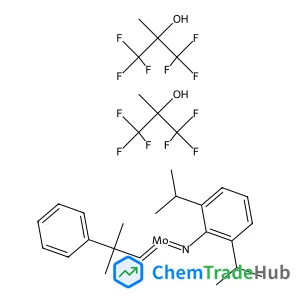
2,6-Diisopropylphenylimidoneophylidene molybdenum(VI) bis(hexafluoro-t-butoxide)
CAS番号:
139220-25-0
分子式:
C30H37F12MoNO2
おすすめサプライヤー




免責事項
このページに表示される学術雑誌情報は、参考および研究目的のみを目的としています。当社は雑誌出版社とは提携しておらず、投稿の取り扱いも行っておりません。出版に関するお問い合わせは、各雑誌出版社に直接ご連絡ください。
表示されている情報に誤りがある場合は、support@chemtradehub.com までご連絡ください。迅速に確認し、対応いたします。