


Fluorination reactions in microreactors
文献情報
出版日
2008-04-29
DOI
10.1039/B803695K
インパクトファクター
6.222
著者
Tomas Gustafsson, Ryan Gilmour, Peter H. Seeberger
原文を見る
要旨
The DAST-mediated conversion of a range of alcohols to the corresponding fluorides in a microstructured device is described. This safe, practical fluorination method will facilitate reactions currently challenging on large scale.
おすすめジャーナル

Chemical Communications

Chemistry Education Research and Practice

New Journal of Chemistry

Current Opinion in Solid State & Materials Science

Organic Process Research & Development

Russian Journal of Organic Chemistry

Saudi Pharmaceutical Journal

Russian Journal of Coordination Chemistry

Drug Discovery Today

Russian Journal of Bioorganic Chemistry
関連文献
Synthesis, properties and applications of flowerlike Ni–NiO composite microstructures
Feifei Yuan, Yonghong Ni, Li Zhang, Shengmei Yuan, Jieding Wei
2013-05-17
Paper
DOI: 10.1039/C3TA11219E
Zinc oxide heterostructures: advances in devices from self-powered photodetectors to self-charging supercapacitors
Sukanta Nandi, Sumana Kumar, Abha Misra
2021-09-09
Review Article
DOI: 10.1039/D1MA00670C
Quantum-dot-encapsulated core–shell barcode particles from droplet microfluidics
Feika Bian, Huan Wang, Lingyu Sun, Yuxiao Liu, Yuanjin Zhao
2018-07-19
Paper
DOI: 10.1039/C8TB00946E
Encapsulating nanoscale zero-valent iron with a soluble Mg(OH)2 shell for improved mobility and controlled reactivity release
Yi-bo Hu, Xiao-yan Li
2017-11-30
Paper
DOI: 10.1039/C7TA08605A
Retrieval of the complex refractive index of aerosol droplets from optical tweezers measurements
Rachael E. H. Miles, Jim S. Walker, Daniel R. Burnham, Jonathan P. Reid
2012-01-11
Paper
DOI: 10.1039/C2CP23999J
Striking influence of Fe2O3 on the “catalytic carbonization” of chlorinated poly(vinyl chloride) into carbon microspheres with high performance in the photo-degradation of Congo red
Jie Liu, Zhiwei Jiang, Xuecheng Chen, Xin Wen, Ewa Mijowska, Nana Tian, Tao Tang
2013-02-26
Paper
DOI: 10.1039/C3TA10316A
Advanced nanoparticle generation and excitation by lasers in liquids
Stephan Barcikowski, Giuseppe Compagnini
2012-11-08
Editorial
DOI: 10.1039/C2CP90132C
Application of tailored silica microspheres in coatings: synthesis, characterization, thermal and hydrophobic properties
Meng Wang, Qiqi Zeng, Bin Zhao
2013-07-29
Paper
DOI: 10.1039/C3TA12024D
Kinetics of α hydrogen abstractions from thiols, sulfides and thiocarbonyl compounds
Aäron G. Vandeputte, Maarten K. Sabbe, Marie-Françoise Reyniers, Guy B. Marin
2012-06-29
Paper
DOI: 10.1039/C2CP41114H
こちらもおすすめ
化合物よくある質問
6- bromo-1-cyclopropyl-1H-benzimidazoleの市場動向や研究トレンドはどうですか?
6- bromo-1-cyclopropyl-1H-benzimidazoleは、抗炎症、抗ウイルス作用を持つことが報告されており、新薬開発の研究対象として注目...
1416713-53-56-Bromo-1-cyclopropy...
化合物よくある質問
環氧プロpanol-d5を取り扱う際の実験室安全事項は何ですか?
取り扱う際には、防護眼鏡と手袋を使用し、ドラフトチャンバー内で操作することを推奨します。漏洩時には適切な手順で処理し、安全データシートを常に参照してください。
1246819-20-4Glycidol-d5
化合物よくある質問
2,2’-ジメチル-3,3’-ビピリジンはどのように合成されますか?
2,2’-ジメチル-3,3’-ビピリジンは、ピリジンと2-メチルアクリルアミドを有機合成反応で合成します。この反応では、ピリジンと2-メチルアクリルアミドを含有...
86156-55-02,2’-Dimethyl-3,3’-b...
化合物よくある質問
6-甲基ピリジン-2-ボリック酸の主な用途は何ですか?
6-甲基ピリジン-2-ボリック酸は、合成化学、医薬品合成、以及研究用途などに広く使用され、特に組換えDNA技術や分子生物学の研究において重要な役割を果たします。
372963-50-3(6-Methyl-2-pyridiny...
化合物よくある質問
(R)-3-(1-甲基-2-氧環己基)プロpano酸メチルは安全ですか?
(R)-3-(1-甲基-2-氧環己基)プロpano酸メチルは一定の安全性がありますが、直接的な皮膚接触や吸入は避けるべきです。使用する際は適切な個々の安全データ...
94089-47-1methyl 3-[(1R)-1-met...
化合物よくある質問
ketorolacはどのように保存すればよいですか?
ketorolacは、密封して遮光容器に保管し、直射日光や高温を避けて保存してください。温度は常温で保存し、湿度をなるべく低く保つことが推奨されます。
74103-06-3rac Ketorolac
化合物よくある質問
L-2,3-二氨基丙酸二盐酸盐を取り扱う際の実験室安全事項は何ですか?
L-2,3-二氨基丙酸二盐酸盐は腐食性が強く、皮膚や粘膜に刺激を与える可能性があります。取り扱う際は、防塵マスク、ゴーグル、手袋を使用し、適切な排気設備を使用し...
19777-68-5(S)-2,3-Diaminopropa...
化合物よくある質問
2-(4-溴ピリジン-2-基)乙腈の物理化学的性質は何ですか?
2-(4-溴ピリジン-2-基)乙腈のCAS番号は312325-73-8です。主に結晶形態で存在し、分子量は159.01 g/molです。この化合物は水に溶けやす...
312325-73-8(4-Bromo-2-pyridinyl...
化合物よくある質問
3-フローロ-[1,1-ベンジレン]-3,4-ジカルボン酸を取り扱う際の実験室安全事項は何ですか?
この化合物は毒性は低いですが、直接的な接触や吸入に注意が必要です。PPE(個人防護具)を着用し、ドラフトチャンバーを使用して操作することを推奨します。また、漏洩...
1261915-32-53'-Fluoro-[1,1'-biph...
化合物よくある質問
3-(1-氧代-1,3-二氢-2H-2-异吲哚)丙酸の主な用途は何ですか?
3-(1-氧代-1,3-二氢-2H-2-异吲哚)丙酸は、薬理学研究や医薬品製造において広く用いられる化合物です。また、工業的な用途でも一部の化学反応の触媒や助剤...
83747-30-23-(1-Oxo-1,3-dihydro...
掲載誌
Chemical Communications
CiteScore:
8.6
自己引用率:
4.7%
年間論文数:
2458
ChemComm publishes urgent research which is of outstanding significance and interest to experts in the field, while also appealing to the journal’s broad chemistry readership. Our communication format is ideally suited to short, urgent studies that are of such importance that they require accelerated publication. Our scope covers all topics in chemistry, and research at the interface of chemistry and other disciplines (such as materials science, nanoscience, physics, engineering and biology) where there is a significant novelty in the chemistry aspects. Major topic areas covered include: Analytical Chemistry Catalysis Chemical Biology and medicinal chemistry Computational Chemistry and Machine Learning Energy and sustainable chemistry Environmental Chemistry Green Chemistry Inorganic Chemistry Materials Chemistry Nanoscience Organic Chemistry Physical Chemistry Polymer Chemistry Supramolecular Chemistry
おすすめ化合物
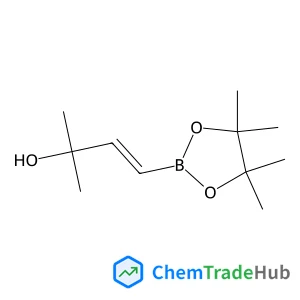
(E)-2-methyl-4-(4,4,5,5-tetramethyl-1,3,2-dioxaborolan-2-yl)but-3-en-2-ol
CAS番号:
581802-26-8
分子式:
C11H21BO3
![[4-(Isobutyrylamino)phenyl]boronic acid structure](https://static.chemtradehub.com/structs/874/874219-50-8-6ab5.webp "[4-(Isobutyrylamino)phenyl]boronic acid structure")
おすすめサプライヤー





免責事項
このページに表示される学術雑誌情報は、参考および研究目的のみを目的としています。当社は雑誌出版社とは提携しておらず、投稿の取り扱いも行っておりません。出版に関するお問い合わせは、各雑誌出版社に直接ご連絡ください。
表示されている情報に誤りがある場合は、support@chemtradehub.com までご連絡ください。迅速に確認し、対応いたします。