












Gas-phase electronic spectrum of the C14 ring
文献情報
出版日
2006-11-13
DOI
10.1039/B613109C
インパクトファクター
3.676
著者
A. E. Boguslavskiy, J. P. Maier
原文を見る
要旨
The electronic spectrum of a cyclic C14 in the visible range has been detected in the gas phase by a mass selective resonant two-color two-photon ionization technique coupled to a laser ablation source. Absorption is localized in the 19 000 to 20 000 cm−1 region and appears as a dozen of 3–7 cm−1 narrow peaks belonging to one or two close-lying electronic states. Bands have structures which for the narrowest ones is likely to be the rotational profile contour. The spectrum is attributed to a cyclic form of C14 based on time-dependent density-functional calculations and reactivity with H2. The spectral pattern differs from that previously seen in the larger C4n+2 member rings, C18 and C22, indicating some sort of a structural crossover.
関連文献
Photo-induced oxidation of the uniquely liganded heme f in the cytochrome b6f complex of oxygenic photosynthesis
Adrien A. P. Chauvet, Rachna Agarwal, André al Haddad, Frank van Mourik, William A. Cramer
2016-04-19
Paper
DOI: 10.1039/C6CP01592A
Aromatic stabilization of functionalized corannulene cations
Jingbai Li, Andrey Yu. Rogachev
2016-01-07
Paper
DOI: 10.1039/C5CP07002C
DFT-based ab initio MD simulation of the ionic conduction in doped ZrO2 systems under epitaxial strain
M. Oka
2015-09-22
Paper
DOI: 10.1039/C5CP03238E
Fine-tuning of microsolvation and hydrogen bond interaction regulates substrate channelling in the course of flavonoid biosynthesis
Julien Diharce, Jérôme Golebiowski, Sébastien Fiorucci, Serge Antonczak
2016-03-14
Paper
DOI: 10.1039/C5CP05059F
Bifunctional Ce1−xEuxO2 (0 ≤ x ≤ 0.3) nanoparticles for photoluminescence and photocatalyst applications: an X-ray absorption spectroscopy study
Aditya Sharma, Mayora Varshney, Jaehun Park, Tae Kyun Ha, Keun Hwa Chae, Hyun Joon Shin
2015-10-19
Paper
DOI: 10.1039/C5CP05251C
Nonlinear optical chromophores based on Dewar's rules: enhancement of electro-optic activity by introducing heteroatoms into the donor or bridge
Shuhui Bo, Xinhou Liu
2015-10-07
Paper
DOI: 10.1039/C5CP04959H
Are the three hydroxyphenyl radical isomers created equal? – The role of the phenoxy radical –
P. Hemberger, G. da Silva, A. J. Trevitt, T. Gerber, A. Bodi
2015-10-21
Paper
DOI: 10.1039/C5CP05346C
The interactions between TiO2 and graphene with surface inhomogeneity determined using density functional theory
Brandon Bukowski, N. Aaron Deskins
2015-10-12
Paper
DOI: 10.1039/C5CP04073F
Long-term stability of phase-separated half-Heusler compounds
B. Balke, S. Ouardi, S. Selle, T. Höche, C. Felser, W. Hermes, M. Schwind
2015-10-15
Paper
DOI: 10.1039/C4CP04875J
こちらもおすすめ
化合物よくある質問
3-イチチルビフェニルはどのように合成されますか?
3-イチチルビフェニルは、ビフェニルとイチプロピオニトリルを回収率約90%で反応させて合成されます。触媒は通常、亜リチウムホウ素を用います。
5668-93-93-Ethylbiphenyl
化合物よくある質問
8-溴-5-三氟甲基喹啉はどのように合成されますか?
8-溴-5-三氟甲基喹啉は、5-トリフルオロメチル-2-メチル-1,3-ベンゼンジオールをブロモエタノールと反応させて生成します。この反応は塩基性条件下で行われ...
917251-92-48-Bromo-5-(trifluoro...
化合物よくある質問
ジメチル4-(4,4,5,5-テトラメチル-1,3,2-ドioxaborolan-2-基)-2,6-ピリジンジカルボイル酸フェニルアミニドの代替品はありますか?
ジメチル4-(4,4,5,5-テトラメチル-1,3,2-ドioxaborolan-2-基)-2,6-ピリジンジカルボイル酸フェニルアミニドの代替品としては、4-...
741709-66-0Dimethyl 4-(4,4,5,5-...
化合物よくある質問
N-(3,5-ヘキサクロロ-4-ピリドインイル)-8-メチオキシ-5-キノリンカーボン酸の市場動向や研究トレンドはどのようなものでしょうか?
N-(3,5-ヘキサクロロ-4-ピリドインイル)-8-メチオキシ-5-キノリンカーボン酸の市場動向は、主に産業用途での需要により影響を受けます。研究トレンドとし...
199871-63-1N-(3,5-Dichloro-4-py...
化合物よくある質問
イソステアロイルグリセリルは安全ですか?
イソステアロイルグリセリルは一般的に安全性が高いとされていますが、過度な使用や個人差により皮�owsん炎などの反応が起こる可能性があります。使用前に医師に相談す...
222723-55-92-[(5Z,8Z,11Z,14Z)-5...
化合物よくある質問
1-(二苯甲基)-3,3-二氟-氮杂环丁烷の市場動向や研究トレンドはどうですか?
1-(二苯甲基)-3,3-二氟-氮杂环丁烷の市場動向は、医薬品や合成化学の研究分野で注目を集めています。新興研究は、該当化合物の合成改良と生体内での作用メカニズ...
288315-02-61-Benzhydryl-3,3-dif...
化合物よくある質問
3-チオフェンスチオールの物理化学的性質は何ですか?
3-チオフェンスチオールのCAS番号は7774-73-4です。結晶性の白色粉末で、分子量は122.17です。この化合物は水に微溶解し、エタノールやジクロロメタン...
7774-73-43-Thiophenethiol
化合物よくある質問
2-Methyl-2-propanyl (2S)-2-(aminomethyl)-1-piperidinecarboxylateは安全ですか?
2-Methyl-2-propanyl (2S)-2-(aminomethyl)-1-piperidinecarboxylateは一定の安全性基準を満たしていま...
475105-35-22-Methyl-2-propanyl ...
化合物よくある質問
CAS番号1316822-90-8の化合物は安全ですか?
CAS番号1316822-90-8の化合物は安全性に関しては評価が不足していますが、一般的には生物学的に活性な物質であり、取り扱いには適切な安全防護措置が必要で...
1316822-90-8Gal beta(1-3)[Neu5Ac...
化合物よくある質問
Tert-butyl 2-(2-羟基乙基)哌嗪-1-羧酸はどのように保存すればよいですか?
Tert-butyl 2-(2-羟基乙基)哌嗪-1-羧酸は、冷暗所で保存し、直射日光から遠ざけてください。容器は密閉し、高湿度や高温を避けて保管してください。
517866-79-4Tert-butyl 2-(2-hydr...
掲載誌
Physical Chemistry Chemical Physics

CiteScore:
5.5
自己引用率:
10.3%
年間論文数:
3036
Physical Chemistry Chemical Physics (PCCP) is an international journal co-owned by 19 physical chemistry and physics societies from around the world. This journal publishes original, cutting-edge research in physical chemistry, chemical physics and biophysical chemistry. To be suitable for publication in PCCP, articles must include significant innovation and/or insight into physical chemistry; this is the most important criterion that reviewers and Editors will judge against when evaluating submissions. The journal has a broad scope and welcomes contributions spanning experiment, theory, computation and data science. Topical coverage includes spectroscopy, dynamics, kinetics, statistical mechanics, thermodynamics, electrochemistry, catalysis, surface science, quantum mechanics, quantum computing and machine learning. Interdisciplinary research areas such as polymers and soft matter, materials, nanoscience, energy, surfaces/interfaces, and biophysical chemistry are welcomed if they demonstrate significant innovation and/or insight into physical chemistry. Joined experimental/theoretical studies are particularly appreciated when complementary and based on up-to-date approaches.
おすすめ化合物
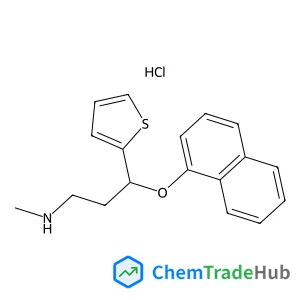
N-Methyl-3-(1-naphthyloxy)-3-(2-thienyl)-1-propanamine hydrochloride (1:1)
CAS番号:
1188266-11-6
分子式:
C18H20ClNOS
おすすめサプライヤー





免責事項
このページに表示される学術雑誌情報は、参考および研究目的のみを目的としています。当社は雑誌出版社とは提携しておらず、投稿の取り扱いも行っておりません。出版に関するお問い合わせは、各雑誌出版社に直接ご連絡ください。
表示されている情報に誤りがある場合は、support@chemtradehub.com までご連絡ください。迅速に確認し、対応いたします。