












A time-dependent Hartree–Fock approach for studying the electronic optical response of molecules in intense fields
文献情報
出版日
2004-12-10
DOI
10.1039/B415849K
インパクトファクター
3.676
著者
Xiaosong Li, Stanley M. Smith, H. Bernhard Schlegel
原文を見る
要旨
For molecules in high intensity oscillating electric fields, the time-dependent Hartree–Fock (TDHF) method is used to simulate the behavior of the electronic density prior to ionization. Since a perturbative approach is no longer valid at these intensities, the full TDHF equations are used to propagate the electronic density. A unitary transform approach is combined with the modified midpoint method to provide a stable and efficient algorithm to integrate these equations. The behavior of H2+ in an intense oscillating field computed using the TDHF method with a STO-3G basis set reproduces the analytic solution for the two-state coherent excitation model. For H2 with a 6-311++G(d,p) basis set, the TDHF results are nearly indistinguishable from calculations using the full time-dependent Schrödinger equation. In an oscillating field of 3.17 × 10¹³ W cm−2 and 456 nm, the molecular orbital energies, electron populations, and atomic charges of H2 follow the field adiabatically. As the field intensity is increased, the response becomes more complicated as a result of contributions from excited states. Simulations of N2 show even greater complexity, yet the average charge still follows the field adiabatically.
関連文献
Sizable dynamics in small pores: CO2 location and motion in the α-Mg formate metal–organic framework
Yuanjun Lu, Bryan E. G. Lucier, Yue Zhang, Anmin Zheng, Yining Huang
2017-01-27
Paper
DOI: 10.1039/C7CP00199A
WO3/W:BiVO4/BiVO4 graded photoabsorber electrode for enhanced photoelectrocatalytic solar light driven water oxidation
Junghyun Choi, Pitchaimuthu Sudhagar, Joo Hyun Kim, Jiseok Kwon, Jeonghyun Kim, Chiaki Terashima, Akira Fujishima, Taeseup Song, Ungyu Paik
2017-01-09
Paper
DOI: 10.1039/C6CP08199A
Correction: First-principles analysis of the spectroscopic limited maximum efficiency of photovoltaic absorber layers for CuAu-like chalcogenides and silicon
Marnik Bercx, Nasrin Sarmadian, Rolando Saniz, Bart Partoens, Dirk Lamoen
2017-02-10
Correction
DOI: 10.1039/C7CP90033C
Free-energy patterns in inclusion complexes: the relevance of non-included moieties in the stability constants
Tânia F. G. G. Cova, Sandra C. C. Nunes, Alberto A. C. C. Pais
2017-01-10
Paper
DOI: 10.1039/C6CP08081B
Ionic liquids and deep eutectic solvents for lignocellulosic biomass fractionation
Dannie J. G. P. van Osch, Laura J. B. M. Kollau, Sari Asikainen, Marisa A. A. Rocha
2016-12-02
Perspective
DOI: 10.1039/C6CP07499E
Structural and magneto-electronic properties and electric field-mediated effects for transition metal-terminated zigzag h-BN nanoribbons
J. Liu, Z. H. Zhang, P. F. Yuan, Z. Q. Fan
2017-01-04
Paper
DOI: 10.1039/C6CP06909F
Adsorbing the 3d-transition metal atoms to effectively modulate the electronic and magnetic behaviors of zigzag SiC nanoribbons
Hui Li, Wei Chen, Xiaopeng Shen, Jingwei Liu, Xuri Huang, Guangtao Yu
2017-01-03
Paper
DOI: 10.1039/C6CP06717D
Investigations on Zr incorporation into Li3V2(PO4)3/C cathode materials for lithium ion batteries
Hua-Bin Sun, Ying-Xian Zhou, Lu-Lu Zhang, Xue-Lin Yang, Xing-Zhong Cao, Hanu Arave, Hui Fang, Gan Liang
2017-01-13
Paper
DOI: 10.1039/C6CP07760A
こちらもおすすめ
化合物よくある質問
2-ブロモ-9,9-ジフェニル-9H-フルオレンの主な用途は何ですか?
2-溴-9,9-二苯基芴は、医薬品、工業材料、有機合成の研究分野で応用されます。特に、レーザー材料や機能性ポリマーの合成に使用されることがあります。また、蛍光色...
474918-32-62-Bromo-9,9-diphenyl...
化合物よくある質問
四氯化铱の市場動向や研究トレンドはどうですか?
四氯化铱の市場は研究開発分野で注目されており、特にナノ技術や金属有機框架(MOFs)の分野での需要が増加傾向にあります。価格は安定しており、中国や韓国での生産が...
207399-11-9Tetrachloroiridium h...
882-06-44-Nitrocinnamic acid
化合物よくある質問
1-(4-溴-3-氟苯基)-2-氯乙酮を含む廃棄物はどのように処理すべきですか?
1-(4-溴-3-氟苯基)-2-氯乙酮 (CAS番号: 1260857-14-4) の廃棄物は専門的な廃棄処理が必要です。まず、廃棄物は密閉された容器に収集し、...
1260857-14-41-(4-Bromo-3-fluorop...
化合物よくある質問
苦参酚Kとは何ですか?
苦参酚Kは、CAS番号101236-49-1を持つ化合物で、主に天然由来の生薬から抽出されます。この化合物は、抗炎症作用や抗癌作用を持つことが報告されています。
101236-49-1Kushenol K
化合物よくある質問
POTASSIUM (1-(TERTBUTOXYCARBONYL)AZETIDIN-3-YL)TRIFLUOROBORATE を含む廃棄物はどのように処理すべきですか?
POTASSIUM (1-(TERTBUTOXYCARBONYL)AZETIDIN-3-YL)TRIFLUOROBORATE を含む廃棄物は、まず安全なエント...
1430219-73-0Potassium (1-(tert-b...
化合物よくある質問
4-庚基-4’-联苯羧酸の市場動向や研究トレンドはどうですか?
4-庚基-4’-聯苯羧酸は、特殊化学品や合成化学の分野で用いられる化学物質ですが、市場動向としては、研究開発の進展とともに需要が増加しています。また、環境配慮型...
58573-94-74'-Heptyl-4-biphenyl...
化合物よくある質問
6-ブロモ-3-メトキシ-1-フェニル-1H-インドゾールを含む廃棄物はどのように処理すべきですか?
6-ブロモ-3-メトキシ-1-フェニル-1H-インドゾールを含む廃棄物は、適切な化学廃棄処理が必要です。通常、廃棄物は密閉容器に収集され、専門の廃棄処理業者に引...
1332527-03-36-Bromo-3-methoxy-1-...
化合物よくある質問
4,4-二甲基-2-吡咯烷酮はどの業界で使用されていますか?
4,4-二甲基-2-吡咯烷酮は医薬、ポリマー、センサー、半導体などの業界で広く使用されています。特に溶媒としての性能が高く評価されています。
66899-02-34,4-dimethylpyrrolid...
51312-42-6Sodium Phosphotungst...
掲載誌
Physical Chemistry Chemical Physics

CiteScore:
5.5
自己引用率:
10.3%
年間論文数:
3036
Physical Chemistry Chemical Physics (PCCP) is an international journal co-owned by 19 physical chemistry and physics societies from around the world. This journal publishes original, cutting-edge research in physical chemistry, chemical physics and biophysical chemistry. To be suitable for publication in PCCP, articles must include significant innovation and/or insight into physical chemistry; this is the most important criterion that reviewers and Editors will judge against when evaluating submissions. The journal has a broad scope and welcomes contributions spanning experiment, theory, computation and data science. Topical coverage includes spectroscopy, dynamics, kinetics, statistical mechanics, thermodynamics, electrochemistry, catalysis, surface science, quantum mechanics, quantum computing and machine learning. Interdisciplinary research areas such as polymers and soft matter, materials, nanoscience, energy, surfaces/interfaces, and biophysical chemistry are welcomed if they demonstrate significant innovation and/or insight into physical chemistry. Joined experimental/theoretical studies are particularly appreciated when complementary and based on up-to-date approaches.
おすすめ化合物
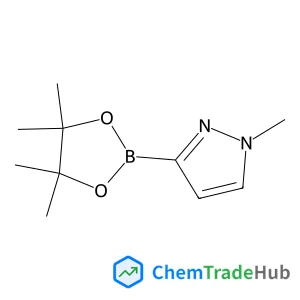
1-Methyl-3-(4,4,5,5-tetramethyl-1,3,2-dioxaborolan-2-yl)-1H-pyrazole
CAS番号:
1020174-04-2
分子式:
C10H17BN2O2
おすすめサプライヤー




免責事項
このページに表示される学術雑誌情報は、参考および研究目的のみを目的としています。当社は雑誌出版社とは提携しておらず、投稿の取り扱いも行っておりません。出版に関するお問い合わせは、各雑誌出版社に直接ご連絡ください。
表示されている情報に誤りがある場合は、support@chemtradehub.com までご連絡ください。迅速に確認し、対応いたします。