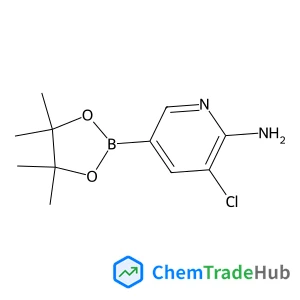
3-Chloro-5-(4,4,5,5-tetramethyl-1,3,2-dioxaborolan-2-yl)-2-pyridinamine
CAS番号:
1032758-99-8
分子式:
C11H16BClN2O2
Rui Si, Ya-Wen Zhang, Chao-Xian Xiao, Shi-Jie Li, Bing-Xiong Lin, Yuan Kou, Chun-Hua Yan
Mesoporous Ce0.2Zr0.8O2 nanosized powders were synthesized via a hydrothermal method in the presence of urea without any templates using a trivalent cerium salt as the starting material. The analyses by medium-angle powder X-ray diffraction (PXRD) and vis-Raman spectroscopy showed that the Ce0.2Zr0.8O2 powders were solid solutions of pure tetragonal phase, whether as-prepared at 160 °C or calcined at 773–1273 K. By low-angle PXRD and transmission electron microscopy, the as-prepared Ce0.2Zr0.8O2 showed a short-range ordered mesostructure probably as a result of the natural agglomeration of uniform nanoparticles upon hydrothermal treatment. The as-prepared powders had high surface areas (232–281 m2 g−1) and narrow pore size distributions (3.5–4.0 nm), according to the measurements of nitrogen adsorption. After calcining at 773 K, this mesostructure was retained to some degree with lower surface areas (66–75 m2 g−1) and larger pore sizes (5.1–7.2 nm). Determined by X-ray photoelectron spectroscopy, the numbers of oxygen vacancies (0.025–0.037) on the nanocrystalline surface was high for both as-prepared and calcined Ce0.2Zr0.8O2. UV-vis absorption measurements showed that the band gap energy of the as-prepared Ce0.2Zr0.8O2 nanocrystals was distinctly blue-shifted compared with the bulk value due to the quantum size effect. The catalytic tests demonstrated that the Ce0.2Zr0.8O2 nanosized powders synthesized at 160 °C showed higher thermal stability in terms of surface area and phase composition, and higher catalytic activity for CO conversion than that synthesized at 140 °C. Among all the catalysts tested, the mesostructured one with the highest surface area and the largest pore volume displayed the highest oxygen storage capacity of 233 μmol CO g−1 at 773 K, and the lowest 50% conversion temperature of 641 K.

Proceedings of the National Academy of Sciences of the United States of America

Journal of Organometallic Chemistry

Kinetics and Catalysis

Pure and Applied Chemistry

Israel Journal of Chemistry

Journal of Medicinal Chemistry

European Journal of Wood and Wood Products

Molecular Pharmacology

Journal of Physics and Chemistry of Solids

Russian Chemical Reviews
J. M. Valverde, F. Pontiga, C. Soria-Hoyo, M. A. S. Quintanilla, H. Moreno, F. J. Duran, M. J. Espin
DOI: 10.1039/C1CP21939A
Grant Copeland, Mariana V. Ghosh, Dudley E. Shallcross, Carl J. Percival, John M. Dyke
DOI: 10.1039/C0CP03004J
Junki Nagakubo, Minoru Ashizawa, Tadashi Kawamoto, Akihiko Tanioka
DOI: 10.1039/C1CP21507H
Stefanie A. Sherrill, Jonathon Duay, Zhe Gui, Parag Banerjee, Gary W. Rubloff
DOI: 10.1039/C1CP21815H
Pedro B. Coto, Luis Serrano-Andrés, Thomas Gustavsson, Takashige Fujiwara, Edward C. Lim
DOI: 10.1039/C1CP21089K
Jonathan Romero, Andres Reyes, Jorge David, Albeiro Restrepo
DOI: 10.1039/C1CP20903E
Yoshinobu Akinaga, Jaewoon Jung, Seiichiro Ten-no
DOI: 10.1039/C1CP21001G
T. Gál, P. Geerlings, F. De Proft, M. Torrent-Sucarrat
DOI: 10.1039/C1CP21213C
Anmin Zheng, Shing-Jong Huang, Feng Deng
DOI: 10.1039/C1CP20417C
Peilin Liao, Emily A. Carter
DOI: 10.1039/C1CP20829B
2-ヒドロキシ-5-ニトロベンジンブロモイドは特定の化学反応に適しているため、代替品は限られています。しかし、同様の構造を持つ2-ヒドロキシ-4-ニトロベンジン...
N-(2-ブロモフェニル)-1-チロール-3-オキソ-3-(ピペリジニル)プロペン-2-イル)ベンゼンアミドは有毒で、皮膚や粘膜に刺激を与える可能性があります。...
この化合物は、新規治療薬の開発に注目されています。市場では、その有効性と安全性が評価され、研究分野では、分子生物学と医薬化学の新たな発見が期待されています。
Succinimidyl-alanyl-phenylalanyl-prolyl-phenylalanine 4-nitroanilide は主に医薬品開発やポ...
メチル6-アミノ-5-クロロピリジン-2-カーボイル酸(CAS番号: 1256794-05-4)の使用には、GHS( Globally Harmonized S...
取り扱いには、耐薬品性の容器を使用し、通気性の良い場所で操作することを推奨します。漏れ時は、SDS(安全データシート)を参照して適切な措置を取ること。手洗いと洗...
(S)-3-ベンZYルピペリジン塩酸塩は、CAS番号1258940-00-9で表される化合物です。これは、(S)-3-苯基哌啶的盐酸盐であり、主に医薬品の原料と...
3,5-二甲基金剛胺は、主に医薬品の原料として使用され、また抗うつ薬や抗アルツハイマー薬の開発に利用されます。さらに、化粧品や食品添加物の製造でも重要な役割を果...
ビス(4-メチル-2-ペンチル)フェニルカルボン酸エステル (CAS番号: 1398066-13-1) の代替品には、ビス(2-エチルヘキシル)フェノールカルボ...

Physical Chemistry Chemical Physics (PCCP) is an international journal co-owned by 19 physical chemistry and physics societies from around the world. This journal publishes original, cutting-edge research in physical chemistry, chemical physics and biophysical chemistry. To be suitable for publication in PCCP, articles must include significant innovation and/or insight into physical chemistry; this is the most important criterion that reviewers and Editors will judge against when evaluating submissions. The journal has a broad scope and welcomes contributions spanning experiment, theory, computation and data science. Topical coverage includes spectroscopy, dynamics, kinetics, statistical mechanics, thermodynamics, electrochemistry, catalysis, surface science, quantum mechanics, quantum computing and machine learning. Interdisciplinary research areas such as polymers and soft matter, materials, nanoscience, energy, surfaces/interfaces, and biophysical chemistry are welcomed if they demonstrate significant innovation and/or insight into physical chemistry. Joined experimental/theoretical studies are particularly appreciated when complementary and based on up-to-date approaches.
![1-[3-(4-Morpholinylsulfonyl)phenyl]methanamine structure](https://static.chemtradehub.com/structs/933/933989-32-3-51af.webp "1-[3-(4-Morpholinylsulfonyl)phenyl]methanamine structure")