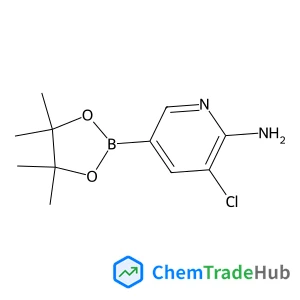
3-Chloro-5-(4,4,5,5-tetramethyl-1,3,2-dioxaborolan-2-yl)-2-pyridinamine
CAS番号:
1032758-99-8
分子式:
C11H16BClN2O2
The phase equilibrium behavior of a typical colloidal dispersion by the van der Waals-like theory was studied. In this theory, the colloid–colloid potential is split into two parts: a repulsive part modeled by the hard-core potential and an attractive part modeled by the square-well potential corrected by a linear tail. The theory is numerically elegant since the colloidal free energy is analytic and, physically, the model can be used to study the role played by the strength and range of interactions on the formation of coexisting phases. The effect of the strength of the interaction can be accounted for by varying the width of the square-well potential (simulated by γ parameter) while the range of the interaction—by changing the “slope” of the linear potential (simulated by λ parameter). In this work, we consider three separate cases. First, we fixed the threshold values γth, being γLLth = 0.221 for liquid–liquid and γSSth = 0.0329 for solid–solid, and increased λ to examine the appearance of the liquid–liquid and solid–solid coexistence curves which were both calculated with respect to their liquid–solid counterparts. Second, we fixed the threshold values λth, being λLLth = 0.325 for liquid–liquid and λSSth = 0.0456 for solid–solid, and increased γ (keeping the λ-slope unchanged) to bring in the strength of the interaction. In these two cases, the calculations showed that a switching on of λ or γ has the consequence of inducing stable liquid–liquid or metastable solid–solid coexisting phases. Finally, we maintained a given γ plus λ. Here the calculated liquid–liquid and solid–solid phase diagrams can be analyzed in finer details to exhibit the combined influences of the strength and range of interactions.

Journal of Physics and Chemistry of Solids

Journal of Catalysis

Israel Journal of Chemistry

Pure and Applied Chemistry

Science Progress

Molecular Pharmacology

Organic Preparations and Procedures International

Proceedings of the National Academy of Sciences of the United States of America

Science

European Journal of Wood and Wood Products
Bounphanh Tonpheng, Junchun Yu, Ove Andersson
DOI: 10.1039/C1CP20785G
Yong-Feng Wang, Shan Xi Tian, Jinlong Yang
DOI: 10.1039/C1CP21267B
T. Gál, P. Geerlings, F. De Proft, M. Torrent-Sucarrat
DOI: 10.1039/C1CP21213C
Cunku Dong, Jingyao Qi
DOI: 10.1039/C1CP21030K
Jonas Fransson, Michael Galperin
DOI: 10.1039/C1CP20720B
J. M. Valverde, F. Pontiga, C. Soria-Hoyo, M. A. S. Quintanilla, H. Moreno, F. J. Duran, M. J. Espin
DOI: 10.1039/C1CP21939A
Weiwei Zhou, Tao Chen, Kim Seng Tan, Xingtao Jia, Zhiqiang Luo, Chunxiao Cong, Huanping Yang, Chang Ming Li
DOI: 10.1039/C1CP21917K
I. A. K. Young, C. Murray, C. M. Blaum, R. A. Cox, R. L. Jones, F. D. Pope
DOI: 10.1039/C1CP21337G
2-ヒドロキシ-5-ニトロベンジンブロモイドは特定の化学反応に適しているため、代替品は限られています。しかし、同様の構造を持つ2-ヒドロキシ-4-ニトロベンジン...
N-(2-ブロモフェニル)-1-チロール-3-オキソ-3-(ピペリジニル)プロペン-2-イル)ベンゼンアミドは有毒で、皮膚や粘膜に刺激を与える可能性があります。...
この化合物は、新規治療薬の開発に注目されています。市場では、その有効性と安全性が評価され、研究分野では、分子生物学と医薬化学の新たな発見が期待されています。
Succinimidyl-alanyl-phenylalanyl-prolyl-phenylalanine 4-nitroanilide は主に医薬品開発やポ...
メチル6-アミノ-5-クロロピリジン-2-カーボイル酸(CAS番号: 1256794-05-4)の使用には、GHS( Globally Harmonized S...
取り扱いには、耐薬品性の容器を使用し、通気性の良い場所で操作することを推奨します。漏れ時は、SDS(安全データシート)を参照して適切な措置を取ること。手洗いと洗...
(S)-3-ベンZYルピペリジン塩酸塩は、CAS番号1258940-00-9で表される化合物です。これは、(S)-3-苯基哌啶的盐酸盐であり、主に医薬品の原料と...
3,5-二甲基金剛胺は、主に医薬品の原料として使用され、また抗うつ薬や抗アルツハイマー薬の開発に利用されます。さらに、化粧品や食品添加物の製造でも重要な役割を果...
ビス(4-メチル-2-ペンチル)フェニルカルボン酸エステル (CAS番号: 1398066-13-1) の代替品には、ビス(2-エチルヘキシル)フェノールカルボ...

Physical Chemistry Chemical Physics (PCCP) is an international journal co-owned by 19 physical chemistry and physics societies from around the world. This journal publishes original, cutting-edge research in physical chemistry, chemical physics and biophysical chemistry. To be suitable for publication in PCCP, articles must include significant innovation and/or insight into physical chemistry; this is the most important criterion that reviewers and Editors will judge against when evaluating submissions. The journal has a broad scope and welcomes contributions spanning experiment, theory, computation and data science. Topical coverage includes spectroscopy, dynamics, kinetics, statistical mechanics, thermodynamics, electrochemistry, catalysis, surface science, quantum mechanics, quantum computing and machine learning. Interdisciplinary research areas such as polymers and soft matter, materials, nanoscience, energy, surfaces/interfaces, and biophysical chemistry are welcomed if they demonstrate significant innovation and/or insight into physical chemistry. Joined experimental/theoretical studies are particularly appreciated when complementary and based on up-to-date approaches.
![4-Chloro-3-(trifluoromethyl)-1H-pyrrolo[2,3-b]pyridine structure](https://static.chemtradehub.com/structs/869/869335-75-1-a9d0.webp "4-Chloro-3-(trifluoromethyl)-1H-pyrrolo[2,3-b]pyridine structure")